Tate County Courthouse
Built 1875-1876

Mississippi Landmark
Erected 2010 by James Gilliam Chapter, National Society Daughters of the American Revolution.
Topics and series. This historical marker is listed in these topic lists: Architecture • Notable Buildings. In addition, it is included in the Daughters of the American Revolution (DAR), and the National Register of Historic Places (NRHP) series lists. A significant historical year for this entry is 1875.
Location. 34° 37.018′ N, 89° 57.948′ W. Marker is in Senatobia, Mississippi, in Tate County. It is at the intersection of South Ward Street and Court Street, on the left when traveling north on South Ward Street. The marker is located on the north/right side of the Tate County Courthouse east entrance. Touch for map. Marker is at or near this postal address: 201 South Ward Street, Senatobia MS 38668, United States of America. Touch for directions.

Regionally, this marker is in Greater Memphis. It is also in the American South, specifically in the Deep South, and in the Mississippi Delta. Globally, it is in North America, a Gulf of Mexico state, the Western Hemisphere,
this page online
Other nearby markers. At least 8 other markers are within 5 miles of this marker, measured as the crow flies: Sid Hemphill (about 300 feet away, measured in a direct line); O.B. McClinton (about 500 feet away); 305 West Main Street (about 600 feet away); Senatobia (approx. 0.2 miles away); Tate County World War I Memorial (approx. 0.4 miles away); Bethesda Cemetery (approx. 0.4 miles away); Jessie Mae Hemphill (approx. 1.7 miles away); Tate County Blues: Coldwater (approx. 5 miles away). Touch for a list and map of all markers in Senatobia.
Regarding Tate County Courthouse. National Register of Historic Places № 94000200; and Mississippi Landmark No. 137-SEN-0236-NR-ML.
From the National Register Nomination prepared by John Linn Hopkins, 6/1/1993:
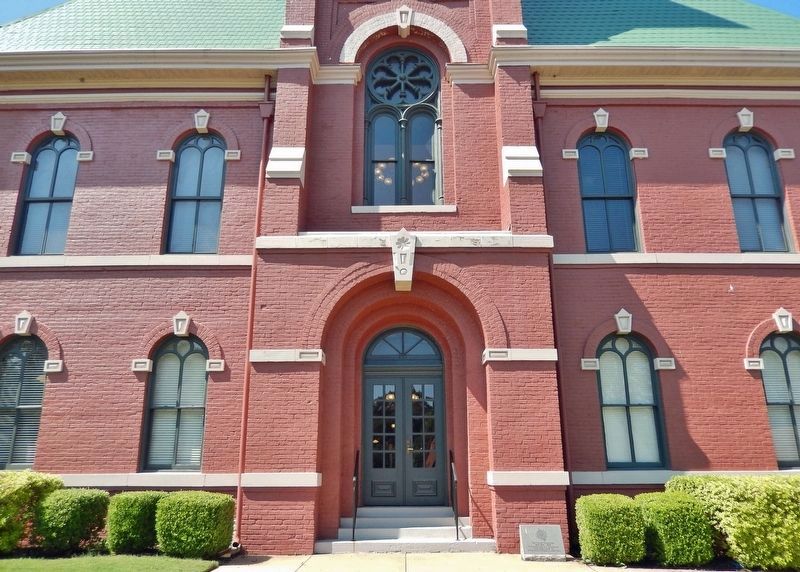
The Tate County Courthouse was built to the designs of James B. Cook as the seat of the new Tate County government, just south of the core of the Downtown area of the city of Senatobia.Unlike many county seats in Mississippi, the Tate County Courthouse is not located on its own square at the center of the county seat community, a condition that is due to the fact that the development of Senatobia preceded the establishment of Tate County by a little more than a decade.Photographed by Cosmos Mariner, September 17, 20242. Tate County Courthouse MarkerThe marker is located at ground level on the right side of the east courthouse entrance.An act of the Mississippi state legislature of April 15, 1873 assembled former portions of DeSoto, Tunica and Marshall counties into a new county, named for an early settler of the area, T. S. Tate. The new county seat was selected to be located at Senatobia, a small but growing railhead town established in ca. 1860 on the Tennessee and Mississippi Railroad. Though other towns in the new county were of comparable or slightly larger size than Senatobia at the time, the leaders of the new jurisdiction realized the potential importance of this railroad community as the center of the new county.
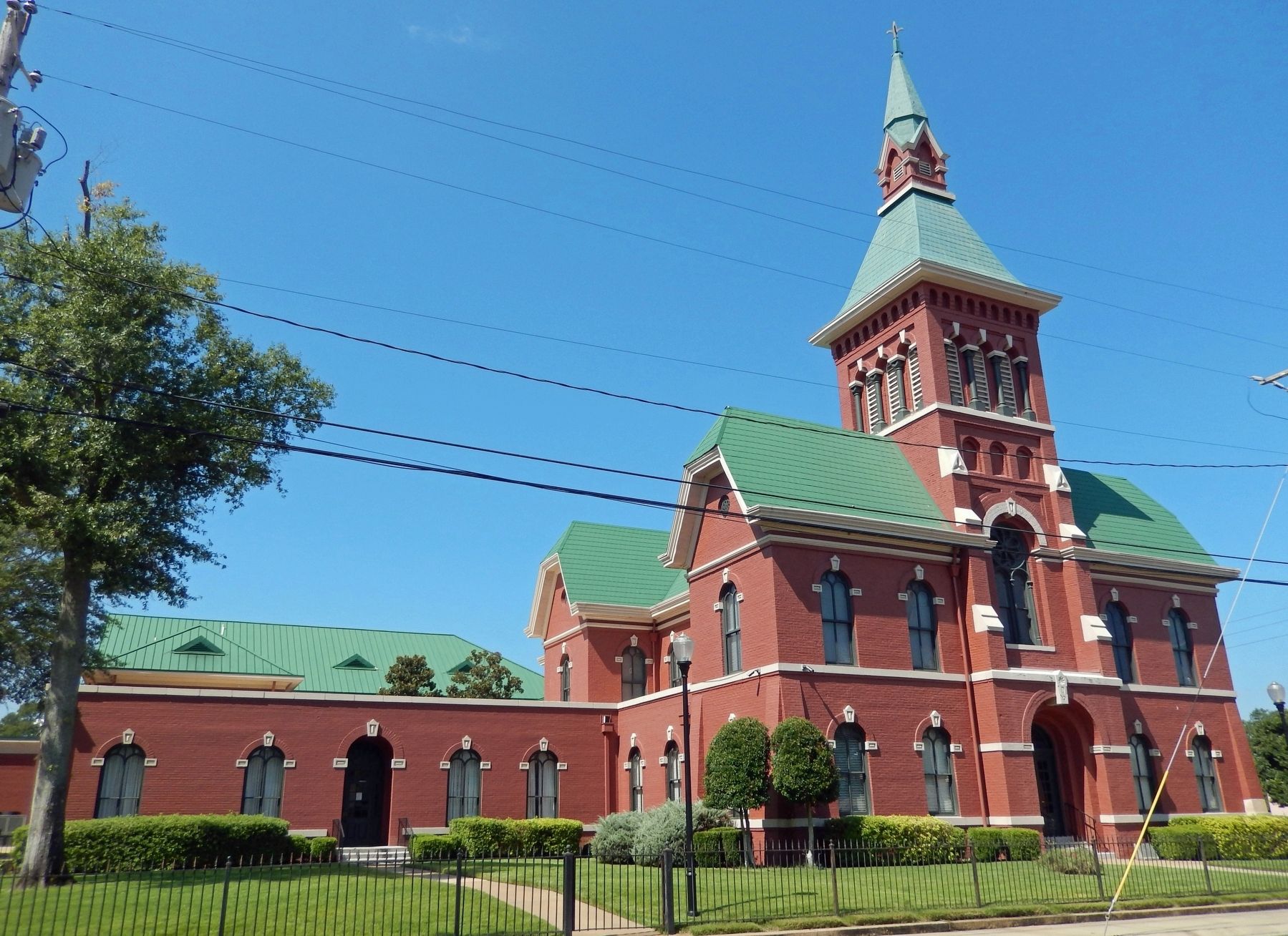
The Tate County Courthouse is a two-story, load-bearing brick masonry structure, designed as a notable example of the Italian Romanesque style. The second floor contains a finely appointed courtroom space, notable for the design of its Renaissance Revival-styled
beamed ceiling. The seven massive beams of the ceiling system are decorated with quatrefoil and C-scroll motifs at their apex; they are supported by wall brackets detailed with quatrefoil and ogee-scroll motifs above the engaged, turned pilasters. The focal point of the courtroom is the paneled Renaissance Revival "reredos" located immediately behind the judge's bench. This surprisingly well-designed and crafted piece of architectural cabinetry features a deep peaked cornice above a molding of tulip-like scroll-sawn motifs. The Tate County Courthouse remains as perhaps one of the finest Victorian public buildings of Mississippi. In spite of alterations through time, the integrity of the building has been maintained with the assistance of very sensitive, but unknown architects in the ca. 1904 and ca. 1975 remodelings of the building. The fact that the building has seen so few modern-day alterations is due, in part, to the great appreciation held by the Tate County government for its landmark courthouse.Photographed by Cosmos Mariner, September 17, 20243. Tate County Courthouse (east elevation)The courthouse is significant as one of the premier architectural landmarks of Tate County, and for its association with the career
of James Bartholomew Cook (1826-1909) of Memphis; this structure is one of the only known public buildings of Cook’s known to survive. This building is also the only known architect-designed structure surviving from the nineteenth century in all of Tate County.Photographed by Cosmos Mariner, September 17, 20244. Tate County Courthouse (southeast elevation)


Also see . . . Tate County Courthouse (Wikipedia).
Excerpt: The Romanesque style courthouse was designed by architect James B. Cook in 1873 and constructed between 1875 and 1876 by builder J. H. Cocke. The building also operates as a heritage museum, the Tate County Heritage Museum. It is listed on the National Register of Historic Places since March 30, 1994; and a Mississippi Landmark since 1984. The attached annex structure was completed in summer 1999.(Submitted on December 16, 2024, by Cosmos Mariner of Cape Canaveral, Florida.)
Credits. This page was last revised on December 16, 2024. It was originally submitted on December 14, 2024, by Cosmos Mariner of Cape Canaveral, Florida. This page has been viewed 240 times since then and 60 times this year. Photos: 1, 2, 3, 4, 5. submitted on December 16, 2024, by Cosmos Mariner of Cape Canaveral, Florida.
