Historic District in Wilmington in New Hanover County, North Carolina — The American South (South Atlantic)
Smith-Gore House
circa 1866
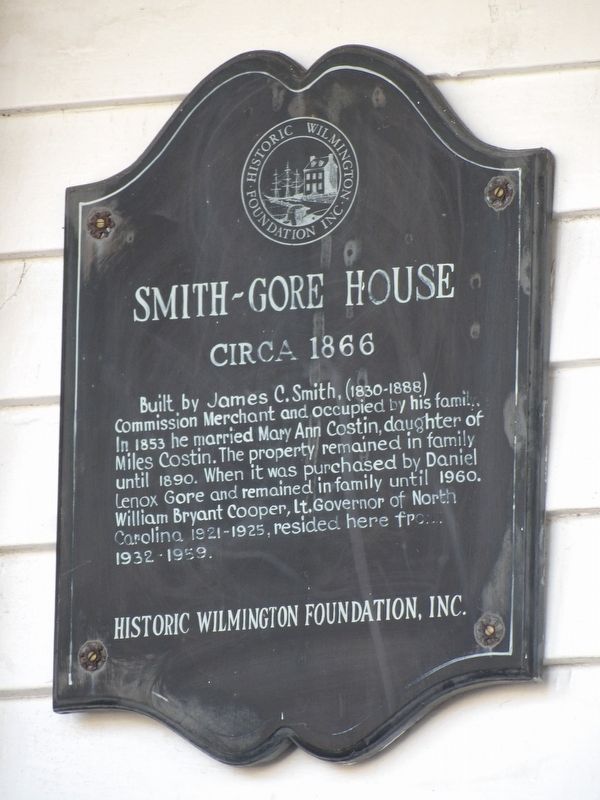
Photographed by Duane and Tracy Marsteller, November 23, 2024
1. Smith-Gore House Marker
Erected by Historic Wilmington Foundation, Inc.
Topics and series. This historical marker is listed in these topic lists: Architecture • Government & Politics. In addition, it is included in the National Register of Historic Places (NRHP), and the North Carolina, Historic Wilmington Foundation series lists. A significant historical year for this entry is 1866.
Location. 34° 14.08′ N, 77° 56.482′ W. Marker is in Wilmington, North Carolina, in New Hanover County. It is in the Historic District. It is on Dock Street east of South 6th Street, on the right when traveling east. Touch for map. Marker is at or near this postal address: 608 Dock St, Wilmington NC 28401, United States of America. Touch for directions.

Regionally, this marker is in the Coastal
this page online
Other nearby markers. At least 8 other markers are within walking distance of this marker: Fennell-Croom House (a few steps from this marker); Elizabeth H. Vollers House (within shouting distance of this marker); Elizabeth Vollers House (within shouting distance of this marker); Harriss House (within shouting distance of this marker); Jacob Weil House (within shouting distance of this marker); Williams-Clark House (within shouting distance of this marker); Singletary House (within shouting distance of this marker); Haar House (within shouting distance of this marker). Touch for a list and map of all markers in Wilmington.
Regarding Smith-Gore House. Daniel

Photographed by Duane and Tracy Marsteller, November 23, 2024
2. Smith-Gore House Marker
Also see . . .
1. Wilmington Historic District (PDF). National Register of Historic Places nomination for the district, which includes this property and was listed in 1974. (Prepared by Survey and Planning Unit, North Carolina Division of Archives and History; via North Carolina State Historic Preservation Office) (Submitted on December 17, 2024, by Duane and Tracy Marsteller of Murfreesboro, Tennessee.)
2. Wilmington Historic District Boundary Expansion and Additional Documentation (PDF). National Register nomination that expanded the district in 2003. (Prepared by Sherry Joines Wyatt and L. Robbie King; via North Carolina State Historic Preservation Office) (Submitted on December 17, 2024, by Duane and Tracy Marsteller of Murfreesboro, Tennessee.)

State Archives of North Carolina via Flickr (Public Domain)
3. William Bryant Cooper (1867–1959)
He served under Gov. Cameron Morrison as North Carolina's 14th lieutenant governor. He was a prominent banker and businessman in Wilmington, owning a general mercantile business and serving as president of the Wilmington Chamber of Commerce. His wife, Frances Ada Gore, was a daughter of D.L. Gore.
Credits. This page was last revised on December 17, 2024. It was originally submitted on December 16, 2024, by Duane and Tracy Marsteller of Murfreesboro, Tennessee. This page has been viewed 206 times since then and 45 times this year. Photos: 1, 2. submitted on December 16, 2024, by Duane and Tracy Marsteller of Murfreesboro, Tennessee. 3. submitted on December 17, 2024, by Duane and Tracy Marsteller of Murfreesboro, Tennessee.
