Tunica in Tunica County, Mississippi — The American South (East South Central)
1888 Courthouse
1300 School Street
Photographed by Cosmos Mariner, September 17, 2024
1. 1888 Courthouse Marker
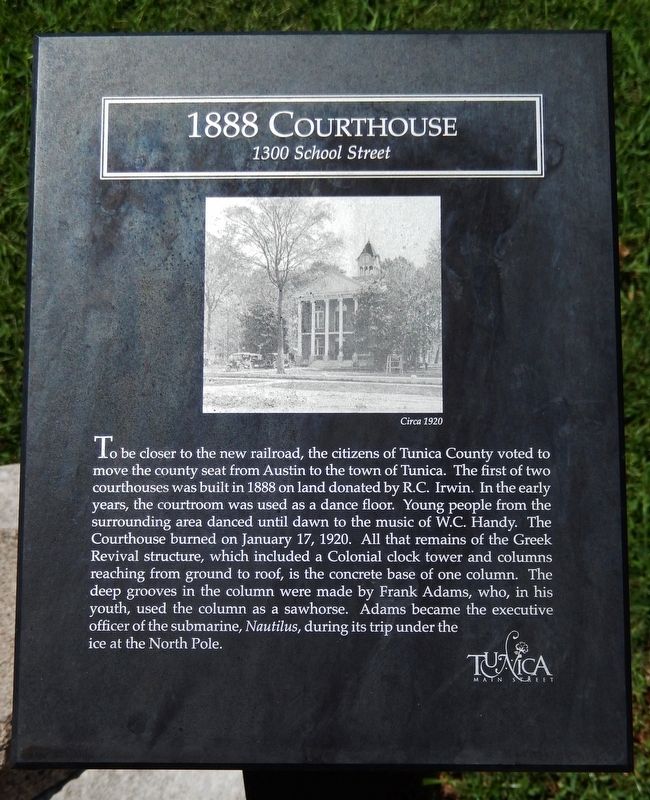
To be closer to the new railroad, the citizens of Tunica County voted to move the county seat from Austin to the town of Tunica. The first of two courthouses was built in 1888 on land donated by R.C. Irwin. In the early years, the courtroom was used as a dance floor. Young people from the surrounding area danced until dawn to the music of W.C. Handy. The Courthouse burned on January 17, 1920. All that remains of the Greek Revival structure, which included a Colonial clock tower and columns reaching from ground to roof, is the concrete base of one column. The deep grooves in the column were made by Frank Adams, who, in his youth, used the column as a sawhorse. Adams became the executive officer of the submarine, Nautilus, during its trip under the ice at the North Pole.
Erected by Tunica Main Street.
Topics and series. This historical marker is listed in these topic lists: Architecture • Notable Buildings. In addition, it is included in the National Register of Historic Places (NRHP) series list. A significant historical date for this entry is January 17, 1920.
Location. 34° 41.315′ N, 90° 22.843′ W. Marker is in Tunica, Mississippi,
this page online

Regionally, this marker is in the American South, specifically in the Deep South, in the Mississippi Delta, and in the Great River Road Region. Globally, it is in North America, a Gulf of Mexico state, the Western Hemisphere, the Western World, and the Anglosphere. Historically, it finds itself in what was once New Spain, the territory of the Mississippian Culture, one of the Confederate States of America, and the Antebellum South.
Other nearby markers. At least 8 other markers are within walking distance of this marker: In Memory of Lieut. John R. Stapleton (within shouting distance of this marker); The Tate Log House (about 400 feet away, measured in a direct line); Lane's Barber Shop (about 500 feet away); Harold "Hardface" Clanton (about 600 feet away); Tunica Full Service
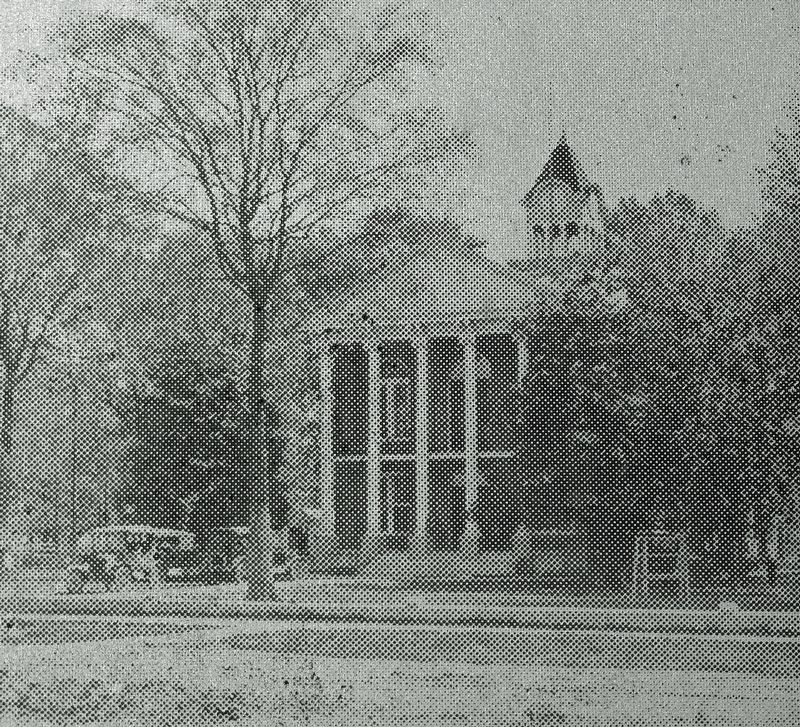
circa 1920
2. Marker detail: 1888 Tunica County Courthouse
Regarding 1888 Courthouse. The replacement (1922) Tunica County Courthouse is a contributing property in the Tunica Historic District, National Register of Historic Places № 06000194.
From the National Register Nomination prepared by Gene and Linda Ford (2004), and Richard J. Cawthon (2006 revisions):
Tunica began to develop when an astute entrepreneur, Edwin Lanier Harris, purchased the area. Harris noted that the Louisville, New Orleans, and Texas Railway Company (LNO&T) was contemplating building a station there. Tunica was laid out on Harris' property in 1884.
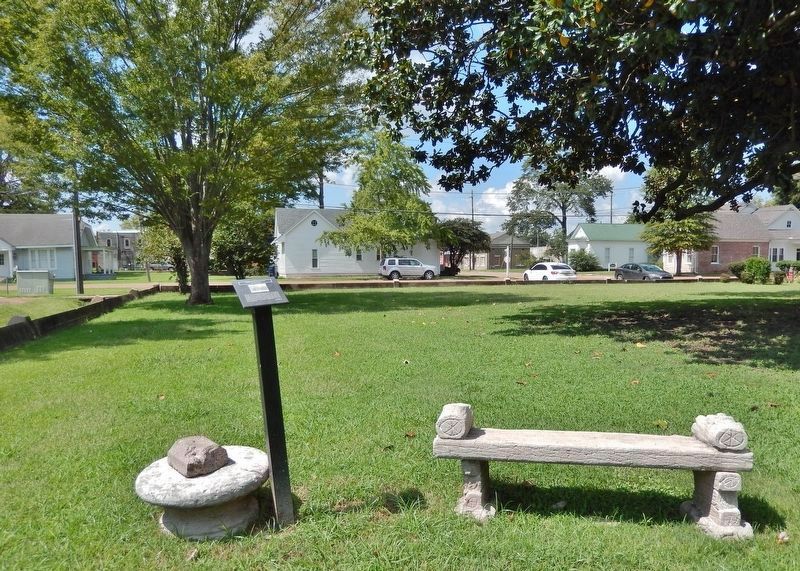
In 1888 Tunica was chosen as the new county seat. Almost immediately a major construction project was underway in downtown Tunica when the new Tunica County Courthouse and Jail were erected. Both the courthouse and jail were built in the Romanesque Revival style that was popular for municipal buildings at the turn of the century. Such characteristics as round arches, bandsof upper story arched or trabeated ribbon windows, and towers summarize this style. The jail burned in 1894 and was rebuilt in the same Romanesque Revival style. The original Romanesque Revival courthouse was destroyed by fire on January 17, 1920.Photographed by Cosmos Mariner, September 17, 20243. 1888 Courthouse MarkerLooking west across the courthouse grounds; School Street crosses in the background. The remaining concrete column base from the 1888 courthouse is on exhibit at the base of the marker.
Photographed by Cosmos Mariner, September 17, 2024
4. 1888 Courthouse Marker
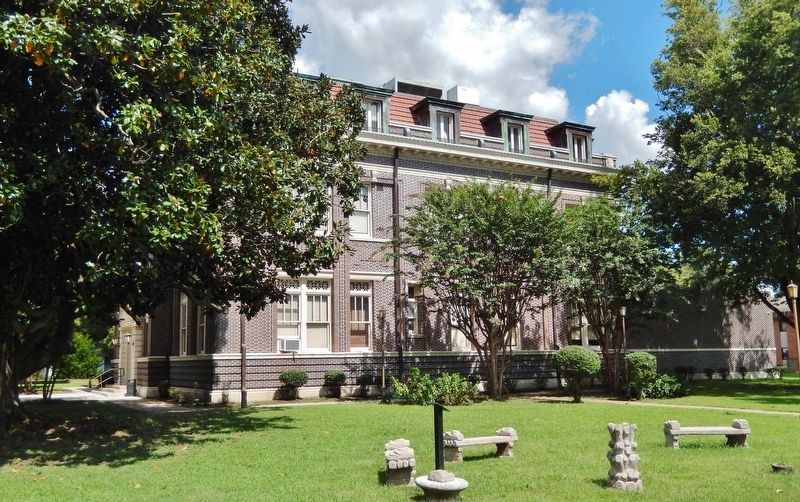
Looking northeast from South Court Street; the marker is on the waist-high post at the bottom center of this photo. The 1922 Tunica County Courthouse is in the background.
Photographed by Cosmos Mariner, September 17, 2024
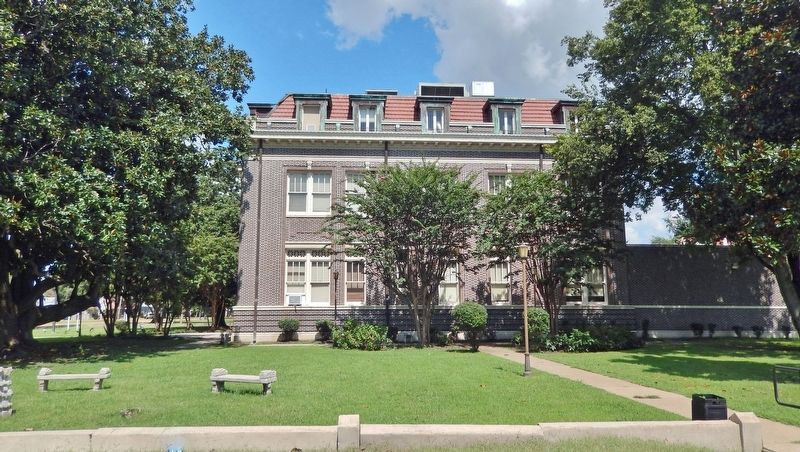
5. Tunica County Courthouse (built 1922) (south elevation)
Photographed by Cosmos Mariner, September 17, 2024
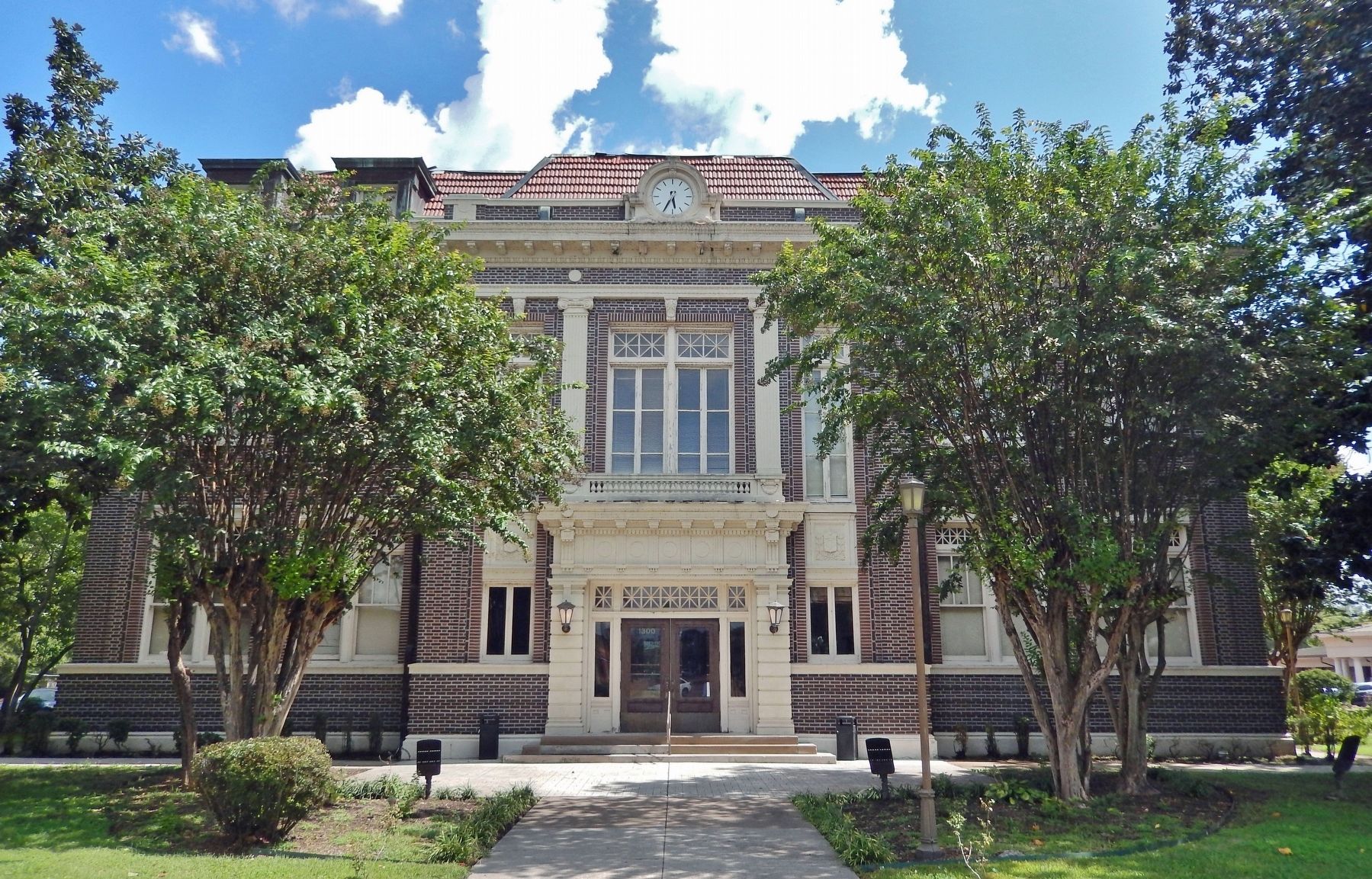
6. Tunica County Courthouse (built 1922) (west/front elevation)
From the National Register Nomination: Two-and-a-half story brick Beaux Arts courthouse with terra cotta tile mansard roof, central block with clock, stone surround and two flanking dormers with flat roofs and casement windows.
A decade of prosperity arrived with the Roaring Twenties. This wealth was reflected in Tunica with the construction of a new Beaux Arts courthouse. Replete with multiple classical details including denticulated cornice, egg and dart cornice, triglyphs, metopes and pilasters with Ionic capitals, the lavish articulation of the Beaux Arts edifice sharply contrasts with the 1888 Romanesque Revival structure it replaced. According to a plaque located within the courthouse, the architect of the edifice was one Frank P. Gates, who worked out of neighboring Clarksdale, and the contractor was Algernon Blair.
A decade of prosperity arrived with the Roaring Twenties. This wealth was reflected in Tunica with the construction of a new Beaux Arts courthouse. Replete with multiple classical details including denticulated cornice, egg and dart cornice, triglyphs, metopes and pilasters with Ionic capitals, the lavish articulation of the Beaux Arts edifice sharply contrasts with the 1888 Romanesque Revival structure it replaced. According to a plaque located within the courthouse, the architect of the edifice was one Frank P. Gates, who worked out of neighboring Clarksdale, and the contractor was Algernon Blair.
Credits. This page was last revised on December 17, 2024. It was originally submitted on December 17, 2024, by Cosmos Mariner of Cape Canaveral, Florida. This page has been viewed 243 times since then and 42 times this year. Photos: 1, 2, 3, 4, 5, 6. submitted on December 17, 2024, by Cosmos Mariner of Cape Canaveral, Florida.
