Hanau in Main-Kinzig-Kreis, Hesse, Germany — Central Europe
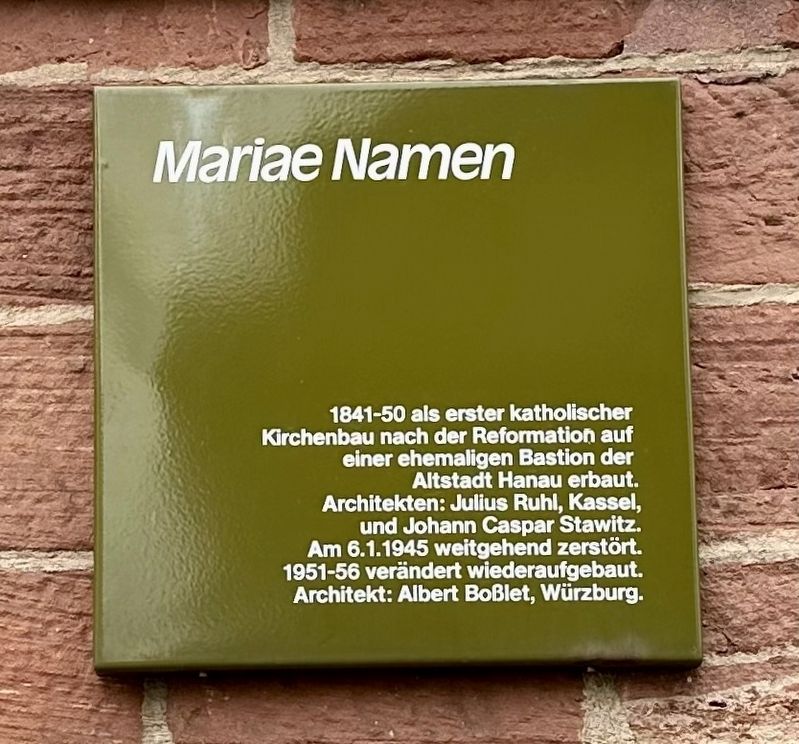
Mariae Namen
Photographed by Andrew Ruppenstein, May 26, 2024
1. Mariae Namen Marker

Built between 1841 and 1850 as the first Catholic church building after the Reformation on a former bastion in the old town of Hanau. Architects: Julius Ruhl, Kassel, and Johann Caspar Stawitz. Largely destroyed on January 6, 1945. Rebuilt with modifications between 1951 and 1956. Architect: Albert Bosslet, Würzburg.
Topics. This historical marker is listed in this topic list: Religion & Religious Structures. A significant historical date for this entry is January 6, 1945.
Location. 50° 8.128′ N, 8° 54.901′ E. Marker is in Hanau, Hessen (Hesse), in Main-Kinzig-Kreis. It is on Im Bangert, on the left when traveling north. Touch for map. Marker is at or near this postal address: Im Bangert 6, Hanau HE 63450, Germany. Touch for directions.

Regionally, it is in Europe, the European Union, Atlantic Europe, Central
this page online
Other nearby markers. At least 8 other markers are within walking distance of this marker: Rest der mittelalterlichen Straße / Remnants of a Medieval Street (about 150 meters away, measured in a direct line); Stadtmauer / City Wall (about 150 meters away); Verlauf der Altstadtmauer / Course of the Old Town Wall (about 150 meters away); „Männchen mit den großen Ohren“ / “Little Man with the Big Ears” (about 210 meters away); Turmhaube Alte Johanniskirche / Belltower of the Old Johanniskirche (about 210 meters away); Hanauer Elle und Gerechtigkeitsbrunnen / The Hanau “Foot” and Fountain of Justice (about 240 meters away); Pranger / Pillory (about 240 meters away); Altstädter Rathaus / Old Town City Hall (about 240 meters away). Touch for a list and map of all markers in Hanau.
Also see . . . Mariae Namen (Hanau) (Wikipedia, in German). Excerpt (in translation):
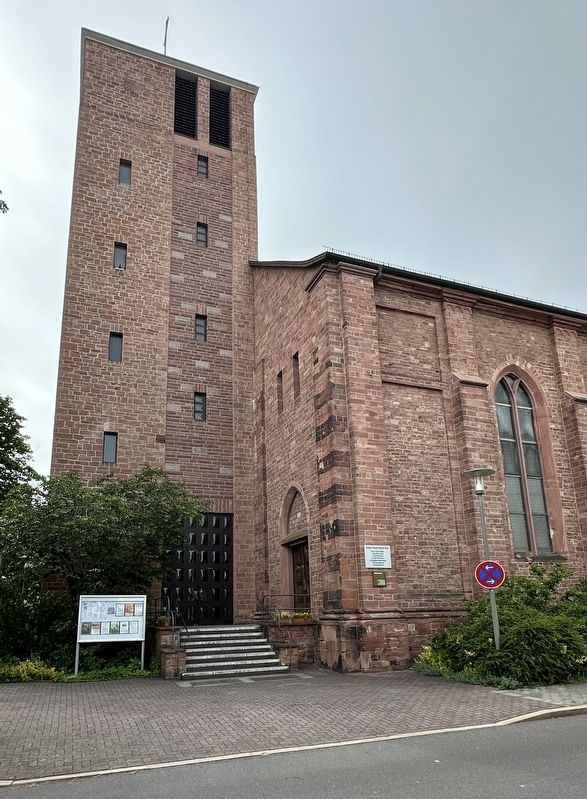
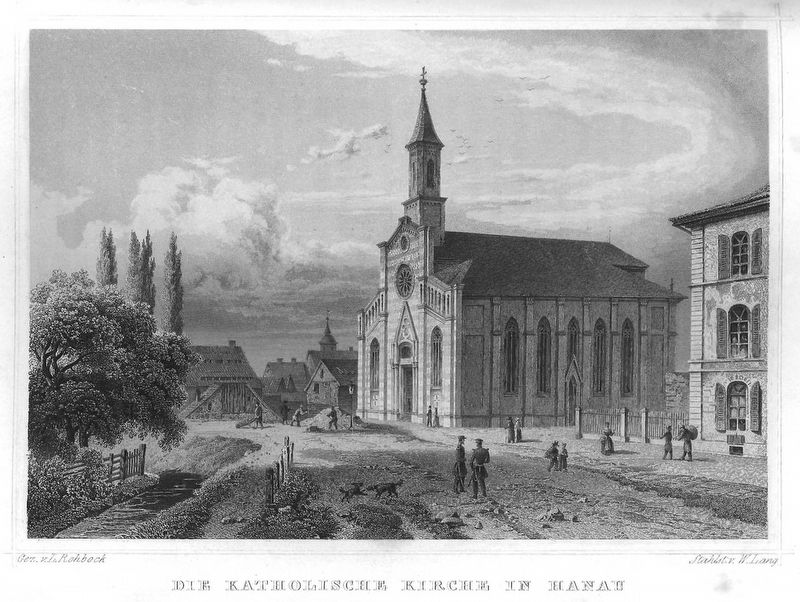
After the County of Hanau had finally adopted the reformed version of the(Submitted on December 18, 2024.)Reformation at the end of the 16th century under Count Philipp Ludwig II of Hanau-Münzenberg, all subjects had to adopt this denomination, because the rule was: cuius regio, eius religio. It was not until 1787 that the then sovereign, Landgrave Wilhelm IX of Hesse-Kassel, allowed believers of the Roman Catholic denomination to hold services. This initially took place in a small prayer room on Gärtnerstrasse. In 1809, the Hospital Church was made available to the Roman Catholic community of Hanau. However, it seems doubtful whether they used the Hospital Church, since Roman Catholic services were still held on Gärtnerstrasse in 1811. In 1841, work began on building the first church of their own. The construction history was difficult: Julius Eugen Ruhl originally planned a three-aisled basilica. However, the half-finished building was damaged by a storm on January 14, 1843, after which the construction site was initially abandoned for years and the church was then completed from 1848 to 1850 at a lower cost as a hall church according to plans by Johann Caspar Stawitz.Photographed by Andrew Ruppenstein, May 26, 20242. Mariae Namen Marker - wide viewThe marker is visible here just to the right of the steps.
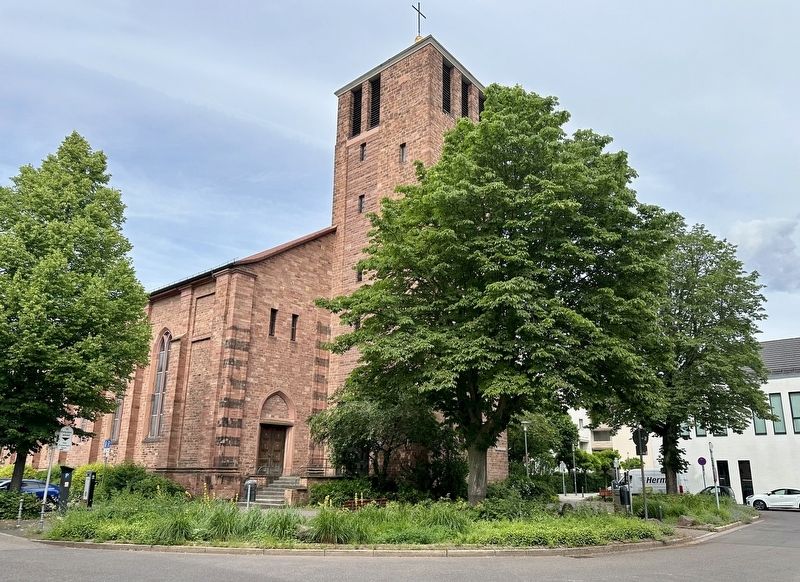
During the Second World War, the church was again partially destroyedin the air raids on Hanau. The current church is a modernized, simplified reconstruction from 1952 by Albert Bosslet, who was obviously very alien to historicism. He placed a sober, functional facade in front of the striped facade, which almost completely conceals the original striped pattern.Photographed by Andrew Ruppenstein, May 26, 20243. Mariae Namen church
Photographed by Ludwig Rohbock, W. Lang (via Wikimedia Commons), 1850
4. Mariae Namen (“The Catholic Church in Hanau”)
Source: The Electorate of Hesse in picturesque original views engraved in steel by various artists. Accompanied by a historical topographical text. Printed and published by Gustav Georg Lange, 1850. P. 566.
Credits. This page was last revised on December 18, 2024. It was originally submitted on December 18, 2024, by Andrew Ruppenstein of Lamorinda, California. This page has been viewed 122 times since then and 7 times this year. Photos: 1, 2, 3, 4. submitted on December 18, 2024, by Andrew Ruppenstein of Lamorinda, California.
