Wilmington in New Hanover County, North Carolina — The American South (South Atlantic)
Chestnut Street Presbyterian Church
Erected 1858
| — | Mr. Moody, builder | — |

Photographed by Duane and Tracy Marsteller, November 23, 2024
1. Chestnut Street Presbyterian Church Marker
Erected by Historic Wilmington Foundation, Inc.
Topics and series. This historical marker is listed in these topic lists: African Americans • Architecture • Religion & Religious Structures. In addition, it is included in the National Register of Historic Places (NRHP), and the North Carolina, Historic Wilmington Foundation series lists. A significant historical year for this entry is 1858.
Location. 34° 14.274′ N, 77° 56.412′ W. Marker is in Wilmington, North Carolina, in New Hanover County. It is on Chestnut Street west of North 8th Street, on the
this page online

Regionally, this marker is in the Coastal Plain and on the Cape Fear Coast. It is also in the American South, specifically in the Upper South, in the Tidewater, and on the Eastern Seaboard. Globally, it is in the North Atlantic Region, North America, the Western Hemisphere, the Western World, and the Anglosphere. Historically, it finds itself in what was once the territory of the Mississippian Culture, one of the original Thirteen Colonies, one of the Confederate States of America, and the Antebellum South.
Other nearby markers. At least 8 other markers are within walking distance of this marker: Bowden-Foard House (within shouting distance of this marker); Altaffer House (within shouting distance of this marker); Eckel-Spillman Cottage (within shouting distance of this marker); Greer House (within shouting distance of this marker); Kahnweiler-Duls House (about 300 feet away, measured in a direct line); Capt. Joseph Price House (about 300 feet away);

Photographed by Duane and Tracy Marsteller, November 23, 2024
2. Chestnut Street Presbyterian Church Marker
Also see . . .
1. About Us. The historic CSPC is the original building that was erected by the First Presbyterian Church of Wilmington, North Carolina in 1858. The building was erected as a result of a revival in 1858, which was part of the third great awakening that spawned new church construction all over the country, including Wilmington, North Carolina. (Chestnut Street Presbyterian Church) (Submitted on December 20, 2024, by Duane and Tracy Marsteller of Murfreesboro, Tennessee.)
2. Wilmington Historic District (PDF). National Register of Historic Places nomination for the district, which includes this property and was listed in 1974. (Prepared by Survey and Planning Unit, North Carolina Division of Archives and History; via North Carolina State Historic Preservation Office) (Submitted on December 20, 2024, by Duane and Tracy Marsteller of Murfreesboro, Tennessee.)
3. Wilmington Historic District Boundary Expansion and Additional Documentation (PDF). National
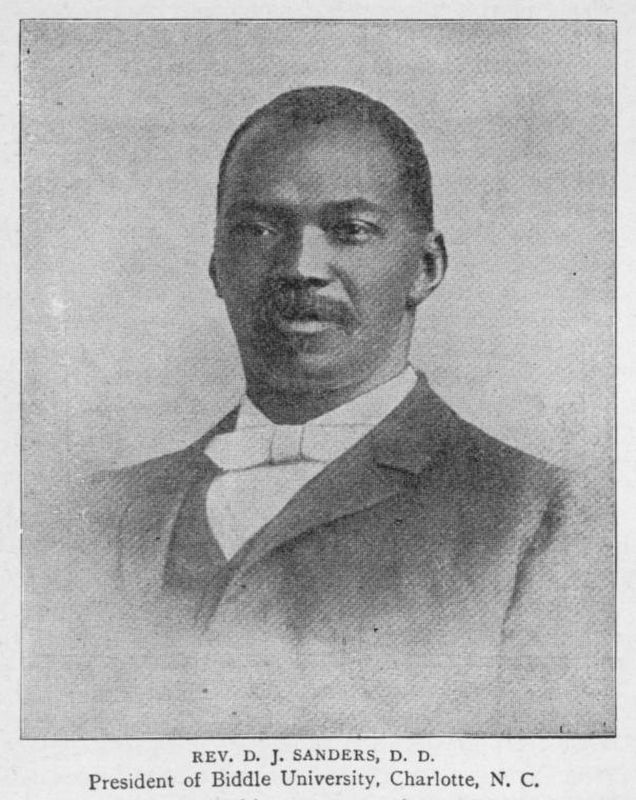
J.L. Nichols; via New York Public Library (Public Domain), 1902
3. Rev. Daniel Jackson Sanders (1847-1907)
Born into slavery in Winnsboro, S.C., he was president of Biddle University (now Johnson C. Smith University) for 17 years.
Credits. This page was last revised on December 20, 2024. It was originally submitted on December 18, 2024, by Duane and Tracy Marsteller of Murfreesboro, Tennessee. This page has been viewed 228 times since then and 51 times this year. Photos: 1, 2. submitted on December 18, 2024, by Duane and Tracy Marsteller of Murfreesboro, Tennessee. 3. submitted on December 20, 2024, by Duane and Tracy Marsteller of Murfreesboro, Tennessee.
