Port Dover in Norfolk County, Ontario — Central Canada (North America)
To Honour the Pioneers
Photographed by Tim Boyd
1. To Honour the Pioneers Marker
To Honour the Pioneers
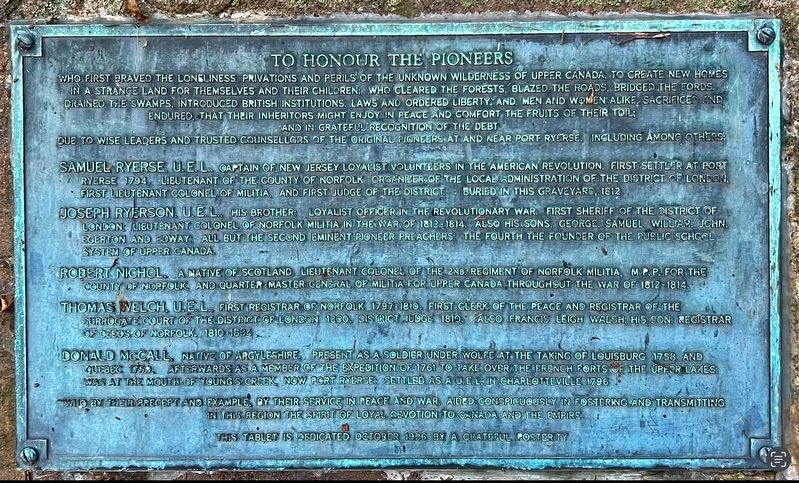
who first braved the loneliness, privations and perils of the unknown wilderness of upper Canada, to create new homes in a strange land for themselves and their children: who cleared the forests, blazed the roads, bridged the fords, drained the swamps, introduced British institutions, laws and ordered liberty, and, men and women alike, sacrificed and endured, that their inheritors might enjoy in peace and comfort the fruits of their toil; and in grateful recognition of the debt due to wise leaders and trusted counsellors of the original pioneers at and near Port Ryerse including among others:
Samuel Ryerse U.E.L., Captain of New Jersey Loyalist Volunteers in the American Revolution. First settler at Port Ryerse 1794. Lieutenant of the County of Norfolk, organizer of the local administration of the District of London. First Lieutenant Colonel of militia, and first judge of the district, buried in this graveyard, 1812.
Joseph Ryerson U.E.L., his brother: loyalist officer in the Revolutionary War. First sheriff of the district of London. Lieutenant Colonel of Norfolk militia in the War of 1812-1814.
this page online
Robert Nichol, a native of Scotland, Lieutenant Colonel of the 2nd regiment of Norfolk Militia, M.P.P. for the County of Norfolk, and Quarter Master General of militia for Upper Canada throughout the war of 1812-1814.
Thomas Welch, U.E.L., first Registrar of Norfolk 1797-1810, first Clerk of the Peace and Registrar of the Surrogate Court of the District of London 1800, District Judge 1810, also Francis Leigh Walsh his son: Registrar of Deeds of Norfolk, 1810-1894.
Donald McCall, native of Argyleshire, present as a soldier under Wolfe at the taking of Louisburg 1758 and Quebec 1759. Afterwards as a member of the expedition of 1761 to take over the French forts of the Upper Lakes: was at the mouth of Young's creek, now Port Ryerse settled as a U.E.L. in Charlotteville 1796
Who by their precept and example, by their service in peace and war aided conspicuously to fostering and transmitting to this region the spirit of loyal devotion to Canada and
Photographed by Tim Boyd, October 2, 2023
2. To Honour the Pioneers Marker
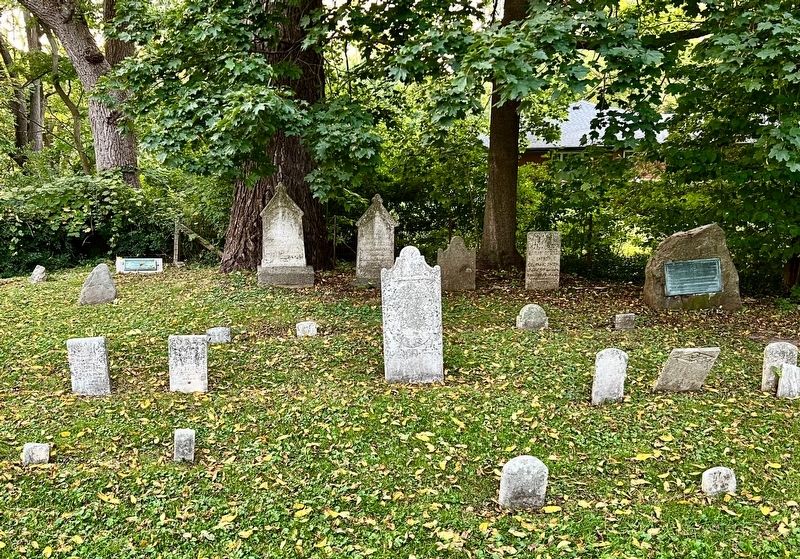
On the right of the photo
This tablet is dedicated October 1926 by a grateful posterity
Erected 1926.
Topics. This historical marker is listed in these topic lists: Settlements & Settlers • War of 1812. A significant historical year for this entry is 1794.
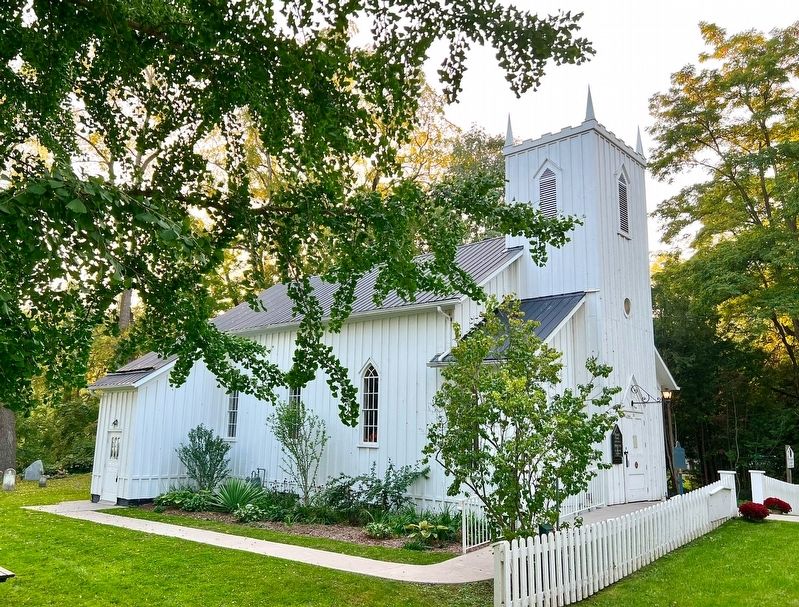
Location. 42° 45.345′ N, 80° 15.43′ W. Marker is in Port Dover, Ontario, in Norfolk County. It is on King Street South 0.2 kilometers south of Commercial Road, on the right when traveling south. The marker is in the cemetery of the Port Ryerse Memorial Anglican Church. Touch for map. Marker is in this post office area: Port Dover ON N3Y 4K2, Canada. Touch for directions.

Regionally, this marker is in the Southwest Ontario Area and in Southwestern Ontario. It is also in Central Canada. Globally, it is in North America, on the Great Lakes, in the Western Hemisphere, in the Western World, and in the Anglosphere. Historically, it finds itself in what was once a British colony, the Viceroyalty of New France, the Haudenosaunee (Iroquois) Confederacy, and Rupert’s Land.
Other nearby markers. At least 8 other markers are within 6 kilometers of this marker, measured as the
Photographed by Tim Boyd, October 2, 2024
3. Port Ryerse Memorial Anglican Church
Also see . . . Port Ryerse.
Lieut-Colonel Samuel Ryerse was a United Empire Loyalist who fought with the British during the American Revolution and came to Upper Canada and founded Port Ryerse in 1794 where he was granted 3000 acres of land. He built a grist mill at the mouth of Young's Creek and a settlement grew up around it. Ryerse remained involved with the military as Lieutenant of the County of Norfolk and was also the chairman of the Court of Quarter Sessions.(Submitted on December 19, 2024, by Tim Boyd of Hamilton, Ontario.)
Lt.-Colonel Samuel Ryerse was the first District Judge of the Long Point Settlement and the founder of the Norfolk Militia. Samuel Ryerse, was the brother of Colonel Joseph Ryerson and uncle of Egerton Ryerson. Ryerse built the first mill in Norfolk in 1796. He was a friend of John Graves Simcoe, the first Lieutenant-Governor of Upper Canada.
The Ryerse and Ryerson families were related. Rev. Egerton Ryerson, the founder of the modern school system in Ontario, had ties to Port Ryerse. He delivered sermons on occasion from the pulpit in Memorial Church.
Many of the first settlers in Norfolk arrived by boat at Port Ryerse. The harbour was the main gateway in its time for vital necessities such as cast iron stoves and millstones. The harbour was also a major shipping point for local grain and lumber from Norfolk County across the lake; although its importance declined significantly sometime around the 1880s due to the advent of the railroad.
Credits. This page was last revised on December 21, 2024. It was originally submitted on December 19, 2024, by Tim Boyd of Hamilton, Ontario. This page has been viewed 148 times since then and 29 times this year. Photos: 1, 2, 3. submitted on December 19, 2024, by Tim Boyd of Hamilton, Ontario. • Andrew Ruppenstein was the editor who published this page.
