Historic District in Wilmington in New Hanover County, North Carolina — The American South (South Atlantic)
Lazarus-Hill-Divine House
c. 1818; c. 1854; c. 1885
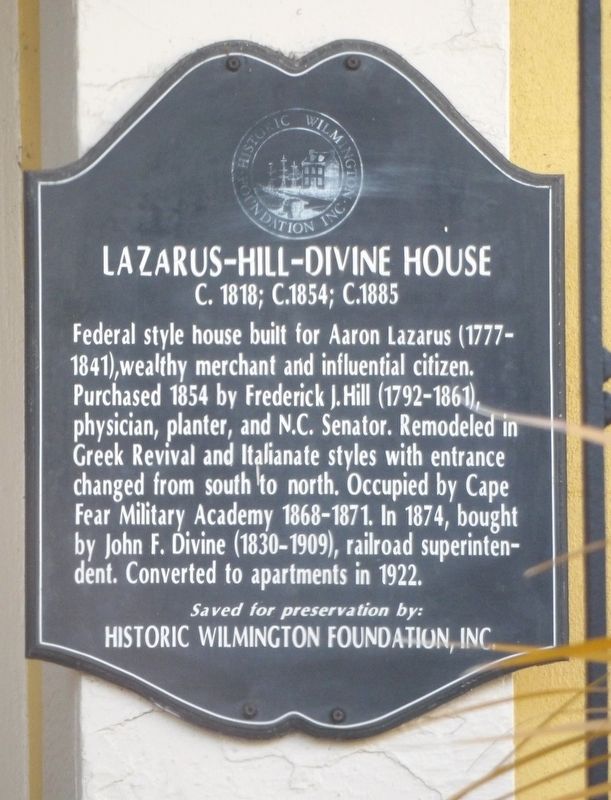
Photographed by Duane and Tracy Marsteller, November 23, 2024
1. Lazarus-Hill-Divine House Marker
Historic Wilmington Foundation, Inc.
Erected by Historic Wilmington Foundation, Inc.
Topics and series. This historical marker is listed in these topic lists: Architecture • Education. In addition, it is included in the National Register of Historic Places (NRHP), and the North Carolina, Historic Wilmington Foundation series lists. A significant historical year for this entry is 1818.
Location. 34° 14.334′ N, 77° 56.734′ W. Marker is in Wilmington, North Carolina, in New Hanover County. It is in the Historic District. It is on Grace Street west of North 4th Street, on the left when traveling west. Touch for map. Marker is at or near this postal address: 314
this page online

Regionally, this marker is in the Coastal Plain and on the Cape Fear Coast. It is also in the American South, specifically in the Upper South, in the Tidewater, and on the Eastern Seaboard. Globally, it is in the North Atlantic Region, North America, the Western Hemisphere, the Western World, and the Anglosphere. Historically, it finds itself in what was once the territory of the Mississippian Culture, one of the original Thirteen Colonies, one of the Confederate States of America, and the Antebellum South.
Other nearby markers. At least 8 other markers are within walking distance of this marker: St. Mark’s (within shouting distance of this marker); Grace Methodist Church (about 300 feet away, measured in a direct line); Wilder-Bulluck House (about 300 feet away); Stephen Jewett House (about 300 feet away); John A. Winslow (about 400 feet away); Thomas F. Wood (about 400 feet away); “Shubert Hall” (about 400 feet away); Powell - Yopp House (about 500 feet away). Touch for a list and map of all markers in Wilmington.
Regarding Lazarus-Hill-Divine House. It
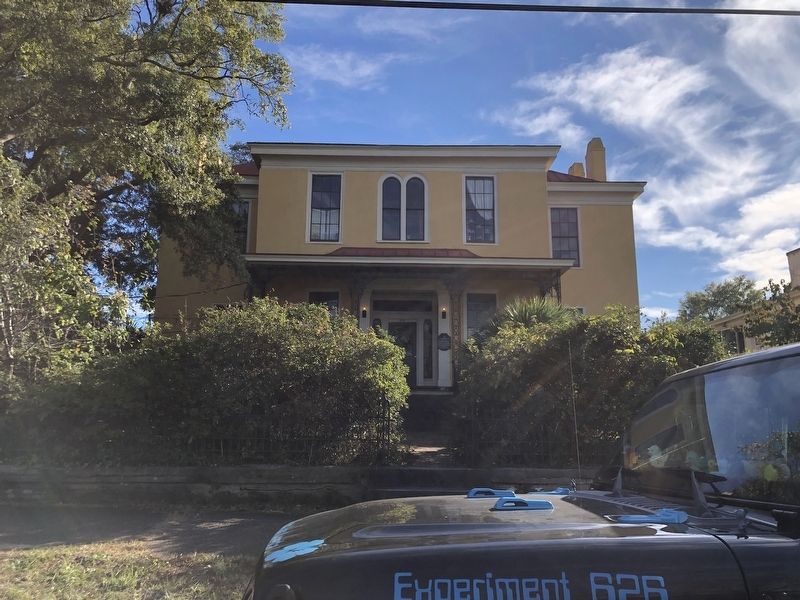
Photographed by Duane and Tracy Marsteller, November 23, 2024
2. Lazarus-Hill-Divine House Marker
Highly significant house exhibits a continuum of stylistic change from its original Federal mode through Greek Revival and finally Italianate. The projecting front pavilion of the north facade has a strong Italianate influence visible in the paired, round-head arched second floor windows and flared-hip porch roof supported by ironwork posts and balustrade. The entry has transom and sidelights and is surrounded by an architrave. The house was built for Aaron Lazarus, an important merchant and was later owned by John Divine, who served as General Superintendent of the Wilmington-Weldon Railroad, President of Clarendon Waterworks, and as a city alderman.
Also see . . .
1. Lazarus-Divine House. The application for the historical plaque includes a comprehensive history of the house and its owners. (Janet K. Seapker; via New Hanover County Public Library) (Submitted on December 21, 2024, by Duane and Tracy Marsteller of Murfreesboro, Tennessee.)
2. Wilmington Historic District (PDF). Original National Register nomination for the district. (Prepared by Survey and Planning Unit, North Carolina Division of Archives and History; via North Carolina State Historic Preservation Office) (Submitted on December 21, 2024, by Duane and Tracy Marsteller of Murfreesboro, Tennessee.)
3. Wilmington Historic District Boundary Expansion and Additional Documentation (PDF). National Register nomination that expanded the district in 2003. (Prepared by Sherry Joines Wyatt and L. Robbie King; via North Carolina State Historic Preservation Office) (Submitted on December 21, 2024, by Duane and Tracy Marsteller of Murfreesboro, Tennessee.)
4. Encyclopedia of Southern Jewish Communities - Wilmington, North Carolina. Aaron Lazarus, the son of a wealthy Charleston merchant, moved to Wilmington in 1795, where he opened a commission and auction house. He eventually became a major landowner in town and opened a successful import/export firm. (Goldring/Woldenberg Institute of Southern Jewish Life) (Submitted on December 21, 2024, by Duane and Tracy Marsteller of Murfreesboro, Tennessee.)
5. General Colston and the Cape Fear Academy. In 1868, former Confederate General Raleigh E. Colston was invited to Wilmington to open the Cape Fear Military Academy, after operating a similar one in Hillsborough, North Carolina since the close of the War Between the States. The new Cape Fear Academy was conducted in the Hill Residence on Grace Street between 3rd & 4th Streets. (Bernhard Thuersam, Cape Fear Historical Institute) (Submitted on December 21, 2024, by Duane and Tracy Marsteller of Murfreesboro, Tennessee.)
Credits. This page was last revised on December 21, 2024. It was originally submitted on December 19, 2024, by Duane and Tracy Marsteller of Murfreesboro, Tennessee. This page has been viewed 341 times since then and 48 times this year. Photos: 1, 2. submitted on December 19, 2024, by Duane and Tracy Marsteller of Murfreesboro, Tennessee.
