Lebanon in Wilson County, Tennessee — The American South (East South Central)
Pickett Chapel Methodist Church

Photographed by Darren Jefferson Clay, December 21, 2024
1. Pickett Chapel Methodist Church marker
Erected 2022 by William G. Pomeroy Foundation. (Marker Number 482.)
Topics. This historical marker is listed in this topic list: Notable Buildings. A significant historical year for this entry is 1977.
Location. 36° 12.537′ N, 86° 17.332′ W. Marker is in Lebanon, Tennessee, in Wilson County. It is on East Market Street, on the left when traveling east. Touch for map. Marker is at or near this postal address: 211 E Market St, Lebanon TN 37087, United States of America. Touch for directions.

Regionally, this marker is in Middle Tennessee and in Greater Nashville. It is also in the American South and specifically in the Upper South. Globally, it is in North America, the Western Hemisphere, the Western World, and the Anglosphere. Historically, it finds itself in what was once the territory of the Mississippian Culture, one of the Confederate States of America, and the Antebellum South.
Other nearby markers. At least 8 other markers are within walking distance
this page online
Regarding Pickett Chapel Methodist Church. As seen in the nomination to the National Registry of Historic Places:
"Pickett Chapel Methodist Church has stood on a town lot near the center of Lebanon for nearly 150 years and has served both the black and white citizens of this county seat during most of this period. The small (forty by sixty feet), rectangular, brick church was built on a cut and coursed limestone foundation. All of the sixteen-inch thick walls, except the north, contain handmade brick laid in the Flemish bond pattern. The medium gable roof, originally sheathed with wooden shingles, is now clad with composition
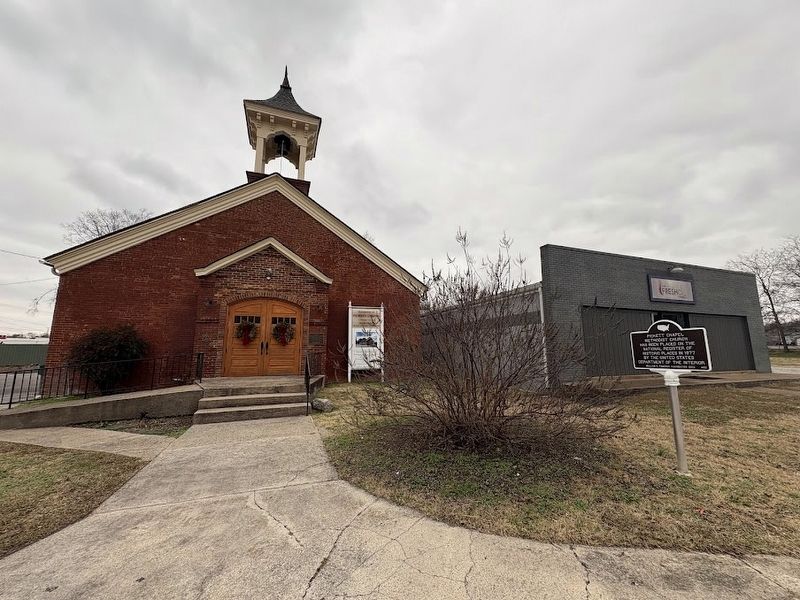
Photographed by Darren Jefferson Clay, December 21, 2024
2. Pickett Chapel Methodist Church marker
The south elevation has a gable-roofed, enclosed porch constructed of brick laid in stretcher bond with modern, aluminum double-leaf doors, having head and sidelights, and concrete steps. This addition, which probably dates from the late nineteenth or early twentieth century, also has a decorative cornice, a brick beltcourse, and below the eaves line, a corbel table. The main roof raking features a decorative, compound cornice.
The east and west elevations are identical; each has four elongated, four-over-four windows which have translucent lights, plain wooden sills, and brick, radiating vous-soir arches. A distinguishing feature of these walls is the segmented cyma recta cornice
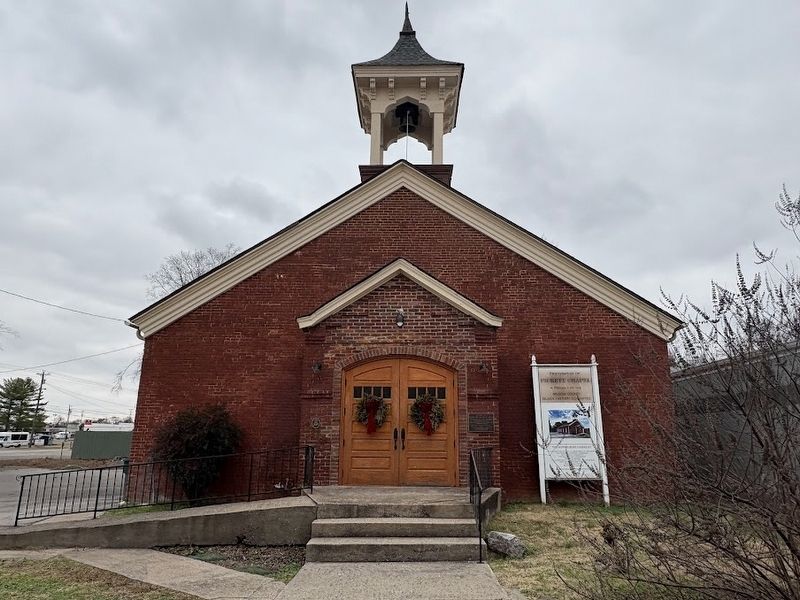
Photographed by Darren Jefferson Clay, December 21, 2024
3. Pickett Chapel Methodist Church
The north wall, laid in common bond, has only one opening, a large aperture which would accommodate double leaf doors. The roof trim has closed verges. Traces of an earlier addition, which had approximately the same size, configuration, and location as the front porch, are still visible on the north wall. A hodgepodge of concrete and cinder block, flit-roofed additions were attached to the rear of the church in recent years; unfortunately these cannot be seen from the street.
Although the church interior has been considerably modernized, it is still possible to determine its original configuration. The hardwood floor slopes ten inches in a distance of forty feet from the south wall. A dais, located in the northwest corner,is enclosed by a balustrade which contains a heavy rail and turned balusters. The plaster, baseboards, wainscotting, chair rails, and crown and frieze moldings all appear original. Decorative molding surrounds the double leaf doors in the southwall. A gallery constructed across the south end of the room, according to local tradition, provided space for the slaves of the antebellum church members. The ceiling, which is covered with acoustical tile, has a twenty-by-forty-foot barrel vault, and six round columns are evenly spaced under the long sides of this feature; this vault was constructed within what was originally a post and lintel framework. At least five styles and vintages of benches, some of which seem handmade, are found in the church.
Shortly after Wilson County was organized in 1799, Methodist circuit riders held meetings in the open or in the courthouse. About 1823 a few settlers met at the house of a Dr. Frazier and organized a congregation. In 1829 a lot in Lebanon was purchased and the Methodists built the first church in the city a year or two later. Until the area Cumberland Presbyterians erected their own church, the Methodists shared their meeting house with that sect. The Methodists soon outgrew the church and in 1856 built a new edifice on East Main Street. Ten years later the church was sold to a Negro Methodist congregation; this group named the church Pickett Chapel in honor of Calvin and James Pickett, members of the board of trustees of the Tennessee Conference, who had assisted them with organization of the congregation. In 1974 the black congregation moved to a new building and rented the church to a white group, the Lighthouse Tabernacle Cogic. The church is now vacant.
In 1834 Tennessee Conference was held in this church, and Bishop William McKendree, the first, native-born American Methodist bishop, presided over this, his last conference. Among the luminaries attending this meeting were John Carr, an early Tennessee historian and one of the originators of the camp meeting movement; a powerful and influential orator Logan Douglass; Bishop James O. Andrew, who inadvertently precipitated a schism in the denomination; leading Southern educator and author of the constitution of the M.E. Church Bishop Joshua Soule; James Gwin, Andrew Jackson's chaplain during the Battle of New Orleans; and John B. McFerrin who wrote Methodism in Tennessee. Pickett Chapel was the first brick church built in Lebanon and is one of the oldest, if not the oldest, brick buildings in the city. Although considerably altered by generations of occupants, the building still retains many of its original architectural refinements—shaped brick cornices, slave gallery, and decorative woodwork—which set it apart from the few surviving examples of early nineteenth-century brick churches in the state. The present owner, Mrs. Richard D. Lawlor, who acquired the church in July 1976,promises a bright future for this important building. A nonprofit organization, the Golladay-Lawlor Foundation, is being formed to insure that the property will be converted for public uses. Immediate plans call for the establishment of the Wilson County Museum in the building; the church hall will house exhibits, and the modern additions in the rear will serve for storage and office and exhibit preparation space. It is envisioned that the growth of the museum will necessitate moving the facility to larger quarters; this will then provide space for setting up a small, intimate playhouse for legitimate theater productions and children's programs."
Also see . . . Tennessee SP Pickett Chapel Methodist Church. (Submitted on December 24, 2024, by Darren Jefferson Clay of Duluth, Georgia.)
Credits. This page was last revised on December 24, 2024. It was originally submitted on December 21, 2024, by Darren Jefferson Clay of Duluth, Georgia. This page has been viewed 172 times since then and 44 times this year. Photos: 1, 2, 3. submitted on December 21, 2024, by Darren Jefferson Clay of Duluth, Georgia. • James Hulse was the editor who published this page.
