
Downtown Harrisburg in Dauphin County, Pennsylvania — The American Northeast (Mid-Atlantic)
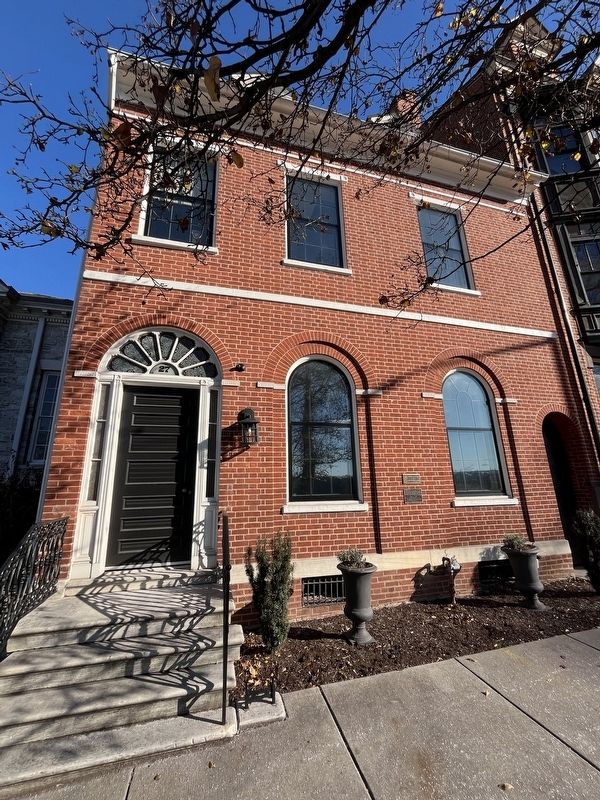
Shulze Executive Mansion
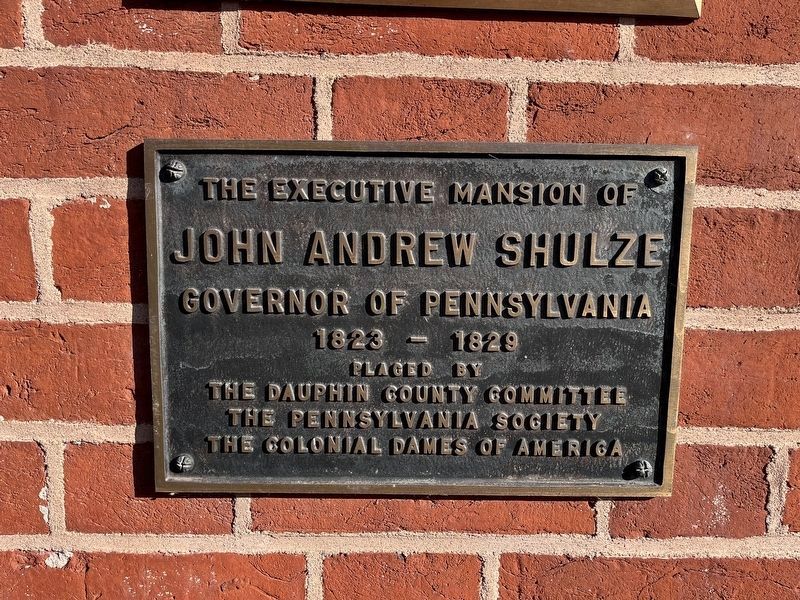
John Andrew Shulze
Governor of Pennsylvania
1823 - 1829
Erected by The Dauphin County Committee, The Pennsylvania Society of the Colonial Dames of America.
Topics and series. This historical marker is listed in this topic list: Government & Politics. In addition, it is included in the The Colonial Dames of America series list. A significant historical year for this entry is 1823.
Location. 40° 15.558′ N, 76° 53.039′ W. Marker is in Harrisburg, Pennsylvania, in Dauphin County. It is in Downtown Harrisburg. It is on North Front Street just south of Walnut Street, on the left when traveling south. Touch for map. Marker is at or near this postal address: 27 N Front St, Harrisburg PA 17113, United States of America. Touch for directions.

Regionally, this marker is in South-Central Pennsylvania, specifically in Pennsylvania Dutch Country, and in the Susquehanna Valley. It is also in the American Northeast and in the Mid-Atlantic. Globally, it is in North America, the Western Hemisphere, the Western World, and the Anglosphere. Historically, it finds itself in what was once the Haudenosaunee
this page online
Other nearby markers. At least 8 other markers are within walking distance of this marker: Shunk Executive Mansion (a few steps from this marker); Findlay Executive Mansion (within shouting distance of this marker); Threatened Invasion of Harrisburg (within shouting distance of this marker); The First River School (within shouting distance of this marker); Governors’ Row (within shouting distance of this marker); Swenson Plaza Flood Memorial (within shouting distance of this marker); Harrisburg Public Library Dauphin County Library System (within shouting distance of this marker); James McCormick Mansion (within shouting distance of this marker). Touch for a list and map of all markers in Harrisburg.
Also see . . . Wikipedia article about John Andrew Shulze.
In 1823, he was elected Governor of Pennsylvania defeating former U.S. Senator Andrew Gregg. A large crowd attended his inaugural ceremonies on December 16, 1823. He was reelected in 1826 over John Sergeant in one of the most lopsided victories in Pennsylvania political history.(Submitted on December 23, 2024, by Devry Becker Jones of Washington, District of Columbia.)
Togetherwith Mayor Joseph Watson of Philadelphia, in the mid-1820s Schulze worked to recover young free blacks of a group of about 20 who had been kidnapped from Philadelphia in 1825 and sold into slavery in Mississippi, as well as to prosecute members of the Cannon-Johnson gang of Maryland/Delaware for the crimes. In 1826 he issued extradition notices related to them to the states of Virginia, Alabama and Mississippi. None of the white members were convicted. John Purnell, a mulatto member of the gang, was tried in Philadelphia County Court in 1826, convicted of two counts of kidnapping and sentenced to a fine and 42 years in prison. He died five years later in prison. Patty Cannon, considered the leader of the gang, evaded capture. She was indicted on four counts of murder in 1829 after the remains of four blacks were found buried on her land, but she died in jail before being tried, likely a suicide.
Shulze pushed to establish free compulsory education in Pennsylvania. Although it failed to pass during his administration, he laid the groundwork for its adoption and funding under his successor, George Wolf. He also oversaw major canal and road building projects in the state.
Credits. This page was last revised on December 23, 2024. It was originally submitted on December 23, 2024, by Bill Pfingsten of Bel Air, Maryland. This page has been viewed 381 times since then and 48 times this year. Photos: 1, 2. submitted on December 23, 2024, by Devry Becker Jones of Washington, District of Columbia. • Devry Becker Jones was the editor who published this page.
Editor’s want-list for this marker. Photo of John Andrew Shulze • Can you help?
