Amboy in San Bernardino County, California — The American West (Pacific Coastal)
Albert Okura
12/03/51 - 1/27/23
| — | The Man who Saved Amboy | — |

Photographed by Craig Baker
1. Albert Okura Marker
Albert Okura, a third-generation Japanese-American, was born and raised in Southern California during the Baby Boom era. Growing up during the economic boom in the United States after World War II, he considered himself a proud American who wholeheartedly believed in the American dream: A belief that anyone could attain their own version of success in a society where upward mobility is possible for everyone no matter what race, age or gender. While he grew up in an impoverished household, a sense of freedom of choice inspired him as a child even as he struggled to find his purpose at a young age.
"I believe I have a 'destiny' in life; This belief has been there ever since I can remember."
After dropping out of college, Albert worked various jobs before finding his calling in the fast-food industry. After managing at Burger King and Del Taco, he faced the decision that ultimately changed his life forever. Instead of working up the corporate ladder of an established chain, he decided to become an entrepreneur and open his own restaurant. In the early 1980's, a shift was trending towards chicken
this page online
In 1998, Albert purchased the site of the original McDonald's in San Bernardino. During his youth, he observed the remarkable ascent of McDonald's as a pioneer in the fast-food industry, which he believed was integral to his own destiny. He established a museum on the property to honor the significance of McDonald's history. His restaurants and museum would serve San Bernardino county for decades, solidifying his reputation within the community. The
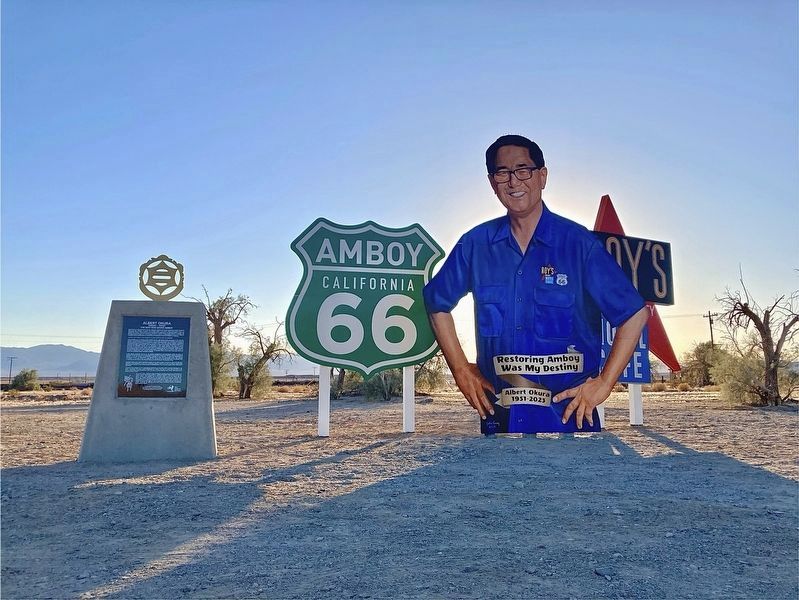
Photographed by Craig Baker, December 20, 2024
2. Albert Okura Marker
Longtime friend Danny Castro introduced Albert to the town of Amboy on Route 66, which was for sale. Believing it was necessary to seize the opportunity quickly, Albert purchased the town of Amboy from Bessie Burris ("Buster" Burris' widow) in 2005. He promised Bessie that he would restore Amboy and used his museum as evidence of his capability to be a responsible proprietor of the town. Despite criticism from many of his peers, colleagues, and family, Albert recognized that owning the town of Amboy was also part of his destiny. When asked about his decision to buy the town, he would respond with a smile, "Who else do you know that owns a town?"
To this day, Amboy stands as a relic of American history, reflecting its significance to Route 66. Established in 1883 as one of a series of railroad towns through the Mojave Desert, Amboy later became famous for Roy's Motel & Café. Roy Crowl and his son-in-law "Buster" Burris erected the famous 50-foot neon sign and "Googie-style" motel

Photographed by Craig Baker, December 20, 2024
3. Albert Okura Marker
Today, travelers from around the globe visit Amboy to gain a glimpse of the once-renowned town. Albert's efforts to realize the American dream and pursue his destiny continue to resonate even after his passing.
Plaque dedicated November 30, 2024 by the Okura family, Juan Pollo Restaurants, and the Billy Holcomb Chapter of the Ancient and Honorable Order of E Clampus Vitus.
Erected 2024 by the Okura family, Juan Pollo Restaurants, and E Clampus Vitus.
Topics and series. This historical marker is listed in these topic lists: Industry & Commerce • Settlements & Settlers. In addition, it is included in the E Clampus Vitus, and the U.S. Route 66 series lists.
Location. 34° 33.477′ N, 115° 44.761′ W. Marker is in Amboy, California, in San Bernardino County. It is on National Trails Highway (Route 66) near Amboy Road, on the right when traveling east. Touch for map. Marker is in this post office area: Amboy CA 92304, United
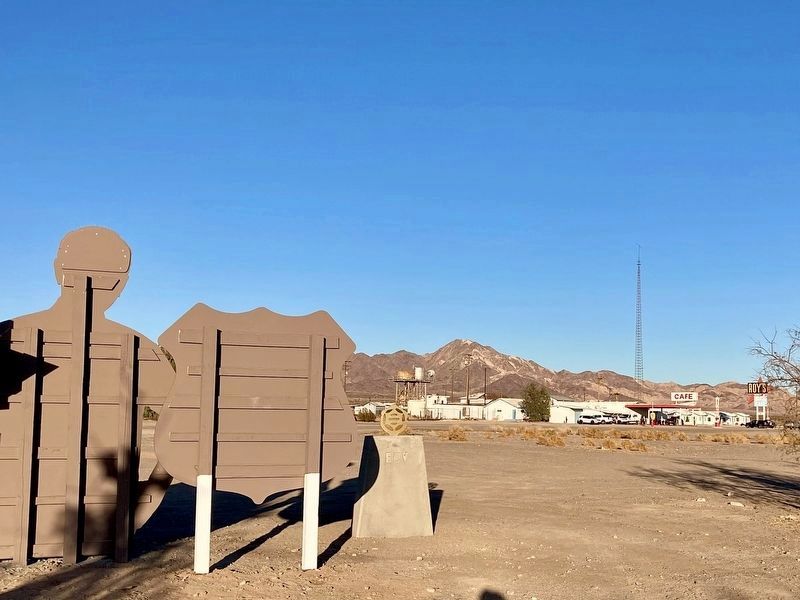
Photographed by Craig Baker, December 20, 2024
4. Albert Okura Marker - facing Amboy

Regionally, this marker is in Greater Los Angeles, in the Mojave Desert, in the Peninsular Ranges, and specifically in the Transverse Ranges. It is also in the American Southwest. Globally, it is in North America, on the Ring of Fire, on the Pacific Rim, in the Western Hemisphere, in the Western World, and in the Anglosphere. Historically, it finds itself in what was once New Spain and also Mexico’s Alta California.
Other nearby markers. At least 8 other markers are within 10 miles of this marker, measured as the crow flies: Amboy and Roy's Café (about 600 feet away, measured in a direct line); Trails and Rails Through the Mojave Desert (approx. 0.2 miles away); Route 66, Amboy, California (approx. 0.2 miles away); Saint Raymond's Church (approx. 0.2 miles away); Amboy Crater (approx. 1.9 miles away); a different marker also named Amboy Crater (approx. 2 miles away); Hallowed Ground (approx. 7.7 miles away); Road Runner’s Retreat (approx. 9.8 miles away). Touch for a list and map of all markers in Amboy.
Also see . . . Amboy - California’s Gold. In this half-hour
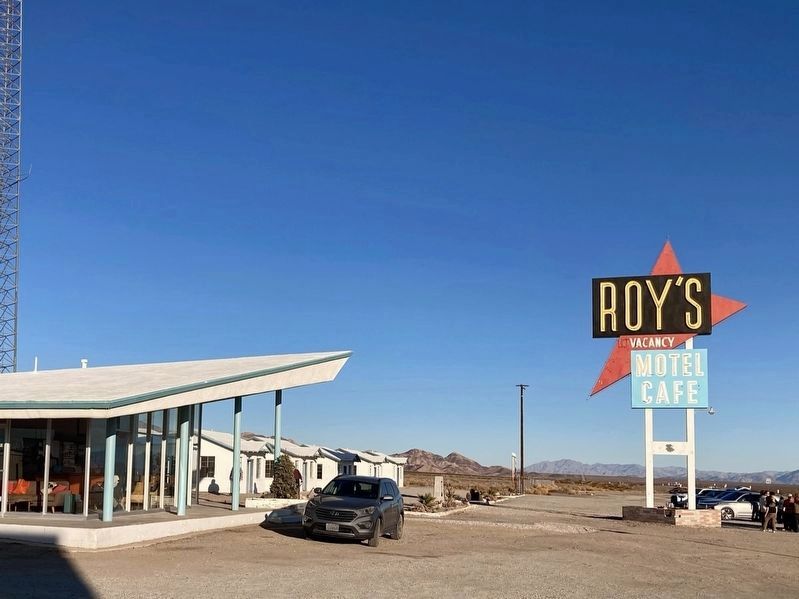
Photographed by Craig Baker, December 20, 2024
5. Amboy

Photographed by Craig Baker, December 20, 2024
6. Highway Pavement
Credits. This page was last revised on December 27, 2024. It was originally submitted on December 24, 2024, by Craig Baker of Sylmar, California. This page has been viewed 1,212 times since then and 267 times this year. Photos: 1, 2, 3, 4, 5, 6. submitted on December 24, 2024, by Craig Baker of Sylmar, California.
