
Breisach am Rhein in Breisgau-Hochschwarzwald, Baden-Württemberg, Germany — Central Europe
Stadtgeschichte & Breisachs Rheinbrücken
City History & Breisach’s Rhine Bridges
Photographed by Steve Stoessel, December 19, 2024
1. Stadtgeschichte/ Breisachs Rheinbrücken Marker
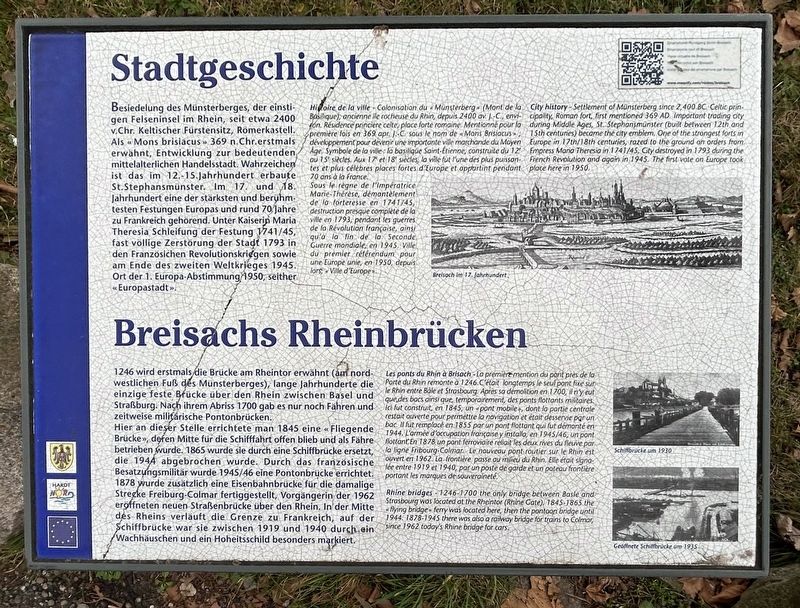
Besiedelung des Münsterberges, der einstigen Felseninsel im Rhein, seit etwa 2400 v.Chr. Keltischer Fürstensitz, Römerkastell. Als « Mons brisiacus» 369 n.Chr.erstmals erwähnt, Entwicklung zur bedeutenden mittelalterlichen Handelsstadt. Wahrzeichen ist das im 12.-15.Jahrhundert erbaute St.Stephansmünster. Im 17. und 18 Jahrhundert eine der stärksten und berühm. testen Festungen Europas und rund 70 Jahre zu Frankreich gehörend. Unter Kaiserin Maria Theresia Schleifung der Festung 1741/45, fast völlige Zerstörung der Stadt 1793 in den Französichen Revolutionskriegen sowie am Ende des zweiten Weltkrieges 1945. Ort der 1. Europa-Abstimmung 1950, seither «Europastadt».
Hipoire de la ville - Colonisation du « Münsterberg » (Mont de la Basilique), ancienne ile rocheuse du Rhin, depuis 2400 av. J.-C, envicon. Résidence princiere celte, place forte romaine. Mentionné pour la première fois en 369 apr. J.-C. sous le nom de «Mons Brisíacus»; développement pour devenir une importante ville marchande du Moyen Age. Symbole de la ville; la basilique Saint-Étienne, construite du 12e au 15e siècles. Aux 17 et 18e siecles, la ville fut
this page online
City history - Settlement of Münsterberg since 2,400 BC. Celtic principality, Roman fort, first mentioned 369 AD. Important trading city during Middle Ages. St. Stephansmunster (built between 12th and 15th centuries) become the city emblem. One of the strongest forts in Europe in 17th-18th centuries, razed to the ground on orders from Empress Maria Theresia in 1741-45, City destroyed in 1793 during the French Revolution and again in 1945. The first vote on Europe took place here in 1950.
[Unoffical English translation]
Settlement of the Münsterberg, the former rocky island in the Rhine, since around 2400 BC. Celtic princely seat, Roman fort. First mentioned as "Mons brisiacus" in 369 AD, Breisach
Photographed by Steve Stoessel, December 19, 2024
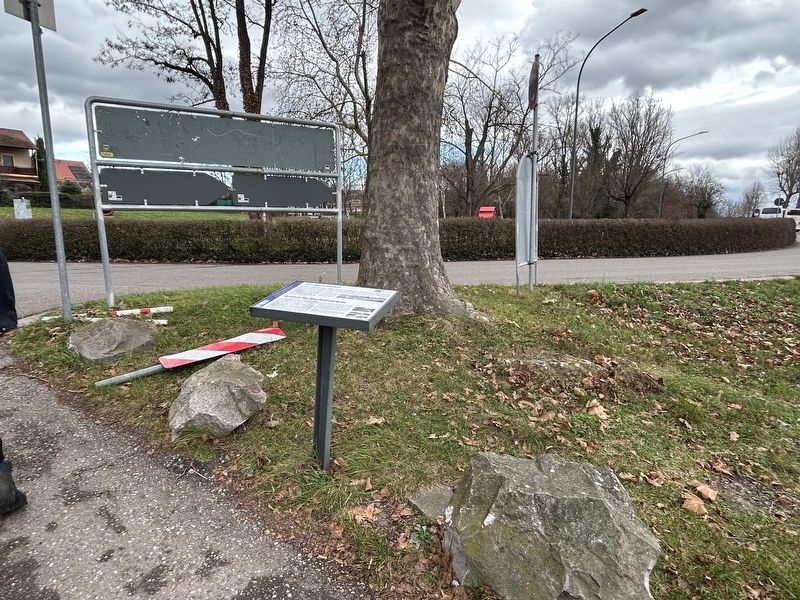
2. Stadtgeschichte/ Breisachs Rheinbrücken Marker
[Photo Caption:]
Breisach im 17.Jahrhundert
Breisach in the 1700s.
Breisachs Rheinbrücken
1246 wird erstmals die Brücke am Rheintor erwähnt (am nord westlichen Fuß des Münsterberges), lange Jahrhunderte die einzige feste Brücke über den Rhein zwischen Basel und Straßburg. Nach ihrem Abriss 1700 gab es nur noch Fähren und zeitweise militärische Pontonbrücken.
Hier an dieser Stelle errichtete man 1845 eine « Fliegende Brücke», defen Mitte für die Schifffahrt offen blieb und als Fähre betrieben wurde. 1865 wurde sie durch eine Schiffbrücke ersetzt, die 1944 abgebrochen wurde. Durch das französische Besatzungsmilitär wurde 1945/46 eine Pontonbrücke errichtet. 1878 wurde zusätzlich eine Eisenbahnbrücke für die damalige Strecke Freiburg-Colmar fertiggestellt, Vorgängerin der 1962 eröffneten neuen Straßenbrücke über den Rhein. In der Mitte des Rheins verläuft die Grenze zu Frankreich, auf der Schiffbrücke war sie zwischen 1919 und 1940 durch ein Wachhäuschen und ein Hoheitsschild besonders markiert.
Les ponts du Rhin à Brisach - La premiere mention du pont près de la Porte du Rhin remonte à 1246. Clétait longtemps le seul pont fixe sur le Rhin entre Bâle et Strasbourg. Après sa démolition en 1700, il n'y eut que des bacs ainsi que, temporairement, des ponts flottants militaires. Ici fut construit, en 1845, un «pont mobile», dont la partie centrale restait ouverte pour permettre la navigation et était desservie par un bac. Il fut remplacé en 1855 par un pont flottant qui fut démonté en 1944. L'armée d'occupation française y installo, en 1945/46, un pont flottant. En 1878 un pont ferroviaire reliait les deux rives du fleuve par la ligne Fribourg-Colman. Le nouveau pont routier sur le Rhin est ouvert en 1962. La frontière passe au milieu du Rhin, Elle était signalée entre 1919 et 1940, par un poste de garde et un poteau frontière portant les marques de souverainete.
Rhine bridges - 1246-1700 the only bridge between Basle and Strasbourg was located at the Rheintor (Rhine Gate). 1845-1865 the “flying bridge” ferry was located here, then the pontoon bridge until 1944. 1878-1945 there was also a railway bridge for trains to Colmar. Since 1962, today's Rhine bridge for cars.
[Unofficial English translation of the German account]
The bridge at the Rhine Gate (at the north-western foot of the Münsterberg) was first mentioned in 1246. For many centuries it was the only permanent bridge over the Rhine between Basel and Strasbourg. After it was demolished in 1700, there were only ferries and, at times, military pontoon bridges. A "flying bridge" was built here in 1845, the middle of which opened for shipping and was used as a ferry. In 1865 it was replaced by a pontoon bridge, which was demolished in 1944. A pontoon bridge was built by the French occupying forces in 1945-46. In 1878, a railway bridge was also completed for the Freiburg-Colmar route. At the time, the predecessor of the new road bridge over the Rhine that opened in 1962. The border with France runs through the middle of the Rhine, and between 1919 and 1940, it was specially marked on the pontoon bridge by a guardhouse and a national shield.
[Photo Captions:] Schiffbrucke um 1930
Pontoon Bridge around 1930
Geöffnete Schiffbrücke um 1935
Opened pontoon bridge around 1935.
Topics. This historical marker is listed in these topic lists: Bridges & Viaducts • Settlements & Settlers.
Location. 48° 1.613′ N, 7° 34.7′ E. Marker is in Breisach am Rhein, Baden-Württemberg, in Breisgau-Hochschwarzwald. It is on Rheinuferstraße 0.1 kilometers south of Josef Bueb Strasse, on the right when traveling north. Touch for map. Marker is in this post office area: Breisach am Rhein BW 79206, Germany. Touch for directions.

Regionally, it is in Europe, the European Union, Atlantic Europe, Central Europe, the Schengen Area, Western Europe, and the Western World. Historically, it finds itself in what was once the Roman Empire and specifically also the Holy Roman Empire.
Other nearby markers. At least 8 other markers are within walking distance of this marker: Martin-Schongauer-Gymnasium (approx. 0.3 kilometers away); Old City Wall (approx. 0.3 kilometers away); Ehemalige Spitalkirche St. Martin / Former Hospital Church (approx. 0.3 kilometers away); Zum Rheinischen Hof (approx. 0.4 kilometers away); Eckartsberg (approx. 0.4 kilometers away); Eckartberg Obelisk (approx. 0.4 kilometers away); Kurmärkischen Dragone (approx. 0.4 kilometers away); Der Eckartsberg im 17. Jahrhundert (approx. 0.4 kilometers away). Touch for a list and map of all markers in Breisach am Rhein.
Also see . . . Breisach (Wikipedia). (Submitted on December 28, 2024, by Steve Stoessel of Niskayuna, New York.)
Credits. This page was last revised on December 29, 2024. It was originally submitted on December 26, 2024, by Steve Stoessel of Niskayuna, New York. This page has been viewed 178 times since then and 46 times this year. Photos: 1, 2. submitted on December 26, 2024, by Steve Stoessel of Niskayuna, New York.
