Princeton in Mercer County, New Jersey — The American Northeast (Mid-Atlantic)
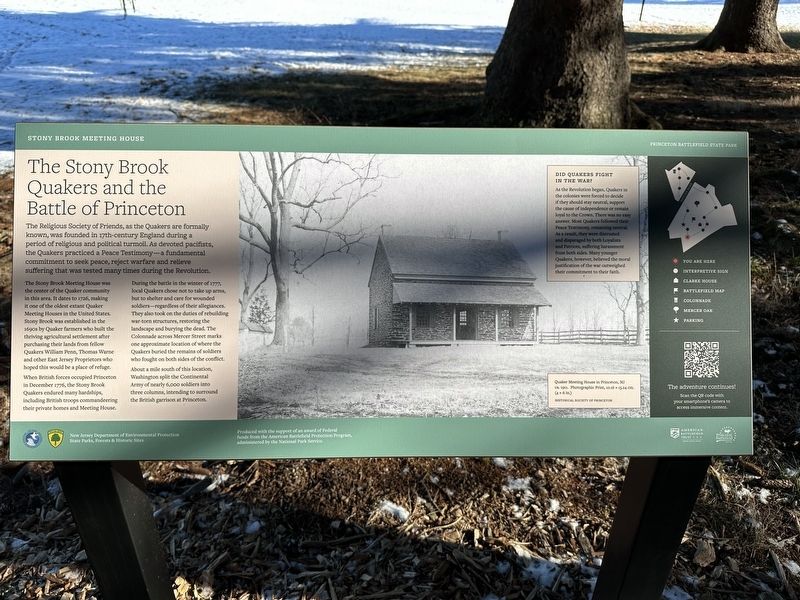
The Stony Brook Quakers and the Battle of Princeton
Stony Brook Meeting House
| — | Princeton Battlefield State Park | — |
Photographed by Pete Skillman, December 23, 2024
1. The Stony Brook Quakers and the Battle of Princeton Marker
The Stony Brook Meeting House was the center of the Quaker community in this area. It dates to 1726, making it one of the oldest extant Quaker Meeting Houses in the United States. Stony Brook was established in the 1690s by Quaker farmers who built the thriving agricultural settlement after purchasing their lands from fellow Quakers William Penn, Thomas Warne, and other East Jersey Proprietors who hoped this would be a place of refuge.
When British forces occupied Princeton in December 1776, the Stony Brook Quakers endured many hardships, including British troops, common during their private homes and Meeting House.
During the battle in the winter of 1777, local Quakers chose not to take up arms, but to shelter and care for wounded soldiers - regardless of their allegiances.
this page online
About a mile south of this location, Washington split the Continental Army of nearly 6,000 soldiers into three columns, intending to surround the British garrison at Princeton.
Did Quakers Fight in the War?
As the Revolution began, Quakers in the colonies, were forced to decide if they should stay neutral, support the cause of independence or remain loyal to the Crown. There was no easy answer. Most Quakers followed their Peace Testimony, remaining neutral. As a result, they were distrusted and disparaged by both Loyalists and Patriots, suffering harassment from both sides. Many younger Quakers, however, believed the moral justification of the war outweighed their commitment to their faith.
Produced with the support of an award of Federal funds from the American Battlefield Protection Program, administered by the National Park Service.
[Caption]:
Quaker Meeting
Photographed by Pete Skillman, December 23, 2024
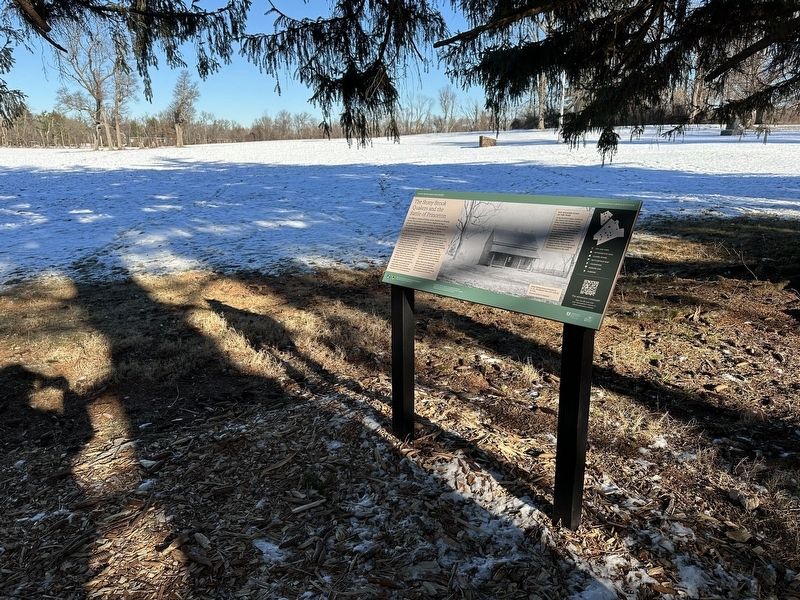
2. The Stony Brook Quakers and the Battle of Princeton Marker - wide view
Historical Society of Princeton
Erected 2024 by American Battlefield Trust and Princeton Battlefield State Park.
Topics and series. This historical marker is listed in these topic lists: Religion & Religious Structures • Settlements & Settlers • War, US Revolutionary. In addition, it is included in the Former U.S. Presidents: #01 George Washington series list. A significant historical year for this entry is 1726.
Location. 40° 19.762′ N, 74° 40.551′ W. Marker is in Princeton, New Jersey, in Mercer County. It can be reached from Mercer Road. Touch for map. Marker is at or near this postal address: 506 Mercer Rd, Princeton NJ 08540, United States of America. Touch for directions.

Regionally, this marker is in Central Jersey. It is also in the American Northeast and in the Mid-Atlantic. Globally, it is in North America, the Western Hemisphere, the Western World, and the Anglosphere. Historically, it finds itself in what was once New Netherland and also one of the original Thirteen Colonies.
Other nearby markers. At least 8 other markers are within walking distance of this marker: Ten Crucial Days (a few steps from this marker); Bystander to Battle (a few steps from this marker); General Hugh Mercer (within shouting distance of this marker); Moulder’s Battery Holds the Line (about 400 feet away, measured in a direct line); The Legacy of the Battle of Princeton (about 500 feet away); Welcome to the Institute Lands (about 700 feet away); Route of Washington’s March (about 800 feet away); The Mercer Oak (approx. 0.2 miles away). Touch for a list and map of all markers in Princeton.
Other markers no longer nearby. The British Occupation of New Jersey (was a few steps from this marker but has been permanently removed); From Trenton to Princeton (was within shouting distance of this marker but has been permanently removed); Thomas Clarke House (was within shouting distance of this marker but has been permanently removed); Site of Moulder’s Battery (was about 400 feet away but has been permanently removed).
Also see . . . The Liberty Trail - Princeton. This is the link from the QR code on the marker. It links to a site hosted by the American Battlefield Trust that has additional resources about the battle. (Submitted on December 26, 2024, by Pete Skillman of Wilmington, Delaware.)
Credits. This page was last revised on December 26, 2024. It was originally submitted on December 26, 2024, by Pete Skillman of Wilmington, Delaware. This page has been viewed 580 times since then and 70 times this year. Photos: 1, 2. submitted on December 26, 2024, by Pete Skillman of Wilmington, Delaware.
