Macon in Bibb County, Georgia — The American South (South Atlantic)
Poplar Street Slave Trading Markets
Photographed by J. Makali Bruton, December 20, 2024
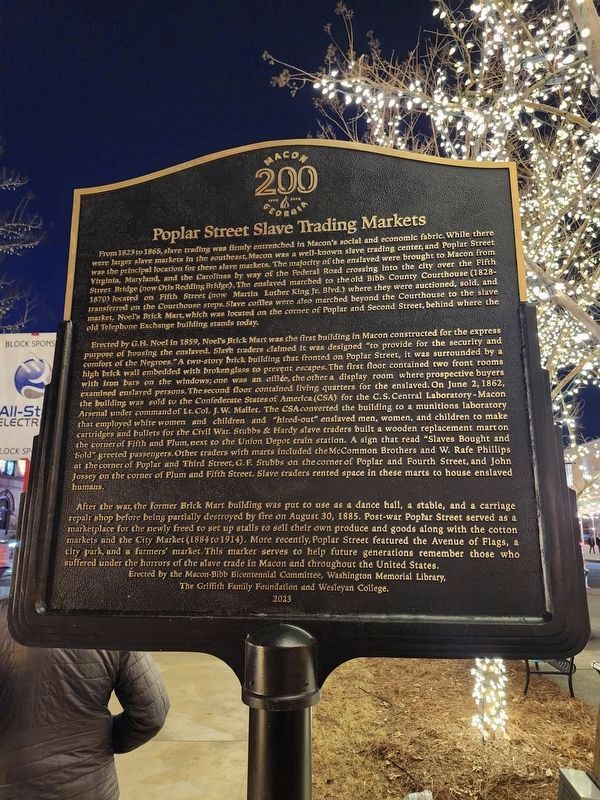
1. Poplar Street Slave Trading Markets Marker
From 1823 to 1865, slave trading was firmly entrenched in Macon's social and economic fabric. While there were larger slave markets in the southeast, Macon was a well-known slave trading center, and Poplar Street was the principal location for these slave markets. The majority of the enslaved were brought to Macon from Virginia, Maryland, and the Carolinas by way of the Federal Road crossing into the city over the Fifth Street Bridge (now Otis Redding Bridge). The enslaved marched to the old Bibb County Courthouse (1828-1870) located on Fifth Street (now Martin Luther King Jr. Blvd.) where they were auctioned, sold, and transferred on the Courthouse steps. Slave coffles were also marched beyond the Courthouse to the slave market, Noel's Brick Mart, which was located on the corner of Poplar and Second Street, behind where the old Telephone Exchange building stands today.
Erected by G.H. Noel in 1859, Noel's Brick Mart was the first building in Macon constructed for the express purpose of housing the enslaved. Slave traders claimed it was designed "to provide for the security and comfort of the Negroes."A two-story brick
this page online
Photographed by J. Makali Bruton, December 20, 2024
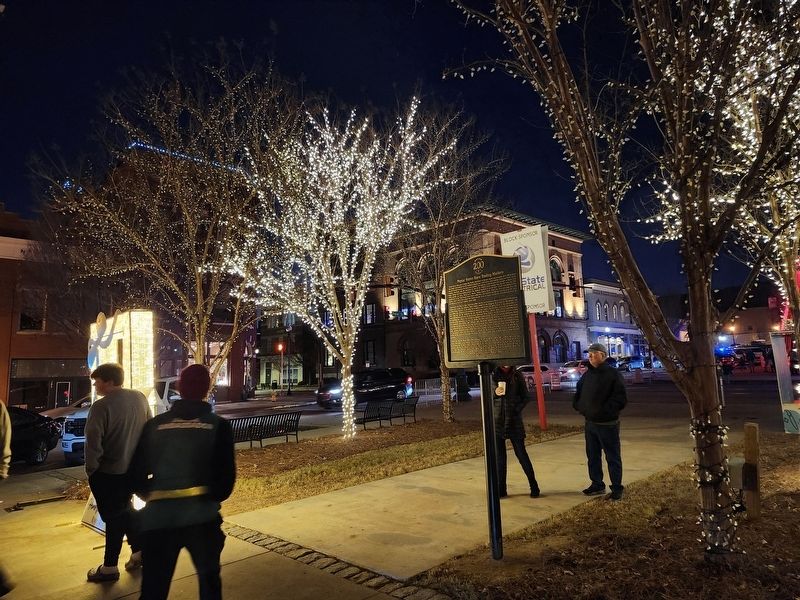
2. Poplar Street Slave Trading Markets Marker
After the war, the former Brick Mart building was put to use as a dance hall, a stable, and a carriage repair shop before being partially destroyed by fire on August 30, 1885. Post-war Poplar Street served as a marketplace for the newly freed to set up stalls to sell their own produce and goods along with the cotton markets and the City Market (1884 to 1914). More recently, Poplar Street featured the Avenue of Flags, a city park, and a farmers' market. This marker serves to help future generations remember those who suffered under the horrors of the slave trade in Macon and throughout the United States.
Erected 2023 by Erected by the Macon-Bibb Bicentennial Committee, Washington Memorial Library, The Griffith Family Foundation and Wesleyan College.
Topics. This historical marker is listed in this topic list: African Americans. A significant historical date for this entry is June 2, 1862.
Location. 32° 50.112′ N, 83° 37.8′ W. Marker is in Macon, Georgia, in Bibb County. It is at the intersection of Poplar Street and 2nd Street, in the median on Poplar Street. Touch for map. Marker is at or near this postal address: 523 Poplar St, Macon GA 31201, United States of America. Touch for directions.

Regionally, this marker is in Georgia’s Piedmont. It is also in the American South and specifically in the Deep South. Globally, it is in North America, the Western Hemisphere, the Western World, and the Anglosphere. Historically, it finds itself in what was once the territory of the Mississippian Culture, one of the original Thirteen Colonies, one of the Confederate States of America, and the Antebellum South.
Other nearby markers. At least 8 other markers are within walking distance of this marker: Grant's Lounge (within shouting distance of this marker); Elizabeth Reed Music Hall (about 700 feet away, measured in a direct line); Rookery (about 700 feet away); Rosa Louise Parks (about 700 feet away); Medal of Honor (about 700 feet away); Macon and Bibb County Veterans Memorial (about 700 feet away); City Auditorium (about 800 feet away); Macon City Hall (about 800 feet away). Touch for a list and map of all markers in Macon.
Credits. This page was last revised on December 26, 2024. It was originally submitted on December 26, 2024, by J. Makali Bruton of Washington, District of Columbia. This page has been viewed 940 times since then and 217 times this year. Photos: 1, 2. submitted on December 26, 2024, by J. Makali Bruton of Washington, District of Columbia.
