Bad Homburg vor der Höhe in Hochtaunuskreis, Hesse, Germany — Central Europe
Ehemaliges Armen- und Waisenhaus
⎯⎯⎯
Former Poorhouse and Orphanage
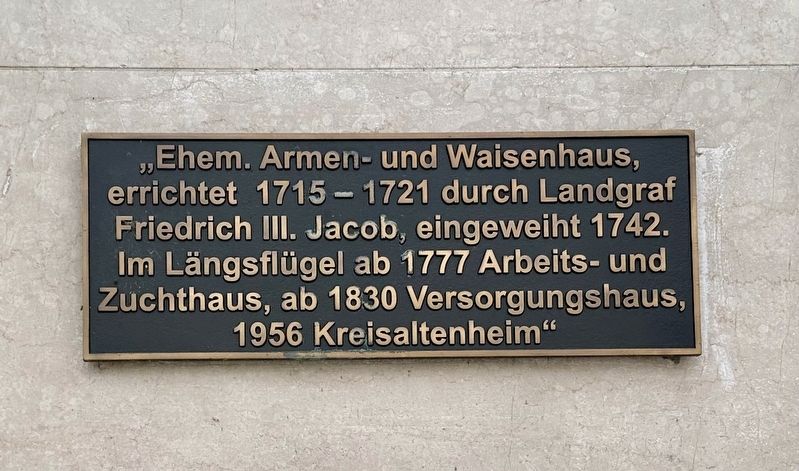
Photographed by Andrew Ruppenstein, May 22, 2024
1. Ehemaliges Armen- und Waisenhaus / Former Poorhouse and Orphanage Marker

Erected 2021 by Stadt Bad Homburg.
Topics. This historical marker is listed in this topic list: Charity & Public Work. A significant historical year for this entry is 1742.
Location. 50° 13.628′ N, 8° 36.906′ E. Marker is in Bad Homburg vor der Höhe, Hessen (Hesse), in Hochtaunuskreis. It is at the intersection of Waisenhausstraße and Waisenhausplatz, on the left when traveling south on Waisenhausstraße. Touch for map. Marker is at or near this postal address: Waisenhausstraße 1, Bad Homburg vor der Höhe HE 61348, Germany. Touch for directions.

Regionally, it is in Europe, the European Union, Atlantic Europe, Central Europe, the Schengen Area, Western Europe, and the Western World. Historically,
this page online
Other nearby markers. At least 8 other markers are within walking distance of this marker: Hofapotheke / Court Apothecary (within shouting distance of this marker); Bad Homburg Franco-Prussian War Memorial (within shouting distance of this marker); Ehemalige Kaiserliche Post / Former Imperial Post Office (about 150 meters away, measured in a direct line); Hotel “Cafe du Parc” (about 180 meters away); François Blanc (approx. 0.2 kilometers away); Engelapotheke / “Angel Apothecary” (approx. 0.3 kilometers away); Ehemalige Gustav-Weigand-Stiftung / Former Gustav Weigand Foundation (approx. 0.4 kilometers away); Bad Homburg vor der Höhe Holocaust Memorial (approx. 0.4 kilometers away). Touch for a list and map of all markers in Bad Homburg vor der Höhe.
Also see . . . Eine Bronzetafel erinnert an das ehemalige Waisenhaus (Taunus Nachrichten, June 9, 2021). Local newspaper article in German, on the dedication of the marker and the history of the orphanage. Excerpt (in translation):
Three full orphans, one half orphan and(Submitted on December 27, 2024.)an illegitimate child: these were the first children to move into the "poorhouse/workhouse and orphanage" built in 1721 on what is now Waisenhausplatz in Bad Homburg's city center. Six years previously, Landgrave Friedrich III Jacob of Hesse-Homburg had purchased a plot of land near the Landgrave's seat of government in Homburg in order to offer orphans a home in the spirit of care and Christian charity.Photographed by Andrew Ruppenstein, May 22, 20242. Ehemaliges Armen- und Waisenhaus / Former Poorhouse and Orphanage Marker - wide viewThe marker is visible here on the corner of the bank building.
The Landgrave's Foundation from 1721 still exists today. Having moved to the outskirts of the city on Bommersheimer Weg in 1968, the child and youth welfare facility still cares for young people in need from difficult social backgrounds in its residential home according to Christian principles and the values of modern pedagogy. To mark its 300th anniversary, the city of Bad Homburg has now had a new bronze plaque installed on the corner of the former orphanage. City historian Professor Barbara Dölemeyer recalled the beginnings of the oldest Bad Homburg foundation still in existence today.
The multi-storey building on Waisenhausstrasse was completed in 1721 - but…the donations required for the operation from the citizens were slow to come. Johann, Johannes, Maria, Christina and Anna were the first children who could finally be taken in. "And Landgrave Friedrich III also used the house to curb begging and idleness in the population." A little later, the Landgrave's foundation was not only a home for orphans, but also a workhouse and penitentiary for minor criminals and those who were afraid of work - "which always caused trouble," according to Dölemeyer. The prayer room in the house was sometimes used as a prison, which was rather stressful for the orphans. But the Landgrave's wife, Christiane Charlotte, in particular, continued her late husband's social efforts after 1746 by founding the "Christianen Foundation" and thus ensured the financing of the orphanage. While the Landgrave had stipulated by statute that only Protestant children should be admitted, Catholic orphans soon came to the Landgrave's Foundation, "but were then confirmed as Protestants: tolerance did not go that far," said Barbara Dölemeyer. It was Landgrave Ludwig who first ensured that children and other "delinquents were physically separated." In Prussian times, the house also became a home for social orphans, i.e. illegitimate children, as well as for "poor people of both sexes." In 1853, the foundation returned to its original statute, and since then the Landgrave's Foundation has been there exclusively for children and young people. Barbara Dölemeyer also recalled curious events from the foundation's history, such as the purchase of a hearse in 1842, which the orphanage used to transport corpses from the funeral home to the cemetery in order to finance itself….

Credits. This page was last revised on December 27, 2024. It was originally submitted on December 27, 2024, by Andrew Ruppenstein of Lamorinda, California. This page has been viewed 187 times since then and 31 times this year. Photos: 1, 2. submitted on December 27, 2024, by Andrew Ruppenstein of Lamorinda, California.
