
Ponca City in Kay County, Oklahoma — The American South (West South Central)
Barnes Store
Photographed by Cosmos Mariner, September 10, 2024
1. Barnes Store Marker
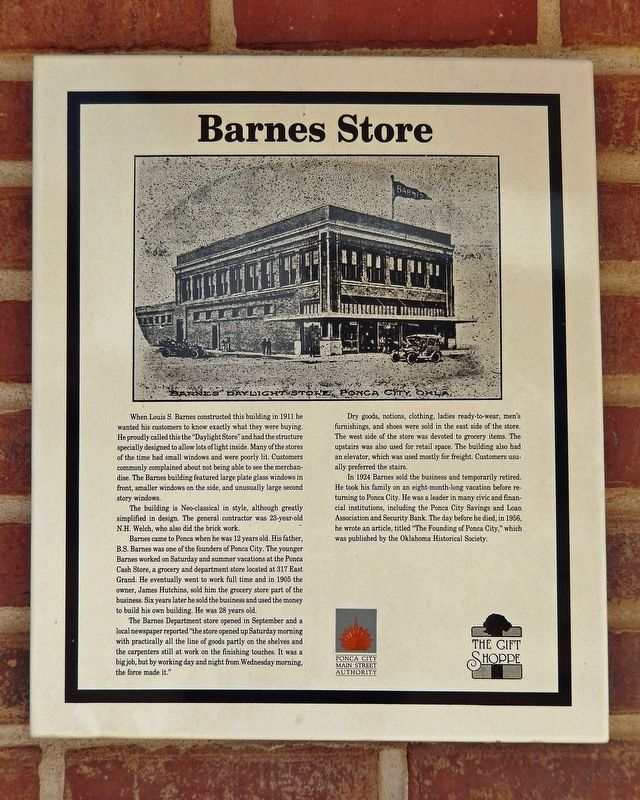
When Louis S. Barnes constructed this building in 1911 he wanted his customers to know exactly what they were buying. He proudly called this the "Daylight Store" and had the structure specially designed to allow lots of light inside. Many of the stores of the time had small windows and were poorly lit. Customers commonly complained about not being able to see the merchandise. The Barnes building featured large plate glass windows in front, smaller windows on the side, and unusually large second story windows.
The building is Neo-classical in style, although greatly simplified in design. The general contractor was 23-year-old N.H. Welch, who also did the brick work.
Barnes came to Ponca when he was 12 years old. His father, B.S. Barnes was one of the founders of Ponca City. The younger Barnes worked on Saturday and summer vacations at the Ponca Cash Store, a grocery and department store located at 317 East Grand. He eventually went to work full time and in 1905 the owner, James Hutchins, sold him the grocery store part of the business. Six years later he sold the business and used the money to build his own building. He
this page online
The Barnes Department store opened in September and a local newspaper reported “the store opened up Saturday morning with practically all the line of goods partly on the shelves and the carpenters still at work on the finishing touches. It was a big job, but by working day and night from Wednesday morning, the force made it.”
Dry goods, notions, clothing, ladies ready-to-wear, men's furnishings, and shoes were sold in the east side of the store. The west side of the store was devoted to grocery items. The upstairs was also used for retail space. The building also had an elevator, which was used mostly for freight. Customers usually preferred the stairs.
In 1924 Barnes sold the business and temporarily retired. He took his family on an eight-month-long vacation before returning to Ponca City. He was a leader in many civic and financial institutions, including the Ponca City Savings and Loan Association and Security Bank. The day before he died, in 1956, he wrote an article, titled “The Founding of Ponca City,” which was published by the Oklahoma Historical Society.
Erected by Ponca City Main Street Authority.
Topics and series.

Photographed by Cosmos Mariner, September 10, 2024
2. Barnes Store Marker
The marker is mounted on the left/southwest corner of the building.
Location. 36° 42.226′ N, 97° 4.865′ W. Marker is in Ponca City, Oklahoma, in Kay County. It is at the intersection of Grand Avenue East and North 3rd Street, on the right when traveling west on Grand Avenue East. The marker is mounted at eye-level on the southwest corner of the subject building, facing Grand Avenue. Touch for map. Marker is at or near this postal address: 301 Grand Avenue East, Ponca City OK 74601, United States of America. Touch for directions.

Regionally, this marker is in the American South, specifically on the prairies, and on the Southern Plains. Globally, it is in North America, the Western Hemisphere, the Western World, and the Anglosphere. Historically, it finds itself in what was once the territory of the Mississippian Culture, the Louisiana Purchase, and Cherokee Outlet.
Other nearby markers. At least 8 other markers are within walking distance

Photographed by Cosmos Mariner, September 10, 2024
3. Barnes Store Building (south/front elevation)
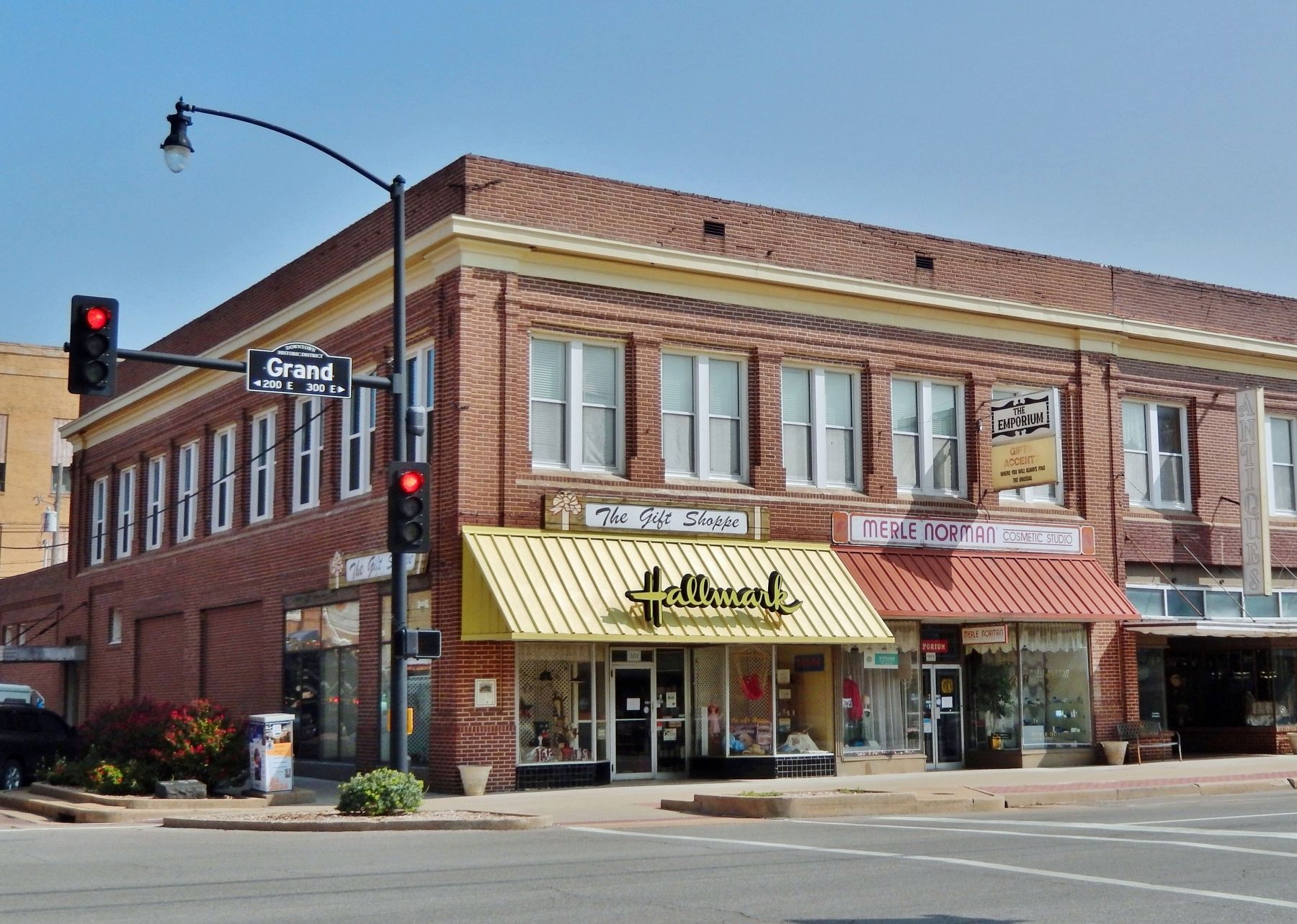
Regarding Barnes Store. Contributing property, Downtown Ponca City Historic District, National Register of Historic Places № 10001010.
From the National Register Nomination prepared by Kelli E. Gaston, June 2010:
The buildings in the Ponca City Downtown Historic District reflect the commercial growth of this community, growth spurred by farming and the discovery of oil and natural gas reserves in the area. The district comprises the historic core of downtown development and is centered along Grand Avenue. Overall, the district retains much of its historic character with relatively few modern intrusions.Barnes Building, 301 Grand Avenue East, 1911, Solomon Andrew Layton, architect.
Twostory Classical Revival corner brick building with two storefronts. The left (west) storefront features a recessed central entry. The entry consists of a single, metal framed glazed slab door with transom and two paned sidelights. A single display window angles back from each side of the entry to the street and there is a single metal display window along the street to each side of the entry. These windows rest on a tile clad knee wall. A shed roof style, standing seam metal awning spans the storefront. The storefront on the right (east) side of the building features a central recessed entry. The entry consists of double, metal framed glazed slab door with transom. A single display window angles out to the street from the entry on each side. An additional larger metal display window is located on each side of the entry along the street. These windows rest on a stucco clad knee wall. A shed roof style, standing seam metal awning spans the storefront. Second floor fenestration consists of five pairs of one over one windows. These windows have brick sills and elaborate brickwork between each pair of windows that creates the illusion of brick columns. The building has an elaborate cast stone cornice.Photographed by Cosmos Mariner, September 10, 20244. Barnes Store Building (southwest elevation)
Related markers. Click here for a list of markers that are related to this marker.
Also see . . . The Founding of Ponca City (Chronicles of Oklahoma).
Louis Seymour Barnes, the youngest son of Burton Seymour Barnes, the founder of Ponca City, was nine years old at the time of the opening of the Cherokee Strip. He came to Ponca City a few months later with his family and was a prominent citizen and leader in civic and financial affairs there all of his life. He wrote this article for The Chronicles on Saturday, November 10, 1956. He died the next morning on November 11, 1956.(Submitted on December 28, 2024, by Cosmos Mariner of Cape Canaveral, Florida.)Excerpt: Burton Seymour Barnes, my father, had been in the furniture business in Adrian, Michigan, but the depression of 1892 caused him to sell that business, and he was interested in finding a new venture. He read of the opening of the Cherokee Strip and in June 1893 went to Arkansas City to look over the new land. It was his idea to found a city. The more he thought of it, the more he became imbued with the idea. He bought a surrey and two fine black horses to drive over the Strip to find the best place to establish the city…
Credits. This page was last revised on December 28, 2024. It was originally submitted on December 28, 2024, by Cosmos Mariner of Cape Canaveral, Florida. This page has been viewed 187 times since then and 30 times this year. Photos: 1, 2, 3, 4. submitted on December 28, 2024, by Cosmos Mariner of Cape Canaveral, Florida.
