Stoney Creek in Hamilton, Ontario — Central Canada (North America)
The Turning Point - June 6th, 1813

Photographed by Tim Boyd, December 27, 2024
1. The Turning Point - June 6th, 1813 Marker
The Battle of Stoney Creek was about to be lost. The daring night-time raid had begun well, penetrating the perimeter of the American camp undetected, but was now close to collapse. The strategy of a bayonet-only assault on the American advance line floundered and the British troops, backlit by a line of campfires, came under heavy fire from the main American force posted along the ridge adjoining this knoll. Unit control broke down, many of the British broke and ran. The raid was about to become a reverse when Major Charles Plenderleath, commander of the 49th Regiment called for volunteers to rush the American artillery on this knoll, which had just been discharged.
The attack was fronted by Sergeant Alexander Fraser of the 49th who led about thirty men, including his brother Corporal Peter Fraser, in a wild bayonet charge directly into the mouths of the American guns, before they could be fired again. Alexander stabbed seven Americans and Peter four. Miraculously, this desperate action succeeded. The charge carried through the battery and scattered a line of infantry supporting the guns. In the ensuing melee the
this page online
The charge, initiated by Plenderleath and executed by Fraser, was the turning point in the battle. For their service at Stoney Creek, Fraser was promoted from the ranks, ending the war a lieutenant, Plenderleath was awarded a knighthood.
Erected 2014 by Hamilton Historical Board.
Topics. This historical marker is listed in this topic list: War of 1812. A significant historical date for this entry is June 6, 1813.
Location. 43° 13.107′ N, 79° 45.843′ W. Marker is in Hamilton, Ontario. It is in Stoney Creek. It is at the intersection of King Street West and Battlefield Drive, on the right when traveling west on King Street West. Touch for map. Marker is at or near this postal address: 70 King St West, Hamilton ON L8G 1H8, Canada. Touch for directions.

Regionally, this marker is on the Golden Horseshoe, in the Hamilton-Halton-Brant Area,

Photographed by Tim Boyd, December 27, 2024
2. The Turning Point - June 6th, 1813 Marker
Other nearby markers. At least 8 other markers are within walking distance of this marker: The Battle of Stoney Creek (a few steps from this marker); The Battlefield of Stoney Creek (within shouting distance of this marker); Battlefield House (about 180 meters away, measured in a direct line); a different marker also named Battle of Stoney Creek (about 210 meters away); Sara Galbraith Calder 1846-1914 (approx. 0.2 kilometers away); The Nash-Jackson House (approx. 0.2 kilometers away); Their Fame Liveth (approx. 0.3 kilometers away); a different marker also named Battle of Stoney Creek (approx. 0.3 kilometers away). Touch for a list and map of all markers in Hamilton.
Also see . . . Battle of Stoney Creek (Wikipedia).
Major Charles Plenderleath, commanding(Submitted on December 29, 2024, by Tim Boyd of Hamilton, Ontario.)the British 49th Regiment, was able to ascertain the position of the American artillery when two field guns fired in quick succession. Realising the importance of possession of the guns, he gathered troops of Fitzgibbon's and other nearby companies to charge the guns before they could reload. First to volunteer for what could be a suicidal attack were 23-year-old sergeant Alexander Fraser and his 21-year-old brother Peter, a corporal in Fitzgibbon's company, with 20 to 30 others. With bayonets fixed, Plenderleath led the charge up Gage's Lane, volunteers following at a run, all fearing that the next discharge from the cannons might annihilate them. However, the U.S. 2nd Artillery under the command of Captain Nathaniel Towson at that moment responded to an order to cease firing, unaware of the British troops advancing on their position. The gunners were without arms of their own. The British charged the field guns, and when they were within a few yards of the gun emplacement, the men began yelling "Come on, Brant". They set upon the helpless gunners, bayoneting man and horse, quickly overrunning and capturing the position before continuingPhotographed by Peter Rindlisbacher3. The Turning Point - June 6th, 1813 marker photo detailon to engage the U.S. 23rd Infantry which got off one round before the momentum of the 49th scattered them.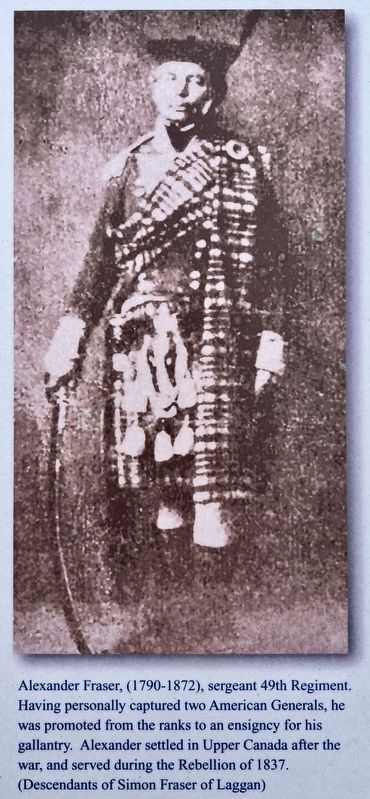 4. The Turning Point - June 6th, 1813 marker photo detail


Photographed by Tim Boyd, December 27, 2024
5. Battle of Stoney Creek Memorial
Credits. This page was last revised on December 31, 2024. It was originally submitted on December 29, 2024, by Tim Boyd of Hamilton, Ontario. This page has been viewed 232 times since then and 29 times this year. Photos: 1, 2, 3, 4, 5. submitted on December 29, 2024, by Tim Boyd of Hamilton, Ontario. • Andrew Ruppenstein was the editor who published this page.
