Old Arkansas City High School
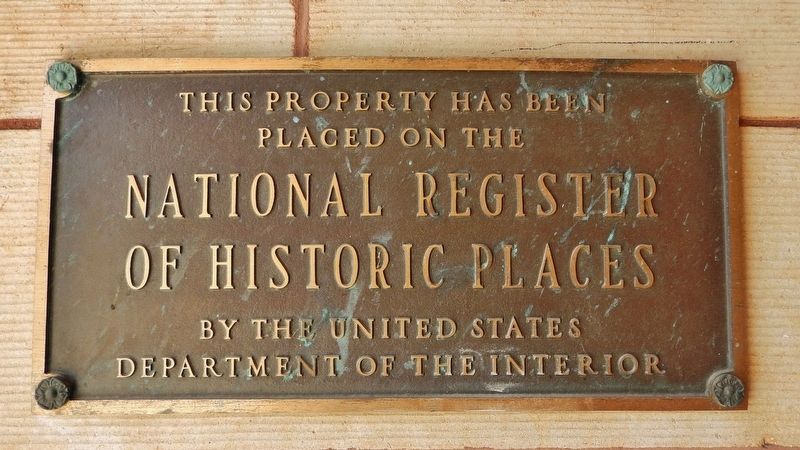
placed on the
National Register
of Historic Places
by the United States
Department of the Interior
Topics and series. This historical marker is listed in these topic lists: Architecture • Education • Notable Buildings. In addition, it is included in the National Register of Historic Places (NRHP) series list. A significant historical date for this entry is July 10, 1890.
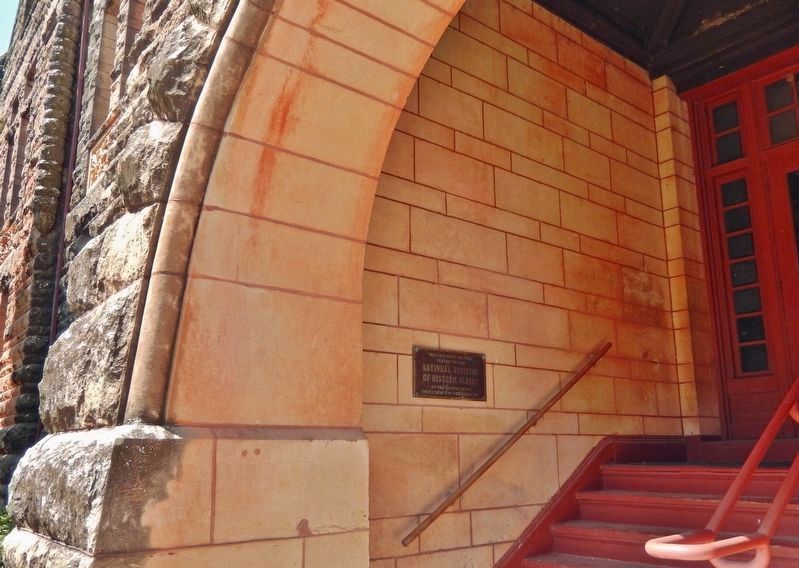
Location. 37° 3.754′ N, 97° 2.514′ W. Marker is in Arkansas City, Kansas, in Cowley County. It is at the intersection of West Central Avenue and North 2nd Street, on the left when traveling east on West Central Avenue. The marker is mounted at eye-level near the south/front entrance of the subject building. Touch for map. Marker is at or near this postal address: 300 West Central Avenue, Arkansas City KS 67005, United States of America. Touch for directions.

Regionally, this marker is in Eastern Kansas and in Greater Wichita. It is also in the American Midwest, in the Corn Belt, on the prairies, and on the Southern Plains. Globally, it is in North America, the Western Hemisphere, the Western World, and the Anglosphere. Historically,
this page online
Other nearby markers. At least 8 other markers are within walking distance of this marker: To Honor Heroes (about 500 feet away, measured in a direct line); Bicentennial Time Capsule (about 600 feet away); Public Library (about 700 feet away); Dedicated to the Heroes of United Flight #93 on Sept. 11, 2001 (approx. half a mile away); Santa Fe Locomotive Engine No. 2542 (approx. half a mile away); Korean War Liberty Tree Memorial (approx. half a mile away); 1996 Olympic Torch Relay (approx. half a mile away); Robert Docking (approx. 0.6 miles away). Touch for a list and map of all markers in Arkansas City.
Regarding Old Arkansas City High School. National Register of Historic Places № 74000824.
From the National Register Nomination prepared by Richard D. Pankratz, Kansas State Historical Society, 8/14/1974:
The contractor for the project was Robert Saird, a well-known area builder from nearby Hackney. One stone mason who worked on the building was Joseph Bossi, native of Milan, Italy, who had settled on a farm southeast of Arkansas City in 1871. Hisneighbor Antonio Buzzi, a native of Switzerland, was also a stone mason and the two had worked together on many local buildings. It is possible that Buzzi too worked on the high school.Photographed by Cosmos Mariner, September 9, 20242. Old Arkansas City High School MarkerThe marker is mounted just inside the front/south entrance alcove.
The Arkansas City High School was first used by students in the 1891-1892 term. The final cost was close to $38,000. Robert Baird, the contractor, reportedly went broke on this job and returned to farming; his expected profits were lost when he had to have the stone used in the basement recut and dressed the same as the outside walls.
The old Arkansas City High School is an outstanding example of the stonecutter's art. The fine detail and workmanship evident on the exterior make it one of the city's architectural landmarks. The building is also significant to the educational development of Arkansas City, having served the community since 1890.
Also see . . . Old Arkansas City High School (Wikipedia).
Excerpt: The Old Arkansas City High School, now known as Ireland Hall and part of the Cowley Community College campus, was listed on the National Register of Historic Places in 1974. Construction began on July 10, 1890, and it was occupied(Submitted on January 2, 2025, by Cosmos Mariner of Cape Canaveral, Florida.)beginning September 7, 1892, with all work done by 1893. In 1922 the high school moved to a new building, and so it served as a sixth-grade center until elementary schools absorbed the sixth grade in 1941. Cowley Community College took possession of the building in 1971. The building was renovated by the college in 1982 and renamed Ireland Hall.Photographed by Cosmos Mariner, September 9, 20243. W.H. “Pat” Ireland Memorial
(Ireland Hall namesake)(also mounted in the entrance alcove)
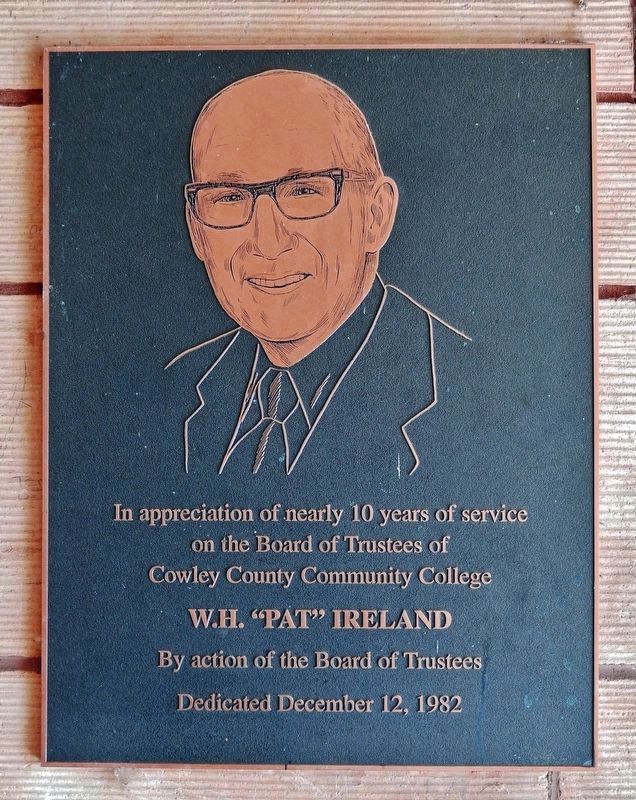
In appreciation of nearly 10 years of service
on the Board of Trustees of
Cowley County Community College
W.H. “Pat” Ireland
By action of the Board of Trustees
Dedicated December 12, 1982
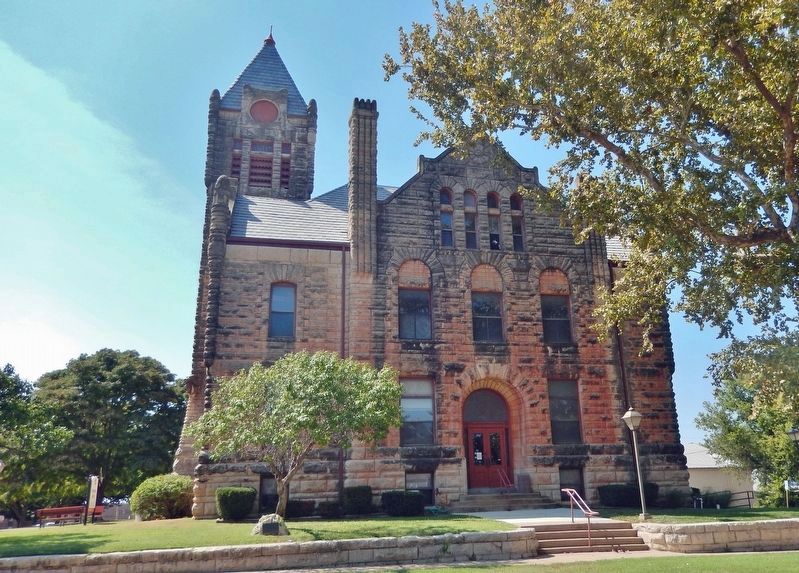
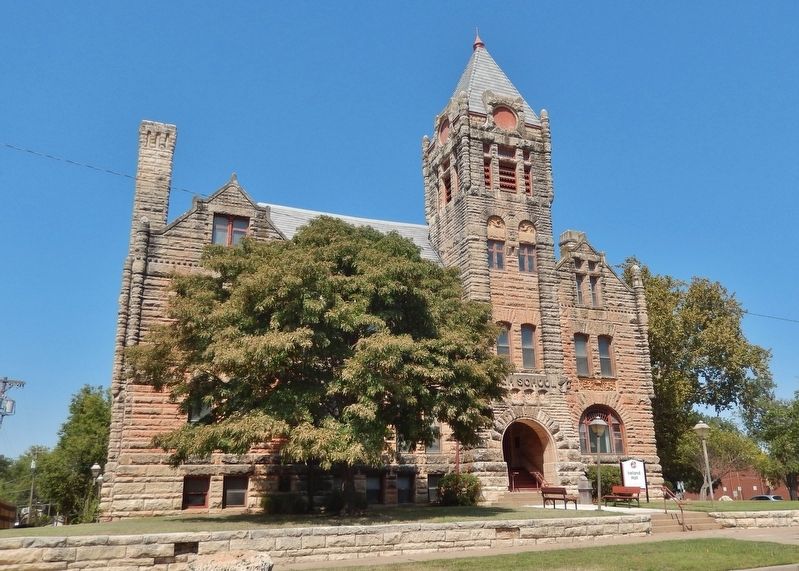
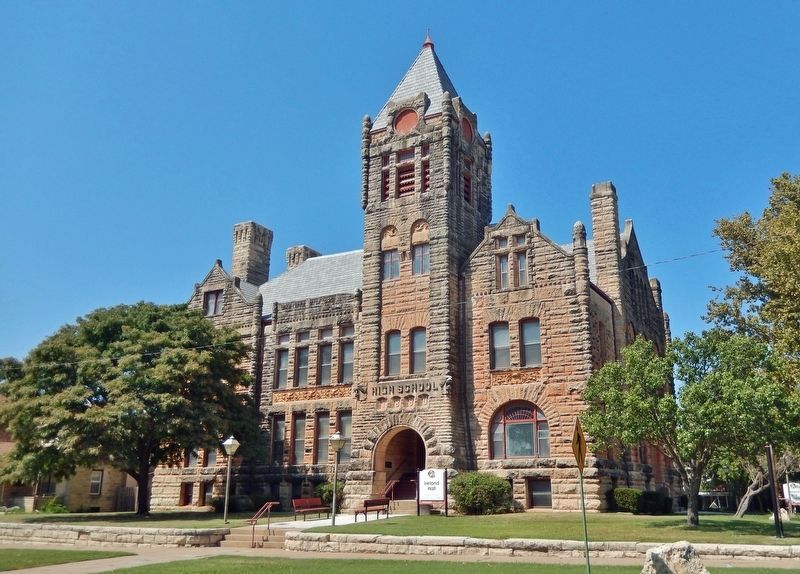
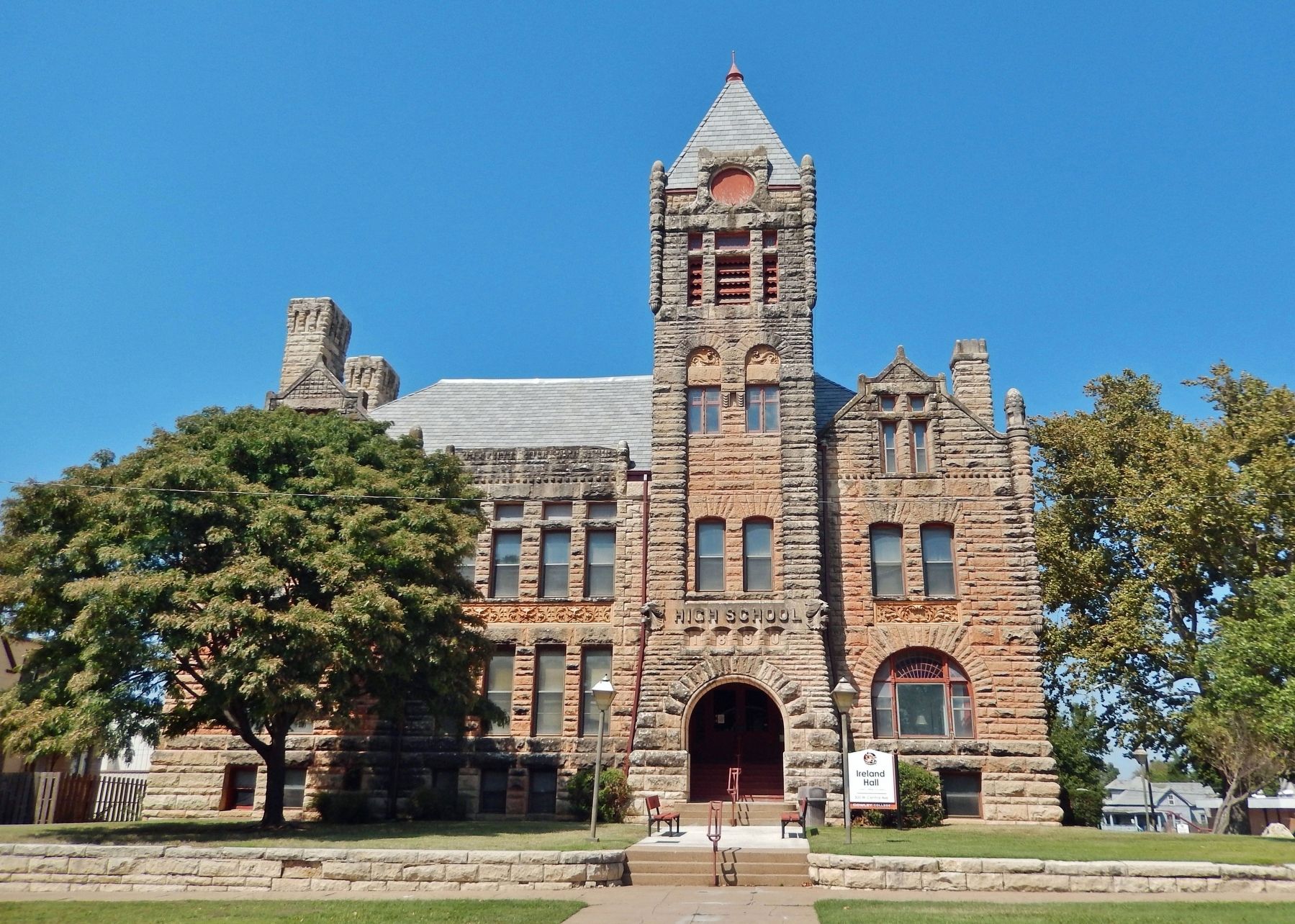
The main entrance is through a massive arched opening on the south, above which a square clock tower rises almost five stories. From study of old photographs, it appears that no clocks were ever installed, and the clock openings remained boarded up from the outset. Directly above the main entrance appear the words "High School" in raised letters and the date 1890 in carved stone insets.
A second arched entry way is located on the east side. Except for one large arched opening east of the main entrance the window openings on the first floor are simple rectangles. Those on the second floor have flat-arched openings on the east part where offices and classrooms were originally located and large rectangular openings with separated transoms on the west portion, the original auditorium. Third floor openings are generally rectangular except for arched windows in the tower and on the east and west gable.
The building's exterior displays many intricate patterns of carving, particularly on the south front. Above the main entrance on either side of the "High School" letters are carved stone animals' heads, apparently lion heads. And above the third-floor tower windows under the paired semicircular arches are two stone dragons. Intricate carved leaf decorations appear at a number of places between the windows of the first and second floors.
Credits. This page was last revised on January 2, 2025. It was originally submitted on January 1, 2025, by Cosmos Mariner of Cape Canaveral, Florida. This page has been viewed 196 times since then and 20 times this year. Photos: 1, 2, 3, 4, 5, 6, 7. submitted on January 2, 2025, by Cosmos Mariner of Cape Canaveral, Florida.
