Mount Airy in Surry County, North Carolina — The American South (South Atlantic)
Trinity Episcopal Church
Photographed by Mark Parker, December 30, 2024
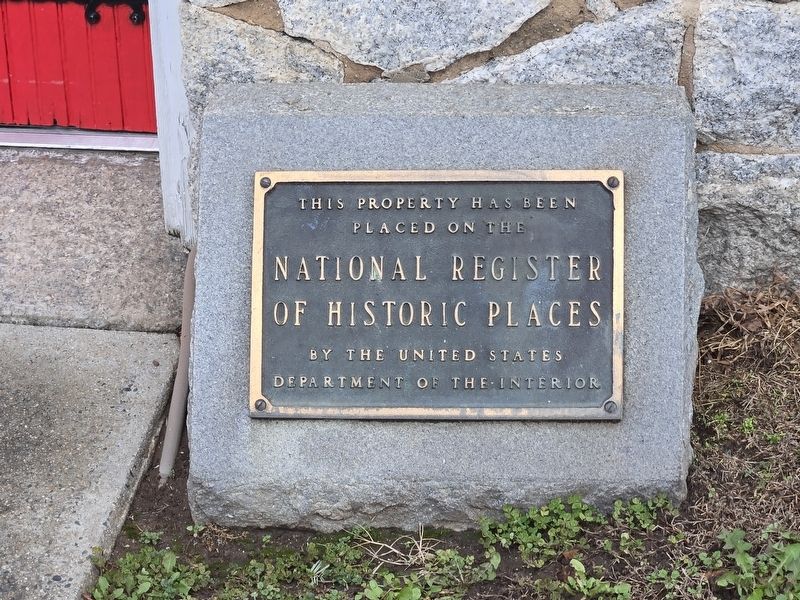
1. Trinity Episcopal Church Marker
placed on the
National Register
of Historic Places
by the United States
Department of the Interior
Erected by United States Department of the Interior.
Topics and series. This historical marker is listed in this topic list: Religion & Religious Structures. In addition, it is included in the National Register of Historic Places (NRHP) series list.
Location. 36° 30.183′ N, 80° 36.526′ W. Marker is in Mount Airy, North Carolina, in Surry County. It can be reached from the intersection of North Main Street and East Independence Boulevard (North Carolina Route 89), on the right when traveling north. The marker is at ground level to the right of the sanctuary entrance. Touch for map. Marker is at or near this postal address: 472 N Main St, Mount Airy NC 27030, United States of America. Touch for directions.

Regionally, this marker is in North Carolina’s Piedmont. It is also in the American South, specifically in the Upper South, in Appalachia, and specifically in Southern Appalachia. Globally, it is in North America, the Western
this page online
Other nearby markers. At least 8 other markers are within walking distance of this marker: The J.D. Smith Building (about 500 feet away, measured in a direct line); Leonidas Harold "L.H." Jones (about 500 feet away); The Whittler (about 500 feet away); The Whittling Wall (about 600 feet away); Tommy Jarrell (about 600 feet away); Fred Cockerham (about 600 feet away); Ralph Epperson (about 600 feet away); Donna Fargo (about 600 feet away). Touch for a list and map of all markers in Mount Airy.
More about this marker. The church is a contributing building to the Mount Airy Historic District and not a separate historic structure.
Regarding Trinity Episcopal Church. Excerpts from the Mount Airy Historic District Nomination Form:
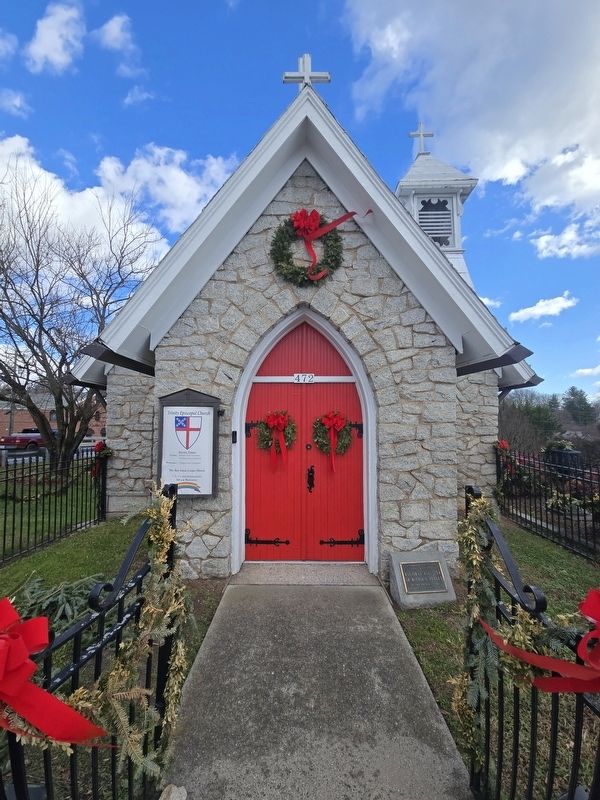
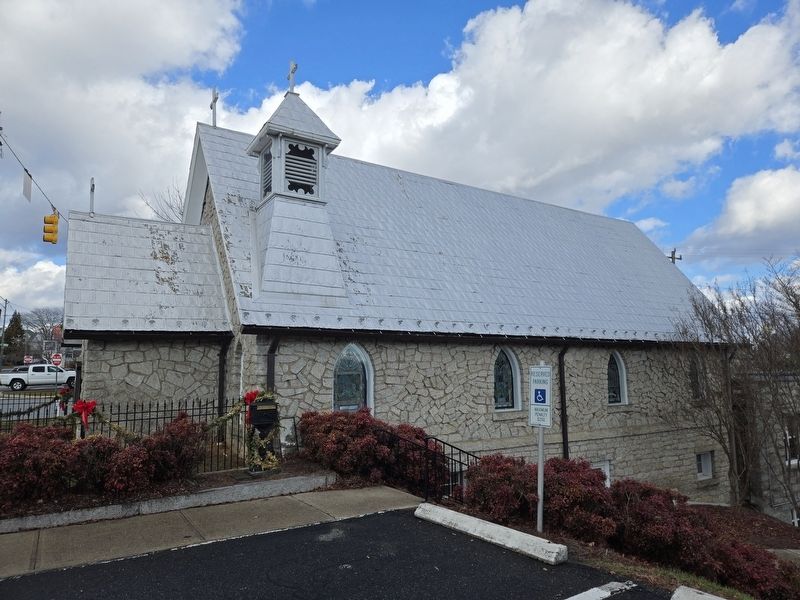
Pictuesque, small Gothic Revival style church built in 1896 by contractor J. A. Tesh from granite donated by quarry owner, Thomas Woodruff. ReportedlyWoodruff's son, Frank, designed the church which is now the oldest church building remaining in Mount Airy and the first local building constructed with granite. The stone later became a distinguishing feature of the town's architecture. Typically, the gable front church features lancet arched bays; a diminutive offset belfry is roofed and sheathed with pressed metal. On the interior a "rustic" effect is achieved by the stained woodwork which contrasts with the white plaster walls. A three-part lancet arch encloses the pulpit area. A flat-roofed, granite parish house was appended to the rear of the church in 1954.Photographed by Mark Parker, December 30, 20242. Trinity Episcopal Church sanctuary entrance. Marker is at ground level to the right of the entrance
Also see . . .
1. Trinity Episcopal Church. Website homepage:
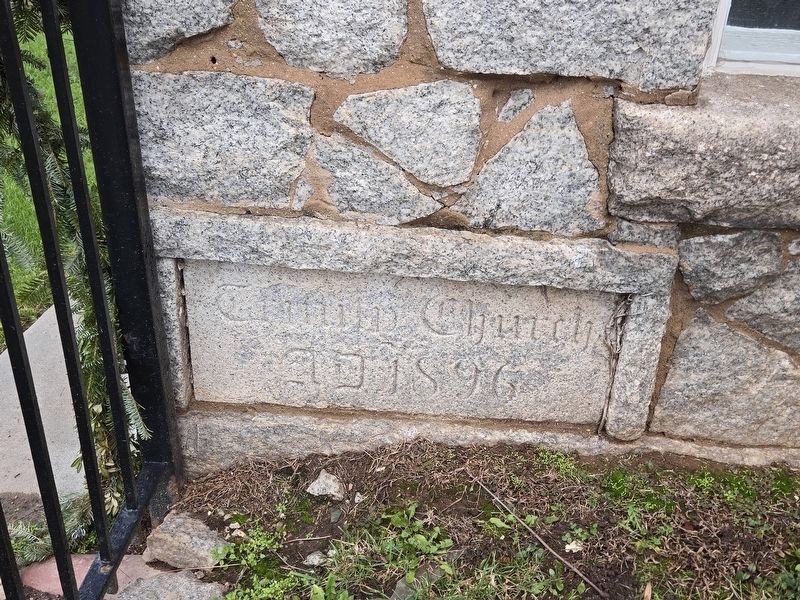
Construction of Trinity Church was begun in the spring of 1896, using local granite donated by parishioner, Thomas Woodruff, president of the granite company at that time. The first service in the new building was held in July of 1896. Trinity was consecrated on October 13, 1900 and was dedicated to “…the Worship and Service of Almighty God, the administration of His Holy Sacraments, the Reading and Preaching of His Holy Word, and for the performance(Submitted on January 2, 2025, by Mark Parker of Hickory, North Carolina.)of All Holy Offices” by the Bishop of North Carolina, the Rt. Reverend Joseph Blount Cheshire.Photographed by Mark Parker, December 30, 20243. Trinity Episcopal Church cornerstoneTrinity Church A.D. 1896
2. Mount Airy Historic District. Wikipedia entry:
Links to National Register of Historic Places documents (Submitted on July 15, 2025, by Larry Gertner of New York, New York.)
Photographed by Mark Parker, December 30, 2024
4. Trinity Episcopal Church southside view

Photographed by Mark Parker, December 30, 2024
5. Full Street view of Trinity Episcopal Church
Credits. This page was last revised on July 16, 2025. It was originally submitted on January 2, 2025, by Mark Parker of Hickory, North Carolina. This page has been viewed 162 times since then and 16 times this year. Photos: 1, 2, 3, 4, 5. submitted on January 2, 2025, by Mark Parker of Hickory, North Carolina. • Bernard Fisher was the editor who published this page.
