Tinley Park in Cook County, Illinois — The American Midwest (Great Lakes)
The Carl Vogt Building
6811 Hickory Street
| — | National Register of Historic Places: 1988 | — |
Photographed by Sean P. Flynn, December 28, 2024
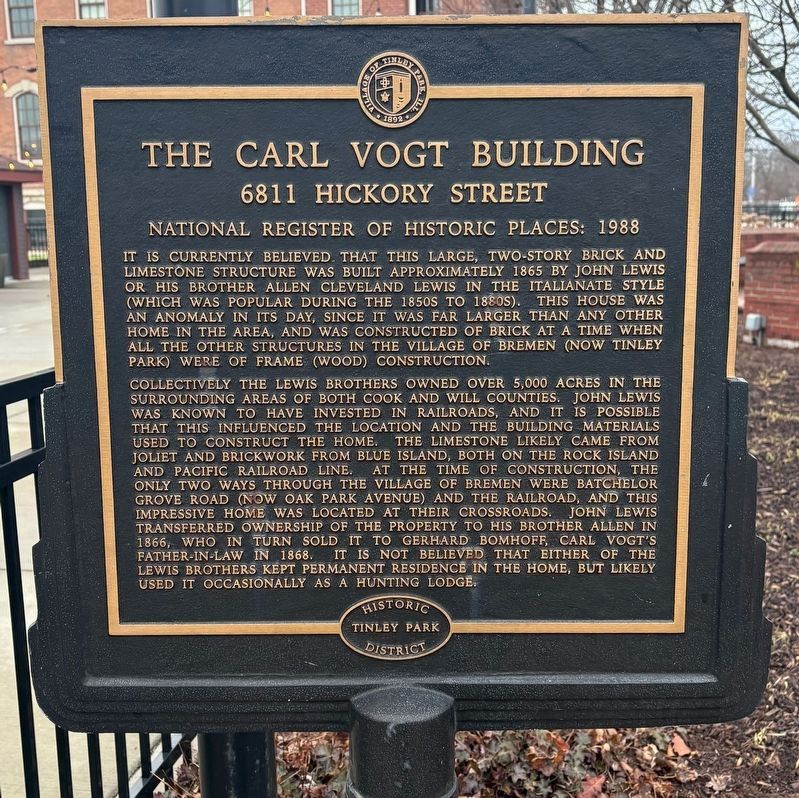
1. The Carl Vogt Building Marker (front side)
It is currently believed that this large, two-story brick and limestone structure was built approximately 1865 by John Lewis or his brother Allen Cleveland Lewis in the Italianate style (which was popular during the 1850s to 1880s). This house was an anomaly in its day, since it was far larger than any other home in the area, and was constructed of brick at a time when all the other structures in the Village of Bremen (now Tinley Park) were of frame (wood) construction.
Collectively the Lewis brothers owned over 5,000 acres in the surrounding areas of both Cook and Will counties. John Lewis was known to have invested in railroads, and it is possible that this influenced the location and the building materials used to construct the home. The limestone likely came from Joliet and brickwork
this page online
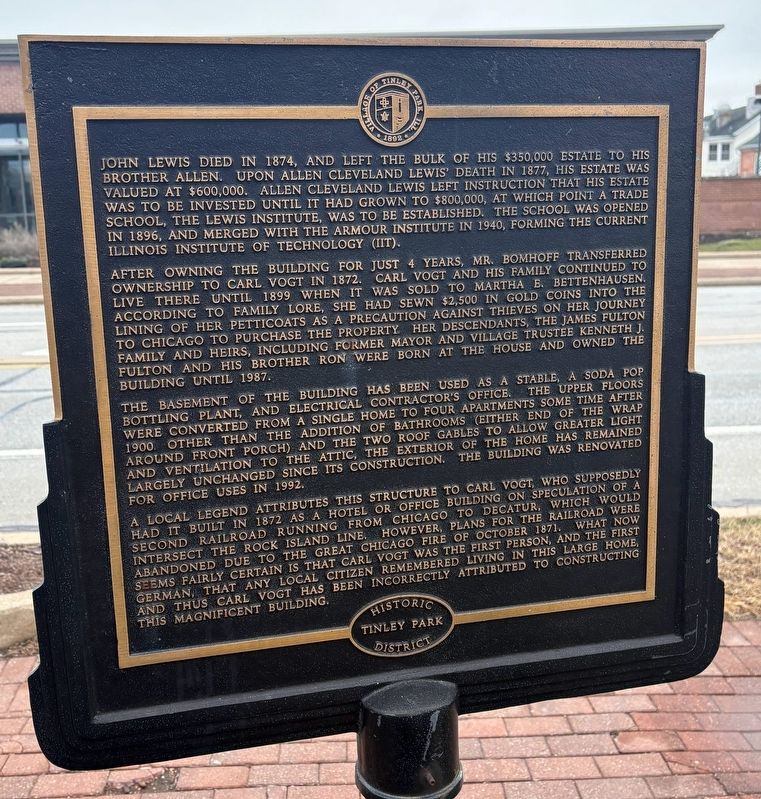
John Lewis died in 1874, and left the bulk of his $350,000 estate to his brother Allen. Upon Allen Cleveland Lewis' death in 1877, his estate was valued at $600,000. Allen Cleveland Lewis left instruction that his estate was to be invested until
Photographed by Sean P. Flynn, December 28, 2024
2. The Carl Vogt Building Marker (rear side)
After owning the building for just 4 years, Mr. Bomhoff transferred ownership to Carl Vogt in 1872. Carl Vogt and his family continued to live there until 1899 when it was sold to Martha E. Bettenhausen. According to family lore, she had sewn $2,500 in gold coins into the lining of her petticoats as a precaution against thieves on her journey to Chicago to purchase the property. Her descendants, the James Fulton family and heirs, including former mayor and village trustee Kenneth J. Fulton and his brother Ron were born at the house and owned the building until 1987.
The
Photographed by Sean P. Flynn, December 28, 2024
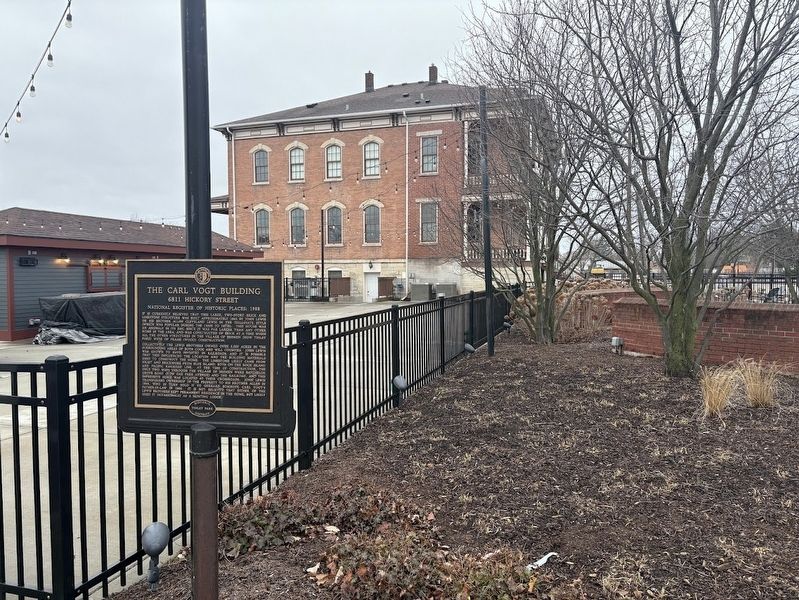
3. The Carl Vogt Building Marker
A local legend attributes this structure to Carl Vogt, who supposedly had it built in 1872 as a hotel or office building on speculation of a second railroad running from Chicago to Decatur, which would intersect the Rock Island line. However, plans for the railroad were abandoned due to the Great Chicago Fire of October
Photographed by Sean P. Flynn, December 28, 2024
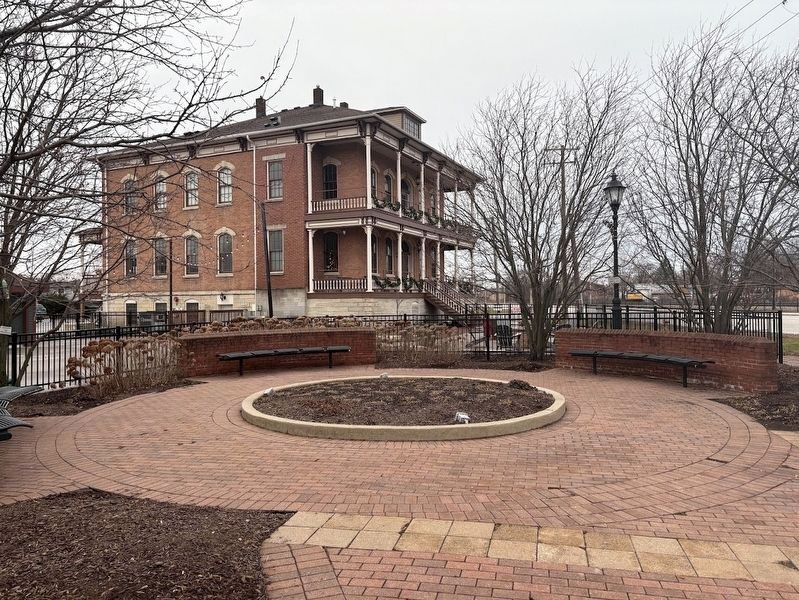
4. The Carl Vogt Building
The building currently houses Banging Gavel Brewpub.
Erected by Village of Tinley Park.
Topics and series. This historical marker is listed in these topic lists: Architecture • Education • Railroads & Streetcars • Settlements & Settlers. In addition, it is included in the Chicago Rock Island & Pacific Railway, the National Register of Historic Places (NRHP), and the The Great Chicago Fire of 1871 series lists. A significant historical year for this entry is 1865.
Location. 41° 34.483′ N, 87° 47.068′ W. Marker is in Tinley Park, Illinois, in Cook County. It is on Oak Park Avenue south of Hickory
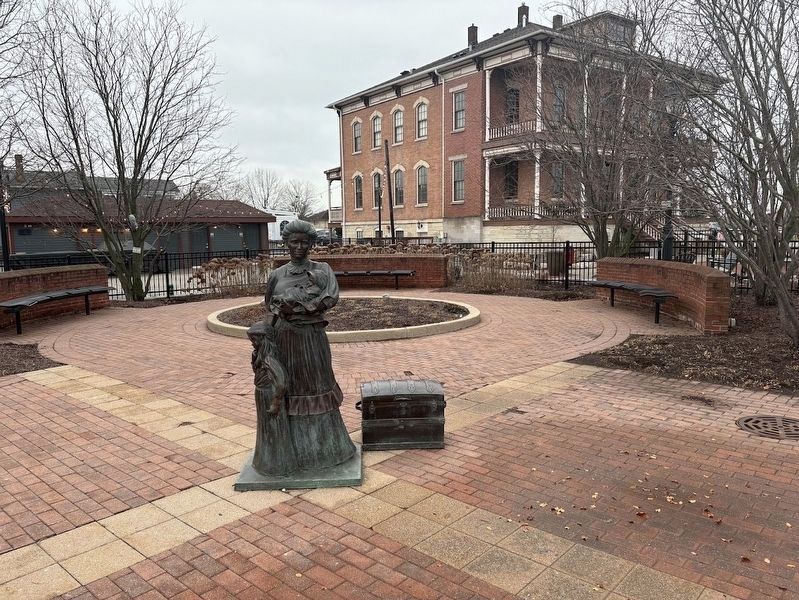
Photographed by Sean P. Flynn, December 28, 2024
5. Statue in front of the Carl Vogt Building

Regionally, this marker is in Greater Chicago. It is also in the American Midwest. Globally, it is in North America, on the Great Lakes, in the Western Hemisphere, in the Western World, and in the Anglosphere. Historically, it finds itself in what was once the Viceroyalty of New France, the territory of the Mississippian Culture, and the Northwest Territory.
Other nearby markers. At least 8 other markers are within walking distance of this marker: J.W. Hollstein's (about 300 feet away, measured in a direct line); Vogt Visual Arts Center (about 300 feet away); Andres Block (about 400 feet away); Tinley Park Volunteer Fire Department (about 400 feet away); World Trade Center Beam (about 500 feet away); Columbia Hotel/Funk's Tavern (about 500 feet away); Weber/Hoogervorst/Erwin Home (about 500 feet away); Tinley Park 9/11 Memorial (about 500 feet away). Touch for a list and map of all markers in Tinley Park.
More about this marker. The building and its namesake are more commonly spelled with a K, Karl Vogt, including in this building's official designation on the National Register of Historic Places.
Regarding The Carl Vogt Building. The building is the only in Tinley Park to be included on the National Register of Historic Places. As of the beginning of 2025, it is home to the Banging Gavel Brewpub.
Also see . . .
1. Banging Gavel Brewpub: The Renovation Project's Current State. Since 2023, a brewpub has renovated the Vogt building to convert it into a brewery and restaurant. (Submitted on January 2, 2025, by Sean P. Flynn of Oak Park, Illinois.)
2. History of Illinois Institute of Technology (IIT). (Submitted on January 2, 2025, by Sean P. Flynn of Oak Park, Illinois.)
Additional keywords. Karl Vogt
Credits. This page was last revised on July 5, 2025. It was originally submitted on January 2, 2025, by Sean P. Flynn of Oak Park, Illinois. This page has been viewed 1,080 times since then and 172 times this year. Photos: 1, 2, 3, 4, 5. submitted on January 2, 2025, by Sean P. Flynn of Oak Park, Illinois.
