
Krutenau in Strasbourg in Bas-Rhin, Alsace, Lorraine, Champagne-Ardenne, France — Western Europe
Grande-Île et Neustadt
Patrimoine Mondial

Photographed by Steve Stoessel, December 18, 2024
1. Grande-Île et Neustadt, Patrimoine Mondial Marker
La Grande-Île, caractéristique de l'Europe rhénane, et la Neustadt, extension urbaine conque à la fin du 19e siècle par l'empire allemand, forment un ensemble urbain cohérent, structuré autour de la cathédrale, chef-d'œuvre majeur de l'art gothique. Ses paysages uniques sont composés et mis en scène par les cours d'eau. Ils se caractérisent également par l'expression d'influences germaniques et françaises qui ont dessiné un espace urbain spécifique par des réalisations des grandes périodes significatives de l'histoire européenne. La Grande-Île de Strasbourg a été inscrite sur la Liste du patrimoine mondial en 1988.
Cette reconnaissance est étendue à la Neustadt depuis 2017.
Die Grande-Île, die charakteristisch für das rheinische Europa ist, und die Neustadt, ein Ende des 19. Jahrhunderts vom Deutschen Reich konzipierte Stadterweiterung, bilden ein kohärentes Stadtensemble, das rund um das Munster, das bedeutende Meisterwerk der gotischen Kunst, angeordnet ist. Das einzigartige Landschaftsbild wird durch die Wasserläufe geprägt und hervorgehoben. Es zeichnet sich auch durch die zum Ausdruck kommenden deutschen und französischen
this page online
Diese Anerkennung wurde 2017 auf die Neustadt ausgedehnt.
The Grande-Île, a typical feature of the North Rhine region, and Neustadt, a "new town" constructed in the 19th century under the German empire, form a coherent urban ensemble around the cathedral, a masterpiece of Gothic art. The rivers and canals form and frame the inimitable landscapes. The local scenery is also characterized by German and French influences that have created a particular urban area developed at significant major periods through Europe's history. Strasbourg's Grande-Île was inscribed on UNESCO's World Heritage List in 1988.
This recognition was extended to Neustadt in 2017.
Topics. This historical marker is listed in this topic list: Architecture. A significant historical year for this entry is 1988.
Location. 48° 34.757′ N, 7° 45.081′ E. Marker is in Strasbourg, Grand Est (Alsace, Lorraine, Champagne-Ardenne), in Bas-Rhin. It is in
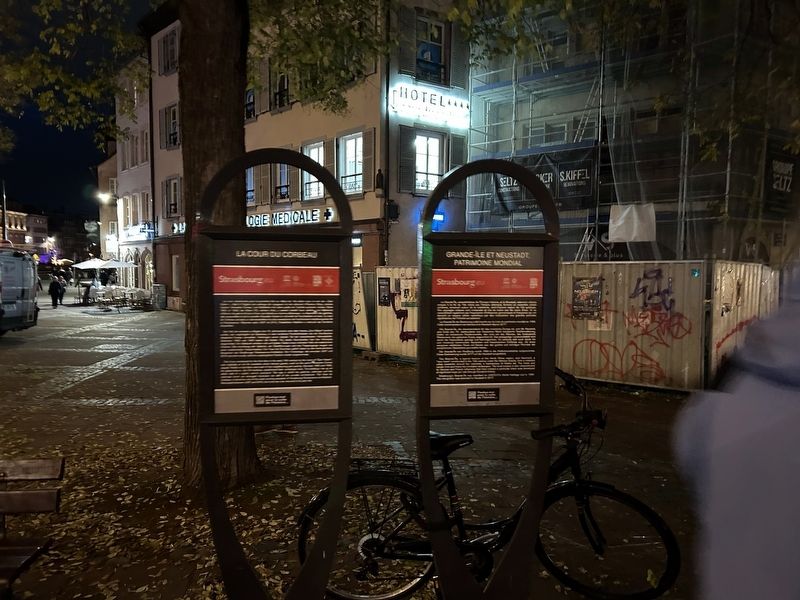
Photographed by Steve Stoessel, December 18, 2024
2. Grande-Île et Neustadt, Patrimoine Mondial Marker

Regionally, it is in the North Atlantic Region, Europe, the European Union, Atlantic Europe, the Schengen Area, Western Europe, a coastal Mediterranean country, and the Western World. Historically, it finds itself in what was once a French colony, the Roman Empire, and specifically the Holy Roman Empire.
Other nearby markers. At least 8 other markers are within walking distance of this marker: La Cour du Corbeau (here, next to this marker); Le Palais Rohan (about 210 meters away, measured in a direct line); Maison de l'Œuvre Notre-Dame (about 210 meters away); La Maison de l’Œuvre Notre-Dame (about 210 meters away); 5 Place du Chateau (about 210 meters away); La Place Gutenberg (approx. 0.3 kilometers away); 500 Ans de Vie Universitaire a Strasbourg (approx. 0.4 kilometers away); L'École Saint-Thomas (approx. half a kilometer away). Touch for a list and map of all markers in Strasbourg.
Also see . . . Grande-Île (Strasbourg). QR link on marker. Available in French, English, and German. (Submitted on January 4, 2025, by Steve Stoessel of Niskayuna, New York.)
Credits. This page was last revised on January 4, 2025. It was originally submitted on January 3, 2025, by Steve Stoessel of Niskayuna, New York. This page has been viewed 119 times since then and 5 times this year. Photos: 1, 2. submitted on January 3, 2025, by Steve Stoessel of Niskayuna, New York.
