Saint Gervais in Paris in Département de Paris, Île-de-France, France — Western Europe
Les bouquinistes de la Seine
—
Histoire de Paris
—
Photographed by Andrew Ruppenstein, September 11, 2024
1. Les bouquinistes de la Seine Marker
Inscription.
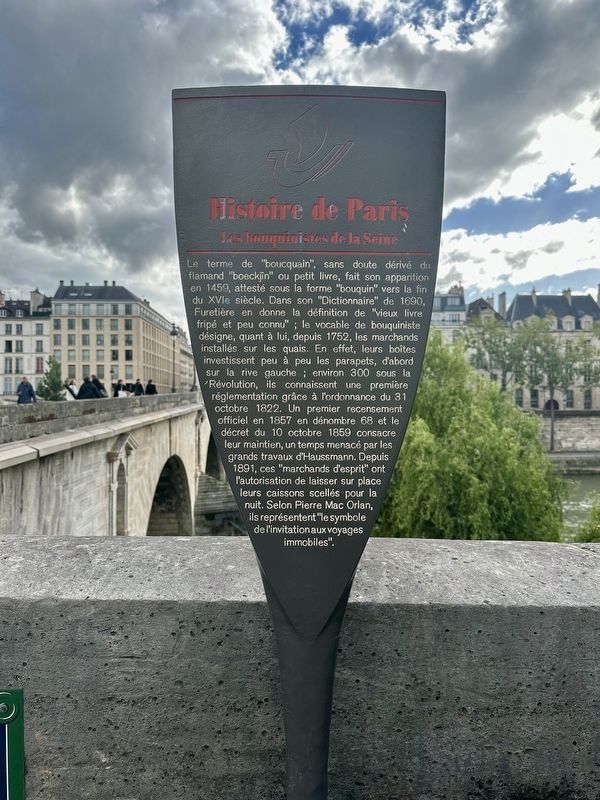
Les bouquinistes de la Seine. . , (English translation:) , The term "boucquain", probably derived from the Flemish "boeckjin" or small book, appeared in 1459, attested in the form "bouquin" towards the end of the 16th century. In his "Dictionary" of 1690, Furetière gives the definition of "Old, crumpled and little-known book"; the term bouquiniste for its part, has designated, since 1752, the merchants established on the quays. Indeed, their boxes gradually invested the parapets, first on the left bank; around 300 under the Revolution, they were first regulated thanks to the ordinance of October 31, 1822. A first official census in 1857 counted 68 of them and the decree of October 10, 1859 confirmed their maintenance, at a time threatened by Haussmann's major works. Since 1891, these "merchants of spirit" have been allowed to leave their sealed boxes on site for the night. According to Pierre Mac Orlan, they represent "the symbol of the invitation to immobile journeys". . This historical marker is in Saint Gervais in Paris in Département de Paris Île-de-France France
Le terme de "boucquain", sans doute dérivé du flamand "boeckjin" ou petit livre, fait son apparition en 1459, attesté sous la forme "bouquin" vers la fin du XVIe siècle. Dans son "Dictionnaire" de 1690, Furetière en donne la définition de "Vieux livre fripé et peu connu"; le vocable de bouquiniste désigne, quant à lui, depuis 1752, les marchands installés sur les quais. En effet, leurs boites investissent peu à peu les parapets, d'abord sur la rive gauche; environ 300 sous la Révolution, ils connaissent une première réglementation grâce à l'ordonnance du 31 octobre 1822. Un premier recensement officiel en 1857 en dénombre 68 et le décret du 10 octobre 1859 consacre leur maintien, un temps menacé par les grands travaux d'Haussmann. Depuis 1891, ces "marchands d'esprit" ont l'autorisation de laisser sur place leurs caissons scellés pour la nuit. Selon Pierre Mac Orlan, ils représentent "le symbole de l'invitation aux voyages immobiles".,
Le terme de "boucquain", sans doute dérivé du
flamand "boeckjin" ou petit livre, fait son apparition
en 1459, attesté sous la forme "bouquin" vers la fin
du XVIe siècle. Dans son "Dictionnaire" de 1690,
Furetière en donne la définition de "Vieux livre
fripé et peu connu"; le vocable de bouquiniste
désigne, quant à lui, depuis 1752, les marchands
installés sur les quais. En effet, leurs boites
investissent peu à peu les parapets, d'abord
sur la rive gauche; environ 300 sous la
Révolution, ils connaissent une première
réglementation grâce à l'ordonnance du 31
octobre 1822. Un premier recensement
officiel en 1857 en dénombre 68 et le
décret du 10 octobre 1859 consacre
leur maintien, un temps menacé par les
grands travaux d'Haussmann. Depuis
1891, ces "marchands d'esprit" ont
l'autorisation de laisser sur place
leurs caissons scellés pour la
nuit. Selon Pierre Mac Orlan,
ils représentent "le symbole
de l'invitation aux voyages
immobiles".
(English translation:)
The term "boucquain", probably derived from the Flemish "boeckjin" or small book, appeared in 1459, attested in the form "bouquin" towards the end of the 16th century. In his "Dictionary" of 1690, Furetière gives the definition of "Old, crumpled and
Click or scan to see this page online
little-known book"; the term bouquiniste for its part, has designated, since 1752, the merchants established on the quays. Indeed, their boxes gradually invested the parapets, first on the left bank; around 300 under the Revolution, they were first regulated thanks to the ordinance of October 31, 1822. A first official census in 1857 counted 68 of them and the decree of October 10, 1859 confirmed their maintenance, at a time threatened by Haussmann's major works. Since 1891, these "merchants of spirit" have been allowed to leave their sealed boxes on site for the night. According to Pierre Mac Orlan, they represent "the symbol of the invitation to immobile journeys".
Topics and series. This historical marker is listed in this topic list: Industry & Commerce. In addition, it is included in the Histoire de Paris series list. A significant historical year for this entry is 1459.
Location. 48° 51.199′ N, 2° 21.453′ E. Marker is in Paris, Île-de-France, in Département de Paris. It is in Saint Gervais. It is on Quai de l'Hôtel de ville. Touch for map. Marker is at or near this postal address: 14 Quai de l'Hôtel de ville, Paris, Île-de-France 75004, France. Touch for directions.
Regionally, it is in the North Atlantic Region,Europe, the European Union, Atlantic
Photographed by Andrew Ruppenstein, September 11, 2024
2. Les bouquinistes de la Seine Marker - wide view
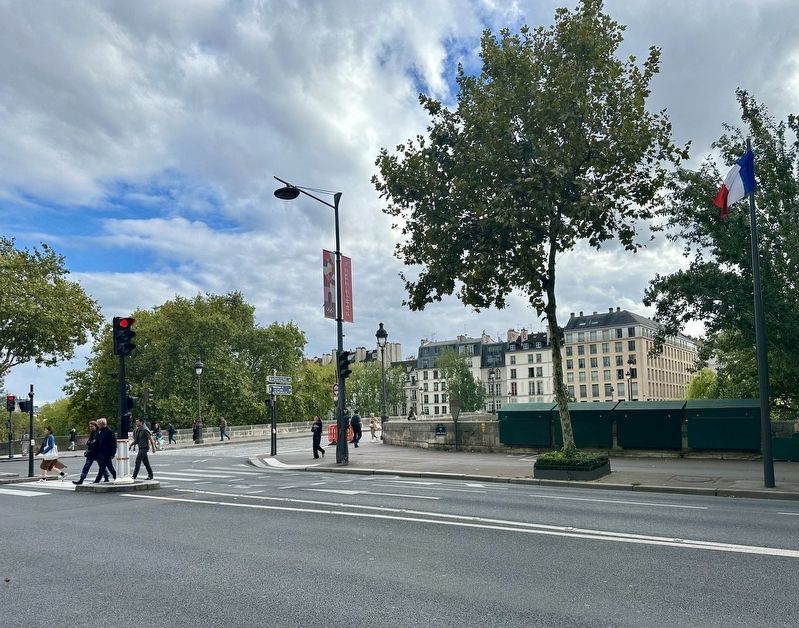
The marker is visible here at the north end of the Pont Marie, just to the left of the green mini-sheds, which are actually bouquiniste stalls.
Europe, the Schengen Area, Western Europe, a coastal Mediterranean country, and the Western World. Historically, it finds itself in what was once a French colony and also the Roman Empire.
The Bouquinistes of Paris, France, are booksellers of used and antiquarian books and rare vintage postcards who ply their trade along large sections of the banks of the Seine: on the right bank from the Pont Marie to the Quai du Louvre, and on the left bank from the Quai de la Tournelle to Quai Voltaire. The Seine is thus described as 'the only river in the
Photographed by Andrew Ruppenstein, September 11, 2024
3. Les bouquinistes de la Seine Marker - wide view
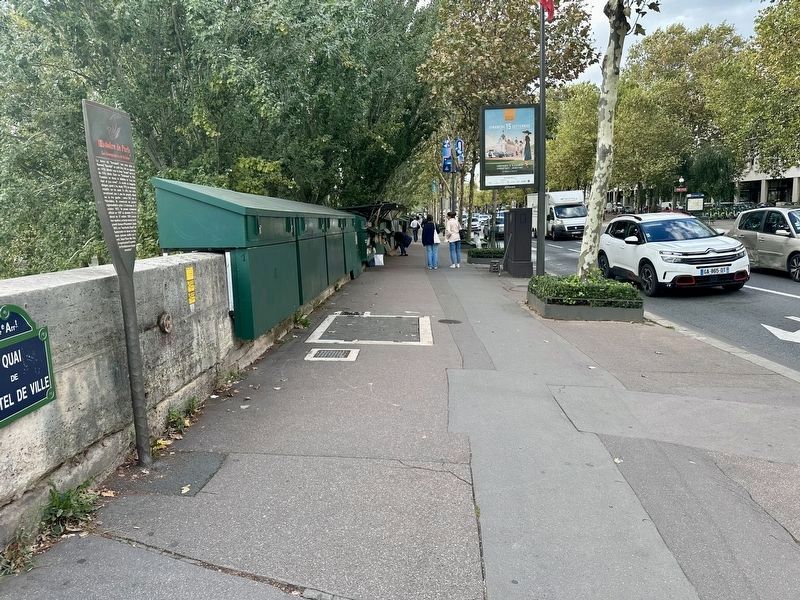
Looking west along the Quai de l'Hôtel de ville at the row of bouquiniste stalls.
world that runs between two bookshelves'.
(Submitted on January 3, 2025.)
Additional keywords. panneau
Photographed by éditions ELD, 1920
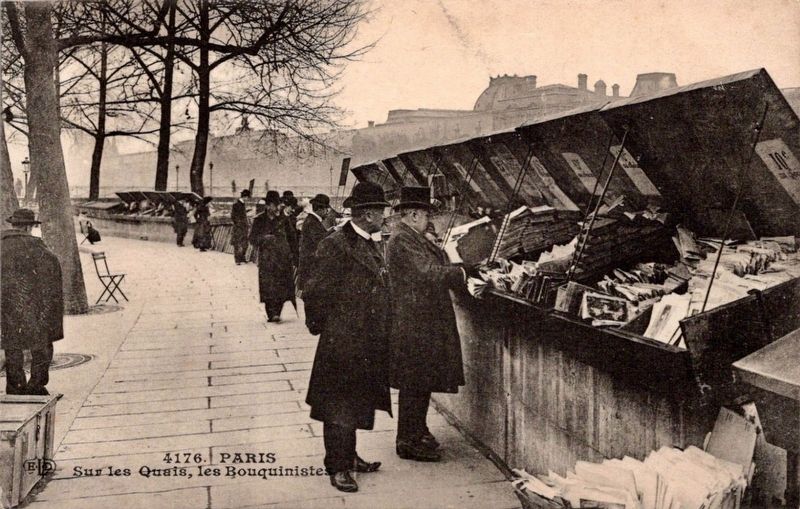
4. Bouquinistes on the Quay
Credits. This page was last revised on April 14, 2025. It was originally submitted on January 3, 2025, by Andrew Ruppenstein of Lamorinda, California. This page has been viewed 115 times since then and 27 times this year. Photos:1, 2, 3, 4. submitted on January 3, 2025, by Andrew Ruppenstein of Lamorinda, California.