Hot Springs in Garland County, Arkansas — The American South (West South Central)
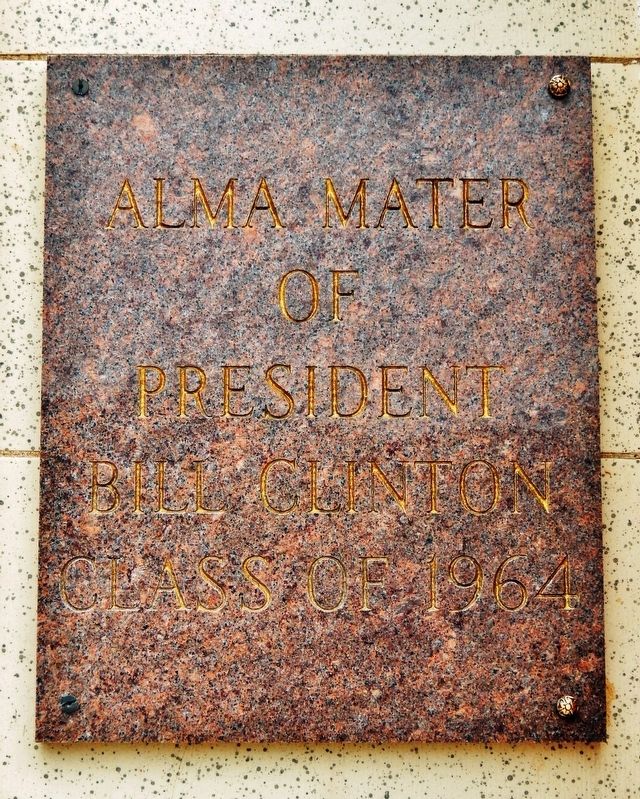
Alma Mater of President Bill Clinton
Photographed by Cosmos Mariner, September 13, 2024
1. Alma Mater of President Bill Clinton Marker
Class of 1964
Topics and series. This historical marker is listed in this topic list: Education. In addition, it is included in the Former U.S. Presidents: #42 William Jefferson "Bill" Clinton, and the National Register of Historic Places (NRHP) series lists. A significant historical year for this entry is 1914.
Location. 34° 30.333′ N, 93° 3.224′ W. Marker is in Hot Springs, Arkansas, in Garland County. It is on Oak Street just north of Orange Street, on the right when traveling north. The marker is mounted at eye-level, directly on the subject building, on the right side of the front/main/west entrance. Touch for map. Marker is at or near this postal address: 125 Oak Street, Hot Springs National Park AR 71901, United States of America. Touch for directions.

Regionally, this marker is in the Ouachita Mountains. It is also in the American South and specifically in the Upper South. Globally, it is in North America, the Western Hemisphere, the Western World, and the Anglosphere. Historically, it finds itself in what was once the territory of the Mississippian Culture, the Louisiana
this page online
Other nearby markers. At least 8 other markers are within walking distance of this marker: Walter Johnson (a few steps from this marker); Dr. and Mrs. D.E. Kloss (about 400 feet away, measured in a direct line); Central Methodist Church (about 500 feet away); Hot Springs/Garland County Ambulance Service (about 600 feet away); Lest We Forget (about 700 feet away); Honus Wagner (about 700 feet away); In Memory of Spanish American War Veterans (about 700 feet away); 1st SGT John M. "Mickey" Callahan (about 700 feet away). Touch for a list and map of all markers in Hot Springs.
Regarding Alma Mater of President Bill Clinton. National Register of Historic Places № 87002495.
From the National Register Nomination prepared by Mary Madden and Tonia Jones, 7/1983:
Hot Springs High School is a four-story symmetrical structure designed in the Late Gothic Revival style, most closely following the English or Perpendicular Gothic traditions. This is most clearly seen in the three main entrances — one on the front facade and one on each end. All three entrancesare distinguished by Tudor arches and are flanked by octagonal towers with crenellated tops. The area between the towers and above the entrances is filled by windows and terra cotta decoration. The terra cotta details include various crests, the name of the school, and the date of construction, all in relief. The towers of the front facade are also decorated by vertical strips of terra cotta at each corner of the octagons.Photographed by Cosmos Mariner, September 13, 20242. Alma Mater of President Bill Clinton MarkerThe marker is mounted at eye-level on the right side of the historic Hot Springs High School entrance.

Related markers. Click here for a list of markers that are related to this marker.
Also see . . . Hot Springs High School (Wikipedia).
Excerpt: Hot Springs High School was built in 1914 by the now famed Sanguinet & Staats architectural firm as a large, Late Gothic Revival structure located near the center of Hot Springs. It was segregated in the school's early history, with African American students able to attend Langston High School starting in 1913. Bill Clinton graduated in 1964. In 1988, this school building was listed on the National Register of Historic Places.(Submitted on January 4, 2025, by Cosmos Mariner of Cape Canaveral, Florida.)After Hot Springs High School moved to its current location on Emory Street in 1968, the old building was used as the Central
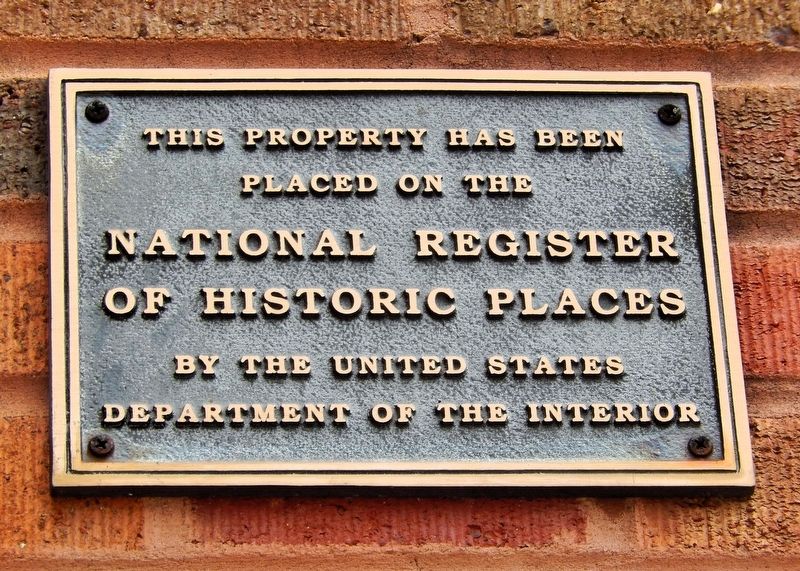
Junior High until 1992. In 2006, the historic facility was repurposed as 32 housing units for persons with disabilities, as the Hot Springs High School Lofts.Photographed by Cosmos Mariner, September 13, 20243. National Register of Historic Places Marker(also mounted on right side of the front entrance)
This property has been
placed on the
National Register
of Historic Places
by the United States
Department of the Interior

Photographed by Cosmos Mariner, September 13, 2024
4. Historic Hot Springs High School Cornerstone
Erected 1914
———
Architects
Sanguinet & Staats
———
Builders
G. Hartmann Cont’g Company
———
Board of Directors
———
W.S. Sorrells, President
C.E. Marsh, Secretary
Hamp Williams • S.P. McKeehan • H.A. Jones
H.C. Covington

Photographed by Cosmos Mariner, September 13, 2024
5. Historic Hot Springs High School (west/front elevation)
From the National Register Nomination: The Late Gothic Revival characteristics of the school are most evident on its imposing facade, which focuses on the central entrance bay. Here the red brick exterior is sharply contrasted by relief sculpture detail in terra cotta. Twin towers with crenellated caps, a distinctive feature of the Late Gothic Revival style, flank the entrance and rise above the fourth story of the building. Gothic detailing is also evident in the use of Tudor arches for entrance and detail and the polychrome contrast of brick and terra cotta throughout the exterior.
To either side is a recessed area that is predominantly filled by windows. Most of the windows are double hung nine-over-nine. Above the windows is a simple terra cotta hood molding. At each end of the facade there is a projecting bay.

Photographed by Cosmos Mariner, September 13, 2024
6. Historic Hot Springs High School (south elevation)

Photographed by Cosmos Mariner, September 13, 2024
7. Historic Hot Springs High School (northwest elevation)

Photographed by Cosmos Mariner, September 13, 2024
8. Historic Hot Springs High School (southwest elevation)
From the National Register Nomination: Prominently sited atop a hill near the central business district of Hot Springs, the Hot Springs High School Building is significant as the area's most impressive example of Late Gothic Revival architecture.
Credits. This page was last revised on June 28, 2025. It was originally submitted on January 4, 2025, by Cosmos Mariner of Cape Canaveral, Florida. This page has been viewed 356 times since then and 93 times this year. Photos: 1, 2, 3, 4, 5, 6, 7, 8. submitted on January 4, 2025, by Cosmos Mariner of Cape Canaveral, Florida.
