Kellogg Public Library and Neville Public Museum

has been placed
on the
National
Register of
Historic Places
by the United States
Department of the
Interior
Topics and series. This historical marker is listed in these topic lists: Architecture • Arts, Letters, Music • Charity & Public Work • Education. In addition, it is included in the Carnegie Libraries, and the National Register of Historic Places (NRHP) series lists. A significant historical date for this entry is February 16, 1903.
Location. 44° 30.719′ N, 88° 0.808′ W. Marker is in Green Bay, Wisconsin, in Brown County. It is on Doty Street just east of South Jefferson Street, on the left when traveling east. The marker is mounted at eye-level, directly on the south facade of the subject building, on the right side of the south entrance. Touch for map. Marker is at or near this postal address: 125 South Jefferson Street, Green Bay WI 54301, United States of America. Touch for directions.

Regionally, this marker is in the Fox River Valley. It is also in the American Midwest and in the Corn Belt. Globally, it is in North America, on the Great Lakes, in the Western Hemisphere, in the Western World,
this page online
Other nearby markers. At least 8 other markers are within walking distance of this marker: Brown County Courthouse (within shouting distance of this marker); Columbus Community Club (within shouting distance of this marker); Brown County Civil War Memorial (within shouting distance of this marker); Remember: September 11, 2001 (about 500 feet away, measured in a direct line); Liberty Bell Replica (about 500 feet away); The Spirit of the Northwest (about 500 feet away); Green Bay Press-Gazette (about 500 feet away); St. Willebrord Catholic Church (about 600 feet away). Touch for a list and map of all markers in Green Bay.
Regarding Kellogg Public Library and Neville Public Museum. National Register of Historic Places № 81000035.
From the National Register Nomination prepared by Michael R. Matucheski and Diane H. Filipowicz, 5/1981:
A small-scale statement of Neoclassical form, the Kellogg Public Library is an unusually solemn and elegant variationof Carnegie library design characteristic of the early twentieth century. In addition to being a fine work by a locally significant architect, the building represents a social/humanitarian achievement in the city in the concerted effort of the city, the Church, and philanthropist Andrew Carnegie to provide a social and educational facility. The severity of Henry A. Foeller's design for the Kellogg Public Library in Green Bay raises the modest-sized structure to the monumental, consistent with the public auditorium, county courthouse and annex, and post office in the immediate area.Photographed by Cosmos Mariner, July 19, 20182. Kellogg Public Library and Neville Public Museum MarkerThe marker is mounted on the south facade of the building, just to the right of the entrance.As a public service and educational facility, the construction of Green Bay's Kellogg Public Library marked an important point in the civic development of the city, and a fruitful exercise in private (Carnegie), public (City of Green Bay) and church (Bishop Messmer) sponsored support. The building was the first in Wisconsin to be sponsored by a grant from philanthropist Andrew Carnegie, whose name is linked with civic betterment nationwide in the funding of such institutions.
The beginnings of the public library in Green Bay date back to the winter of 1883-94
when Rufus B. Kellogg, President of the Kellogg National Bank, introduced the subject in the Green Bay Press-Gazette. The item was then dropped until 1887 when Mr. and Mrs. Arthur C. Neville inaugurated their "Evenings in Italy" series, proceeds from which were donated to the library fund. In the spring of 1888, the city of Green Bay issued $15,000 in municipal bonds, all of which were purchased by Kellogg who gave them back to the city on the condition that Green Bay appropriate at least $900 annually for library services for a fifty year minimum.Photographed by Cosmos Mariner, July 19, 20183. Original Neville Public Museum Entrance (west façade)From the National Register Nomination: In 1926, the library's museum was moved to separate quarters in a southwest wing designed by Marvin S. Stephenson of the firm Foeller, Schober & Stephenson of Green Bay. Temple fronts raised above the basement-story entrance on the northwest and south facades of the museum, each covering a single large rectangular window, constitute the only articulation on the otherwise blank limestone walls. Double-door entrances are set beneath a console- supported cornice and pediment (on the west and south elevations, respectively) in the center of the principal facades. A divided concrete balustrade forms an open forecourt before the west entrance. NEVILLE PUBLIC MUSEUM is inscribed in the frieze of the entablature on the west facade of the museum wing.On February 13, 1901, Andrew Carnegie offered the city of Green Bay $20,000 for a library building if the city would furnish a suitable site and agree to support the library at a cost not less than $2,500 annually. This was the first Carnegie Grant made to Wisconsin. One lot upon which the library was built was donated by Bishop Sebastian G. Messmer of Green Bay, while the adjoining lot was purchased by the city. The library opened on February 16, 1903. An addition was built in 1913, partially funded by another Carnegie Grant. In 1926, an east wing was added to the library in conjunction
with the establishment of the Neville Museum, which was in keeping with the original style of the library.Photographed by Cosmos Mariner, July 19, 20184. Original Carnegie Library Entrance (west façade)


Also see . . .
1. Kellogg Public Library and Neville Museum.
Excerpt: In 1883, local businessman Rufus Kellogg proposed the idea of establishing a library for the city of Green Bay. After a few years, funding was provided by Arthur Neville and a Carnegie Grant. Built in 1902, local architect Henry Foeller designed the Neo-Classical Building. An addition was constructed in 1914. In 1925, construction began on the east wing which became the home of the Neville Public Museum when it was finished in 1927. In 1974, a new city library was built leaving the Kellogg Library vacant. It was later rehabilitated to commercial offices and is known as Jefferson Square.(Submitted on January 6, 2025, by Cosmos Mariner of Cape Canaveral, Florida.)
2. Kellogg Public Library and Neville Public Museum (Wikipedia).
Excerpt: The site was added to the National Register of Historic Places on June 9, 1981, for its significance in architecture and social history. It was built in 1901 in the Classical Revival architectural style.
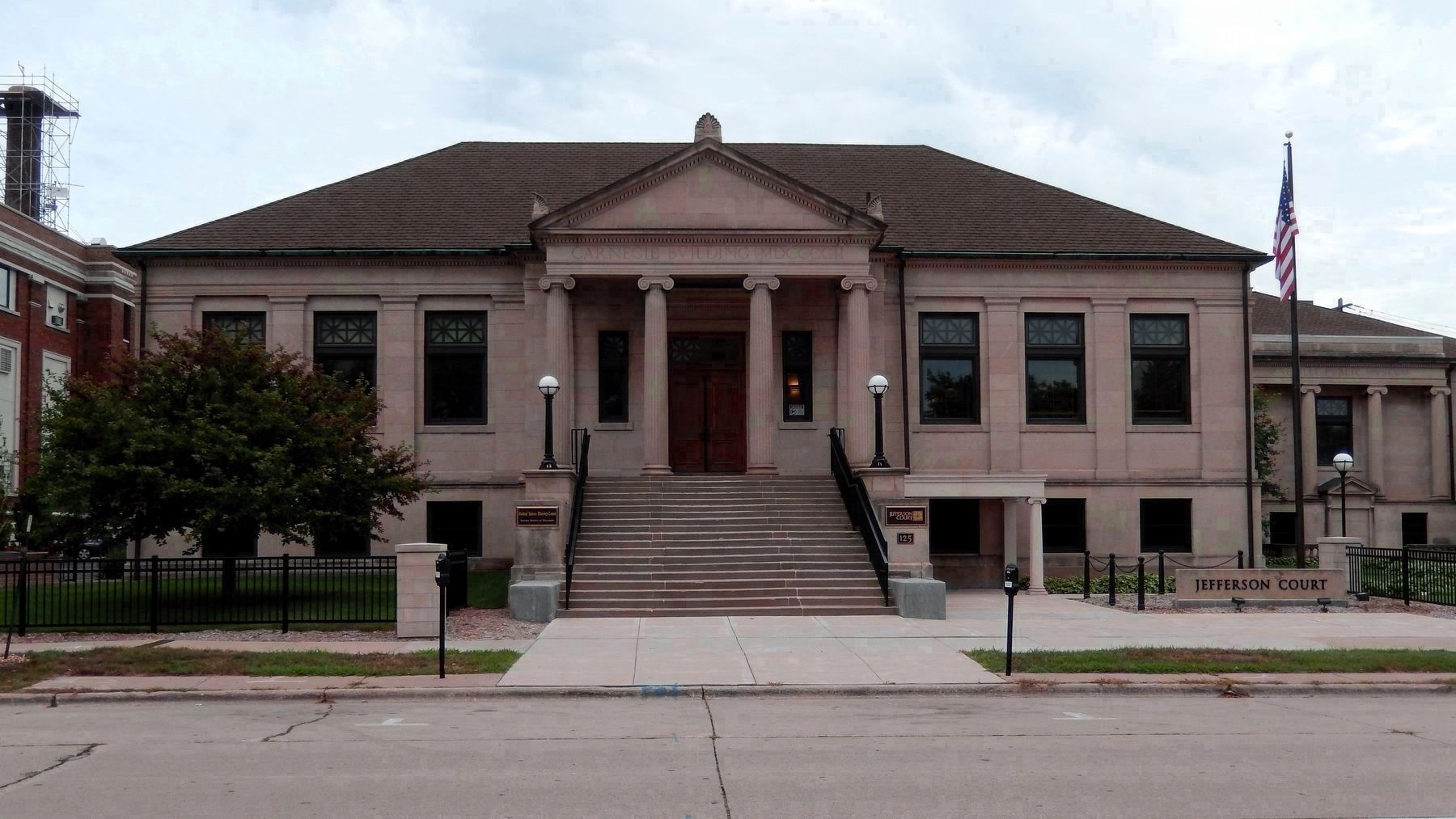
From the National Register Nomination: One story in height, raised above a full basement, the 46x96-foot rectangular building is dominated by a center Ionic portico atop three runs of wide stairs. The double-door entrance, with fixed overlight and flanking narrow overlighted windows, is prefaced by a mosaic tile floor with classical border. A plain pediment with antefix crowns the coursed, cut Bedford limestone walls; the entablature with plain frieze is carried across the walls under the cornice. Regular rectangular window openings composed of single large glass plates topped by fixed overlights, underscored by limestone sills, alternate with wide limestone pilasters on all elevations. Corresponding square plate glass windows light the basement story beneath.

Credits. This page was last revised on July 26, 2025. It was originally submitted on January 6, 2025, by Cosmos Mariner of Cape Canaveral, Florida. This page has been viewed 323 times since then and 85 times this year. Photos: 1, 2, 3, 4, 5, 6. submitted on January 6, 2025, by Cosmos Mariner of Cape Canaveral, Florida.
