Hot Springs in Garland County, Arkansas — The American South (West South Central)
The Great Fire of 1913 Left this City in Ruins
Photographed by Cosmos Mariner, September 13, 2024
1. The Great Fire of 1913 Left this City in Ruins Marker
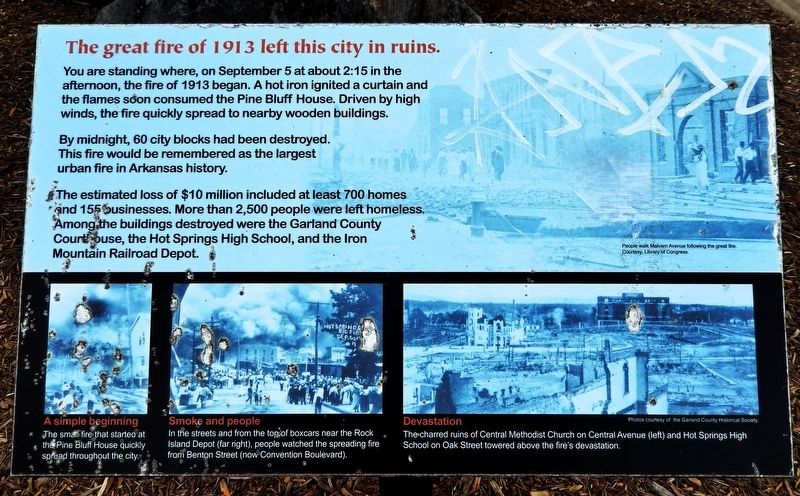
You are standing where, on September 5 at about 2:15 in the afternoon, the fire of 1913 began. A hot iron ignited a curtain and the flames soon consumed the Pine Bluff House. Driven by high winds, the fire quickly spread to nearby wooden buildings.
By midnight, 60 city blocks had been destroyed. This fire would be remembered as the largest urban fire in Arkansas history.
The estimated loss of $10 million included at least 700 homes and 155 businesses. More than 2,500 people were left homeless. Among the buildings destroyed were the Garland County Courthouse, the Hot Springs High School, and the Iron Mountain Railroad Depot.
[photo captions]
• People walk Malvern Avenue following the great fire
Courtesy, Library of Congress
• A simple beginning
The small fire that started at the Pine Bluff House quickly spread throughout the city.
• Smoke and people
In the streets and from the top of boxcars near the Rock Island Depot (far right), people watched the spreading fire from Benton Street (now Convention Boulevard).
• Devastation
The charred ruins of Central Methodist Church on Central Avenue (left) and Hot Springs High School on Oak
this page online
Photos courtesy of the Garland County Historical Society
Erected 2013 by Visit Hot Springs.
Topics. This historical marker is listed in this topic list: Disasters. A significant historical date for this entry is September 5, 1913.
Location. 34° 30.554′ N, 93° 2.939′ W. Marker is in Hot Springs, Arkansas, in Garland County. It is on Church Street just east of Pleasant Street, on the right when traveling east. The marker is located beside the sidewalk, on the north side of Bank OZK Arena Parking Lot 6. Touch for map. Marker is in this post office area: Hot Springs National Park AR 71901, United States of America. Touch for directions.

Regionally, this marker is in the Ouachita Mountains. It is also in the American South and specifically in the Upper South. Globally, it is in North America, the Western Hemisphere, the Western World, and the Anglosphere. Historically, it finds itself in what was once the territory of the Mississippian Culture, the Louisiana Purchase, one of the Confederate States of America, and the Antebellum South.
Other nearby markers. At least 8 other markers are within
Photographed by Cosmos Mariner, September 13, 2024
2. The Great Fire of 1913 Left this City in Ruins Marker
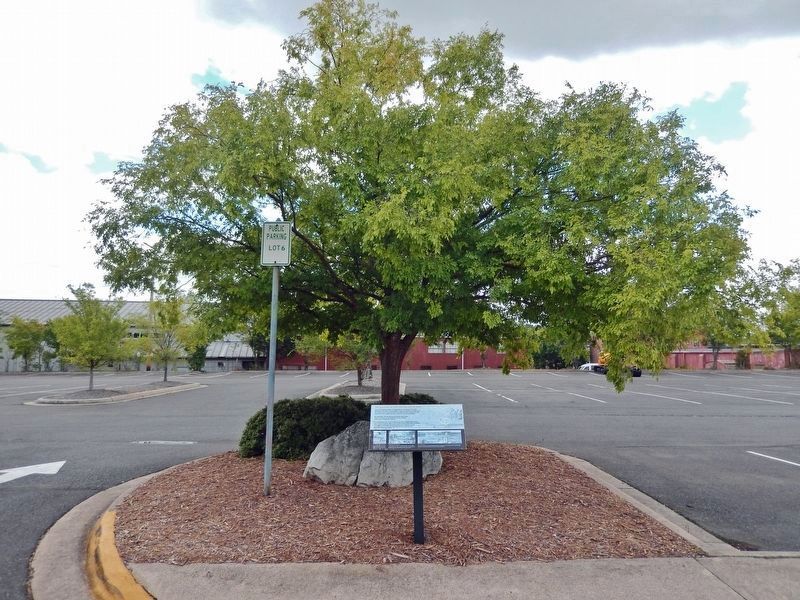
Looking south from Church Street. Bank OZK Arena Parking Lot 6 is in the background.
Also see . . . ‘City in flames’: Historical Society program looks back at tragic fire of 1913.
(The Sentinel-Record, 9/11/2022 - includes photos) Excerpt: "On Sept. 5, 1913, a simple residential fire progressed to a full-blown catastrophe as half of Hot Springs went up in flames," according to a news release from the Historical Society describing the program, which will explore the causes, the scale, and the consequences of the "most devastating fire to ever strike an Arkansas city." To commemorate the community-changing event, Visit Hot Springs in September 2013 placed a plaque on the spot where the fire began, now a parking lot behind Bank OZK Arena.(Submitted on January 7, 2025, by Cosmos Mariner of Cape Canaveral, Florida.)
Credits. This page was last revised on January 7, 2025. It was originally submitted on January 6, 2025, by Cosmos Mariner of Cape Canaveral, Florida. This page has been viewed 435 times since then and 97 times this year. Photos: 1, 2. submitted on January 7, 2025, by Cosmos Mariner of Cape Canaveral, Florida.
