Cedars in Dallas in Dallas County, Texas — The American South (West South Central)
Main Street
Photographed by James Hulse, January 7, 2025
1. Main Street Marker
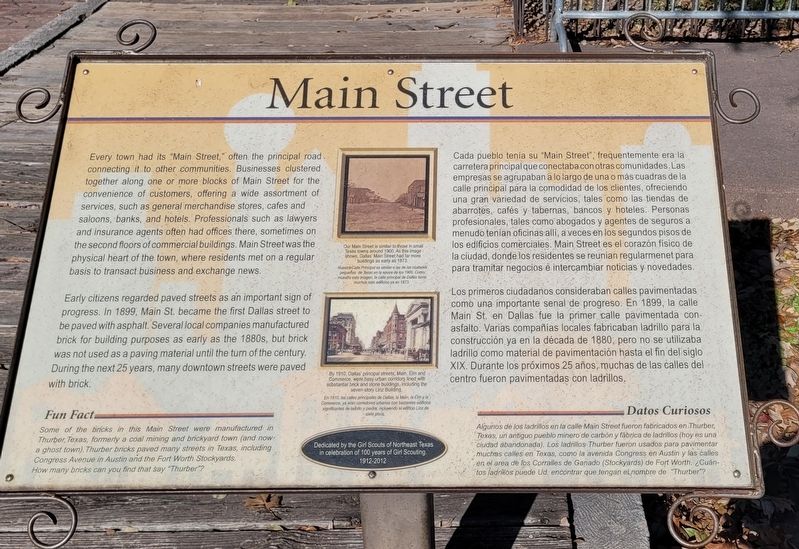
 Every town had its "Main Street," often the principal road connecting it to other communities. Businesses clustered together along one or more blocks of Main Street for the convenience of customers, offering a wide assortment of services, such as general merchandise stores, cafes and saloons, banks, and hotels. Professionals such as lawyers and insurance agents often had offices there, sometimes on the second floors of commercial buildings. Main Street was the physical heart of the town, where residents met on a regular basis to transact business and exchange news.
Early citizens regarded paved streets as an important sign of progress. In 1899, Main St. became the first Dallas street to be paved with asphalt. Several local companies manufactured brick for building purposes as early as the 1880s, but brick was not used as a paving material until the turn of the century. During the next 25 years, many downtown streets were paved with brick.
Fun Fact
Some of the bricks in this Main Street were manufactured in Thurber, Texas, formerly a coal mining and brickyard town (and now - a ghost town). Thurber bricks paved many streets in Texas, including Congress Avenue in Austin and the Fort Worth Stockyards. How many bricks can you find that say "Thurber"?
Captions
(Photo #1) Our Main Street is similar to those in small Texas towns around 1900, As this image shows, Dallas Main Street had far more buildings as early as 1873.
(Photo #2) By 1910, Dallas principal streets, Main, Elm and Commerce, were busy urban corridors lined with substantial brick and stone buildings, including the seven-story Linz Building.
Dedicated by the Girl Scouts of Northeast Texas in celebration of 100 years of Girl Scouting. 1912-2012
Cada
this page online
Los primeros ciudadanos consideraban calles pavimentadas como una importante senal de progreso. En 1899, la calle Main St. en Dallas fue la primer calle pavimentada conasfalto. Varias compañías locales fabricaban ladrillo para la construcción ya en la década de 1880, pero no se utilizaba ladrillo como material de pavimentación hasta el fin del siglo XIX. Durante los próximos 25 años, muchas de las calles del centro fueron pavimentadas con ladrillos.
Datos Curiosos
Algunos de los ladrillos en la calle Main Street fueron fabricados en Thurber, Texas, un antiguo pueblo minero de carbón y fábrica de ladrillos (hoy es una ciudad abandonada). Los ladrillos Thurber fueron usados para pavimentar muchas calles en Texas, como la avenida Congress en Austin y las calles en el area de los Corralles de Ganado (Stockyards) de Fort Worth. ¿Cuántos ladrillos puede Ud. encontrar que tengan el nombre de "Thurber"?
Subtítulos
(Foto #1) Nuestra Calle Principal es similar a las de las ciudades pequeñas de Texas en la época de los 1900. Como muestra esta imagen, la calle principal de Dallas tenía muchos más edificios ya en 1873.
(Foto #2) En 1910, las calles principales de Dallas, la Main, la Elm y la Commerce, ya eran corredores urbanos con bastantes edificios significantes de ladrillo y piedra, incluyendo el edificio Linz de siete pisos
Erected by Dallas
Photographed by James Hulse, January 7, 2025
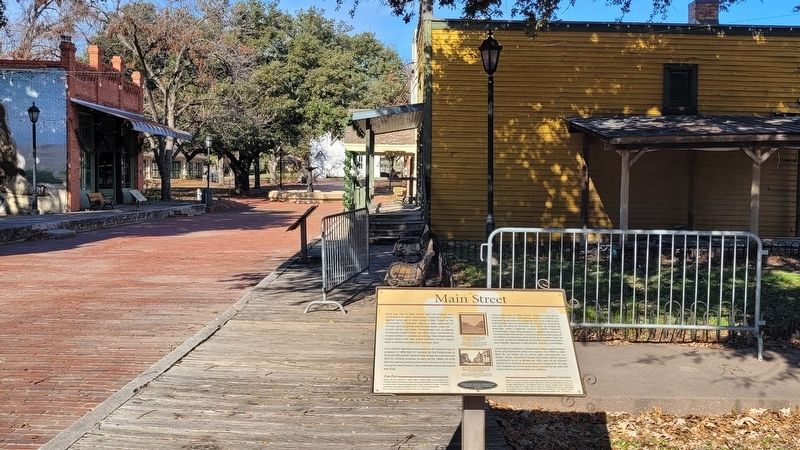
2. Main Street Marker
Topics. This historical marker is listed in this topic list: Notable Buildings. A significant historical year for this entry is 1899.
Location. 32° 46.372′ N, 96° 47.298′ W. Marker is in Dallas, Texas, in Dallas County. It is in Cedars. It is at the intersection of Gano Street and S St Paul Street on Gano Street. The marker is located along the street just past the entrance to the historical park. Touch for map. Marker is at or near this postal address: 1717 Gano Street, Dallas TX 75215, United States of America. Touch for directions.

Regionally, this marker is in the Prairies & Lakes Region. Globally, it is in North America, a Gulf of Mexico state, the Western Hemisphere, the Western World, and the Anglosphere. Historically, it finds itself in what was once New Spain, the Republic of Texas, one of the Confederate States of America, and the Antebellum South.
Other nearby markers. At least 8 other markers are within walking distance of this marker: Blum Brothers General Store (a few steps from this marker); Citizen's Bank (a few steps from this marker); Railroad Depot (a few steps from this marker);
Photographed by James Hulse, January 7, 2025
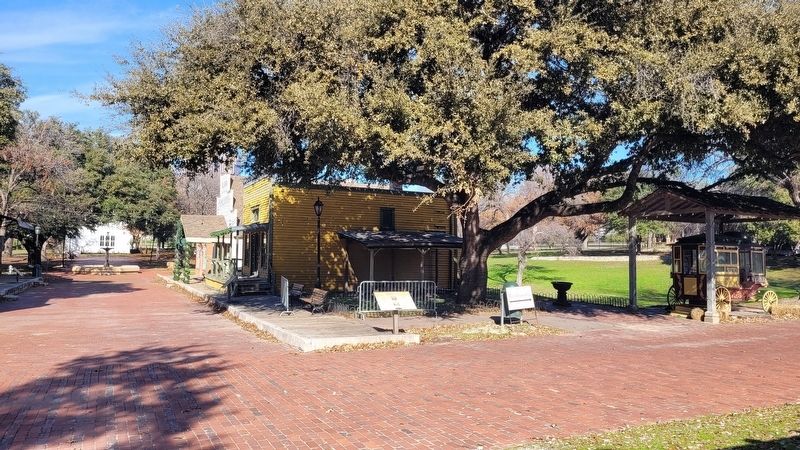
3. The view of Main Street and Marker from the entrance of the park
More about this marker. The historical building and marker are located on the grounds of the Old City Park which is a free park managed by the City of Dallas.
Credits. This page was last revised on January 9, 2025. It was originally submitted on January 7, 2025, by James Hulse of Medina, Texas. This page has been viewed 212 times since then and 39 times this year. Photos: 1, 2, 3. submitted on January 8, 2025, by James Hulse of Medina, Texas.
