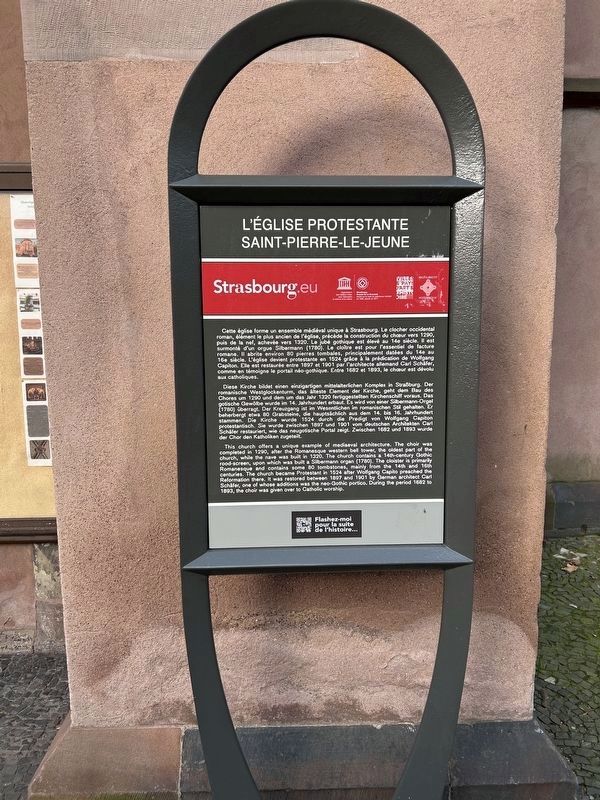
L'Église Protestant Saint-Pierre-le-Jeune. . Cette église forme un ensemble médiéval unique à Strasbourg. Le clocher occidental runs de la net, le plus a ves de 20.lie ie pre gole la oest utive du the rece. 12%0, Le jubé gothique est élevé au 14e siècle. Il est surmonté d'un orgue Silbermann (1780). Le cloître est pour l'essentiel de facture Silbermann (1780). Le cloitre est pour l'essentiel de facture romane. Il abrite environ 80 pierres tombales, principalement datées du 14e au 16e siècle. L'église devient protestante en 1524 grâce à la prédication de Wolfgang Capiton. Elle est restaurée entre 1897 et 1901 par l'architecte allemand Carl Schäfer, comme en témoigne le portail néo-gothique. Entre 1682 et 1893, le choe ur est dévolu aux catholiques., , Diese Kirche bildet einen einzigartigen mittelalterlichen Komplex in Straßburg. Der romanische Westglockenturm, das älteste Element der Kirche, geht dem Bau des Chores um 1290 und dem um das Jahr 1320 fertiggestellten Kirchenschiff voraus. Das gotische Gewölbe wurde im 14. Jahrhundert erbaut. Es wird von einer Silbermann-Orgel (1780) überragt. Der Kreuzgang ist im Wesentlichen im romanischen Stil gehalten. Er beherbergt etwa 80 Grabsteine, die hauptsächlich aus dem 14. bis 16. Jahrhundert stammen. Die Kirche wurde 1524 durch die Predigt von Wolfgang Capiton protestantisch. Sie wurde zwischen 1897 und 1901 vom deutschen Architekten Carl Schäfer restauriert, wie das neugotische Portal zeigt. Zwischen 1682 und 1893 wurde der Chor den Katholiken zugeteilt., , This church offers a unique example of mediaeval architecture. The choir was completed in 1290, after the Romanesque western bell tower, the oldest part of the church, while the nave was built in 1320. The church contains a 14th-century Gothic rood-screen, upon which was built a Silbermann organ (1780). The cloister is primarily Romanesque and contains some 80 tombstones, mainly from the 14th and 16th centuries. The church became Protestant in 1524 after Wolfgang Capito preached the Reformation there. It was restored between 1897 and 1901 by German architect Carl Schäfer, one of whose additions was the neo-Gothic portico. During the period 1682 to 1893, the choir was given over to Catholic worship.
Cette église forme un ensemble médiéval unique à Strasbourg. Le clocher occidental runs de la net, le plus a ves de 20.lie ie pre gole la oest utive du the rece. 12%0,
Le jubé gothique est élevé au 14e siècle. Il est
surmonté d'un orgue Silbermann (1780). Le cloître est pour l'essentiel de facture
Silbermann (1780). Le cloitre est pour l'essentiel de facture
romane. Il abrite environ 80 pierres tombales, principalement datées du 14e au 16e siècle. L'église devient protestante en 1524 grâce à la prédication de Wolfgang Capiton. Elle est restaurée entre 1897 et 1901 par l'architecte allemand Carl Schäfer, comme en témoigne le portail néo-gothique. Entre 1682 et 1893, le choe
ur est dévolu aux catholiques.
Diese Kirche bildet einen einzigartigen mittelalterlichen Komplex in Straßburg. Der romanische Westglockenturm, das älteste Element der Kirche, geht dem Bau des Chores um 1290 und dem um das Jahr 1320 fertiggestellten Kirchenschiff voraus. Das gotische Gewölbe wurde im 14. Jahrhundert erbaut. Es wird von einer Silbermann-Orgel
(1780) überragt. Der Kreuzgang ist im Wesentlichen im romanischen Stil gehalten. Er beherbergt
Click or scan to see this page online
etwa 80 Grabsteine, die hauptsächlich aus dem 14. bis 16. Jahrhundert stammen. Die Kirche wurde
1524 durch die Predigt von Wolfgang Capiton
protestantisch. Sie wurde zwischen 1897 und 1901 vom deutschen Architekten Carl Schäfer restauriert, wie das neugotische Portal zeigt. Zwischen 1682 und 1893 wurde der Chor den Katholiken zugeteilt.
This church offers a unique example of mediaeval architecture. The choir was completed in 1290, after the Romanesque western bell tower, the oldest part of the church, while the nave was built in 1320. The church contains a 14th-century Gothic rood-screen, upon which was built a Silbermann organ (1780). The cloister is primarily Romanesque and contains some 80 tombstones, mainly from the 14th and 16th centuries. The church became Protestant in 1524 after Wolfgang Capito preached the Reformation there. It was restored between 1897 and 1901 by German architect Carl Schäfer, one of whose additions was the neo-Gothic portico. During the period 1682 to 1893, the choir was given over to Catholic worship.
7° 44.793′ E. Marker is in Strasbourg, Grand Est (Alsace, Lorraine, Champagne-Ardenne), in Bas-Rhin. It is in Quartier de la Cathédrale. It is on Rue Thomann near Rue Thomann, on the right when traveling east. Touch for map. Marker is at or near this postal address: Place de Saint Pierre le Jeune, Strasbourg, Grand Est 67000, France. Touch for directions.
Regionally, it is in the North Atlantic Region,Europe, the European Union, Atlantic Europe, the Schengen Area, Western Europe, a coastal Mediterranean country, and the Western World. Historically, it finds itself in what was once a French colony, the Roman Empire, and specifically the Holy Roman Empire.
Credits. This page was last revised on January 11, 2025. It was originally submitted on January 10, 2025, by Steve Stoessel of Niskayuna, New York. This page has been viewed 141 times since then and 17 times this year. Photos:1, 2. submitted on January 10, 2025, by Steve Stoessel of Niskayuna, New York.