Williamson in Pike County, Georgia — The American South (South Atlantic)
The Huey UH-1H Was the Workhorse of Vietnam
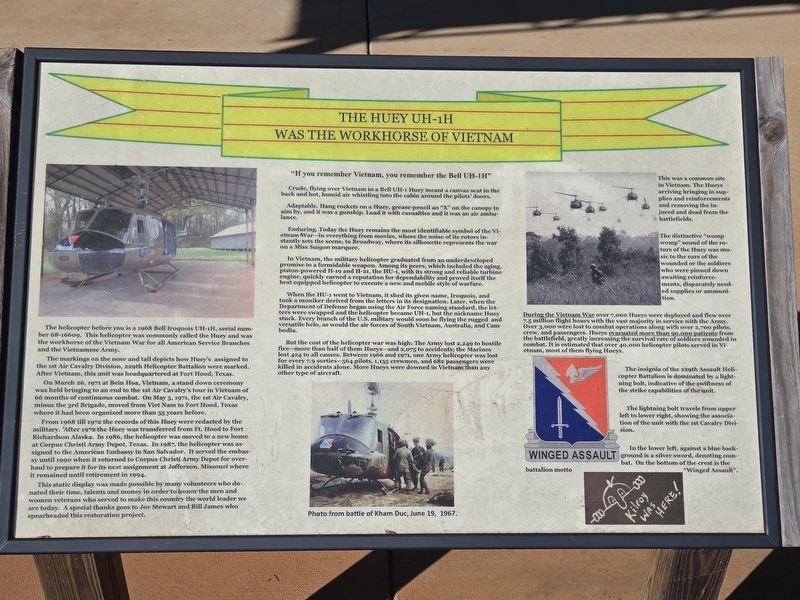
"If you remember Vietnam, you remember the Bell UH-1H"
Photographed by Mark Parker, January 7, 2025
1. The Huey UH-1H Was the Workhorse of Vietnam Marker
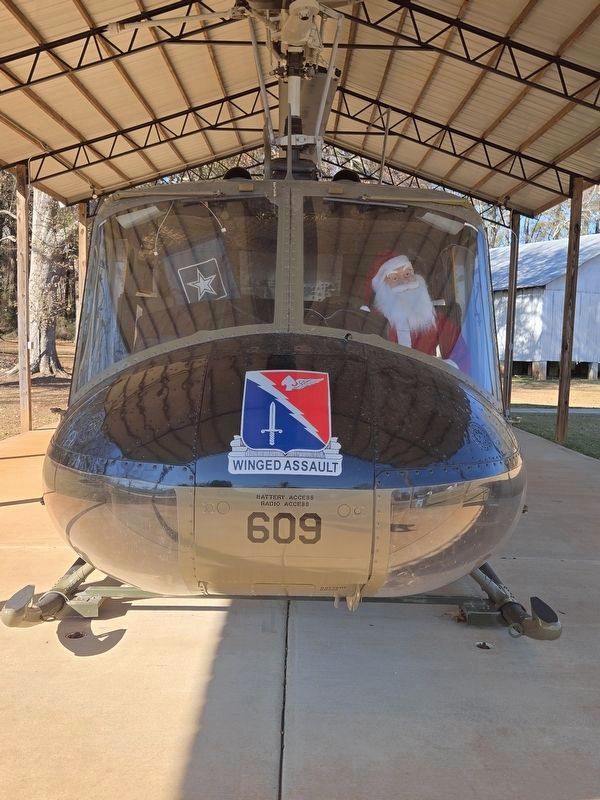
The markings on the nose and tall depicts how Huey's assigned to the 1st Air Cavalry Division, 229th Helicopter Battalion were marked. After Vietnam, this unit was headquartered at Fort Hood, Texas.
On March 26, 1971 at Bein Hoa, Vietnam, a stand down ceremony was held bringing to an end to the sat Air Cavalry's tour in Vietnam of 66 months of continuous combat. On May 5, 1971, the 1st Air Cavalry, minus the 3rd Brigade, moved from Viet Nam to Fort Hood, Texas where it had been organized more than 55 years before.
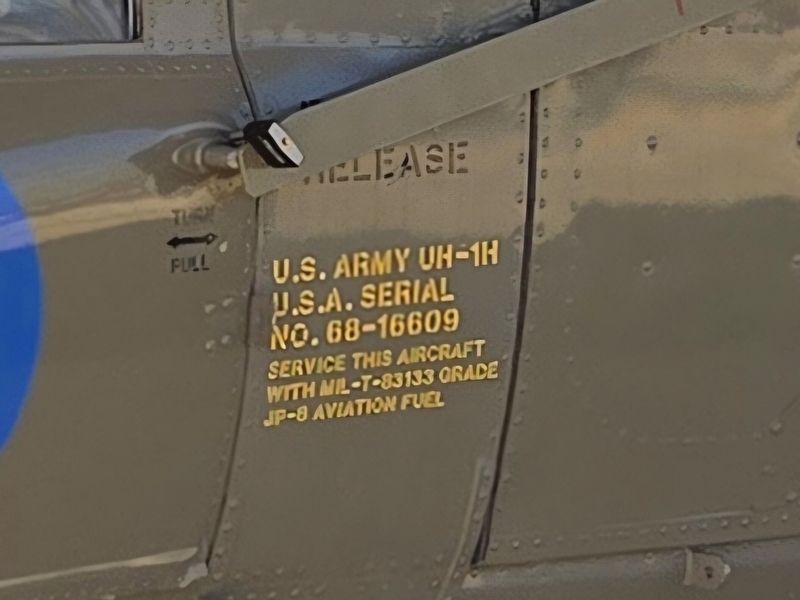
From 1968 till 1972 the records of this Huey were redacted by the military. After 1972 the Hoey was transferred from Ft. Hood to Fort Hood Richardson Alaska. In 1986, the helicopter was moved to a new home at Corpus Christi Army Depot, Texas. In 1987, the helicopter was assigned to the American Embassy in San Salvador. It served the embassy until 1990 when it returned to when it returned
this page online
This static display was made possible by many volunteers who donated their time, talents and money in order to honor the men and women veterans who served to make this country the world leader we are today. A special thanks goes to Joe Stewart and Bill James who spearheaded this restoration project.
Crude, flying over Vietnam in a Bell UH-1 Huey meant a canvas seat in the back and hot, humid air whistling into the cabin around the pilots doors.
Adaptable. Hang rockets on a Huey, grease pencil an "X" on the canopy to aim by, and it was a gunship. Load it with casualties and it was an air ambulance.
Enduring. Today the Huey remains the most identifiable symbol of the Vietnam War—in everything from movies, where the noise of its rotors instantly sets the scene, to Broadway, where its silhouette represents the war on a Miss Saigon marquee.
In Vietnam, the military helicopter graduated from an underdeveloped promise to a formidable weapon. Among its peers, which included the aging
Photographed by Mark Parker, January 7, 2025
2. Front view of a 1968 Bell Iroquois UH-1, 29th Assault Helicopter Battalion insignia
When the HU-1 went to Vietnam, it shed its given name, Iroquois, and took a moniker derived from the letters in its designation. Later, when the Department of Defense began using the Air Force naming standard, the letters were swapped and the helicopter became UH-1, but the nickname Huey stuck. Every branch of the US military would soon be flying the rugged and versatile helo, as would the air forces of South Vietnam, Australia, and Cambodia.
But the cost of the helicopter war was high: The Army lost 2,249 to hostile fire—more than half of them Hueys—and 2,075 to accidents; the Marines lost 424 to all cases. Between 1966 and 1971, one Army helicopter was lost for every 7.9 sorties—564 pilots, 1,155 crewmen, and 682 passengers were killed in accidents alone. More Hueys were downed in Vietnam than any other type of aircraft.
During the Vietnam War over 7,000 Hueys were deployed and flew over 7.5 million flight
Photographed by Mark Parker, January 7, 2025
3. Huey UH-1H Serial No. 68-16609
(captions)
Photo from battle of Kham Duc, June 19, 1967.
This was a common site in Vietnam. The Hueys arriving bringing in supplies and reinforcements and removing the injured and dead from the battlefields.
The distinctive "womp womp" sound of the rotors of the Huey was music to the ears of the wounded or the soldiers who were planed down awaiting reinforcements, desperately needed supplies or ammunition.
battalion motto
The insignia of the 229th Assault Helicopter Battalion is dominated by a lightning bolt, indicative of the swiftness of the strike capabilities of the unit.
The lightning bolt travels from upper left to lower right, showing the association of the unit with the 1st Cavalry Division.
In the lower left, against a blue background
Photographed by Mark Parker, January 7, 2025
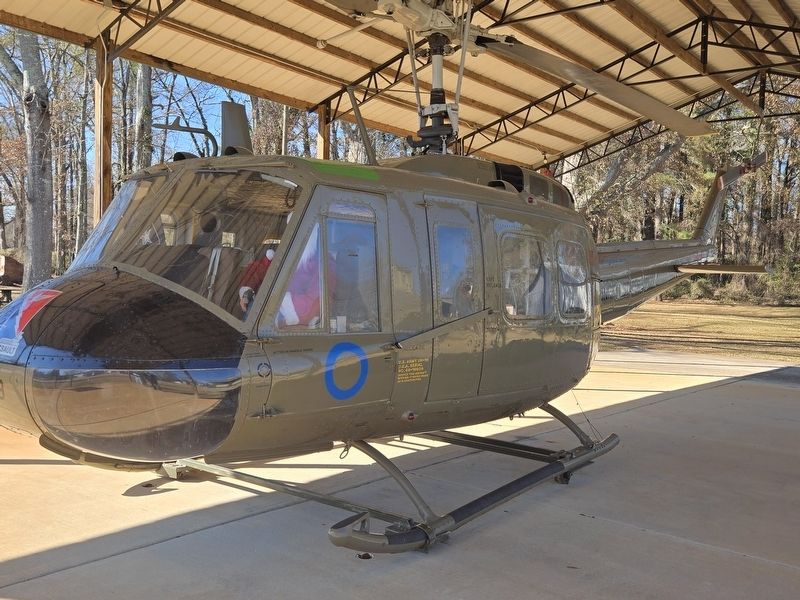
4. Left front side of 1968 Bell Iroquois UH-1H
Topics. This historical marker is listed in this topic list: War, Vietnam. A significant historical year for this entry is 1968.
Location. 33° 10.988′ N, 84° 21.656′ W. Marker is in Williamson, Georgia, in Pike County. It is on Williamson Zebulon Road (Georgia Route 362) north of 2nd District Road, on the left when traveling north. The helicopter and marker are next door to the Williamson Library. Touch for map. Marker is in this post office area: Williamson GA 30292, United States of America. Touch for directions.

Regionally, this marker is in the Piedmont. It is also in the American South and specifically in the Deep South. Globally, it is in North America, the Western Hemisphere, the Western World, and the Anglosphere. Historically, it finds itself in what was once the territory of the Mississippian Culture, one of the original Thirteen Colonies, one of the Confederate States of America, and the Antebellum South.
Other nearby markers. At least 8 other markers are within 7 miles of this marker, measured as the crow flies: Williamson Veterans Memorial
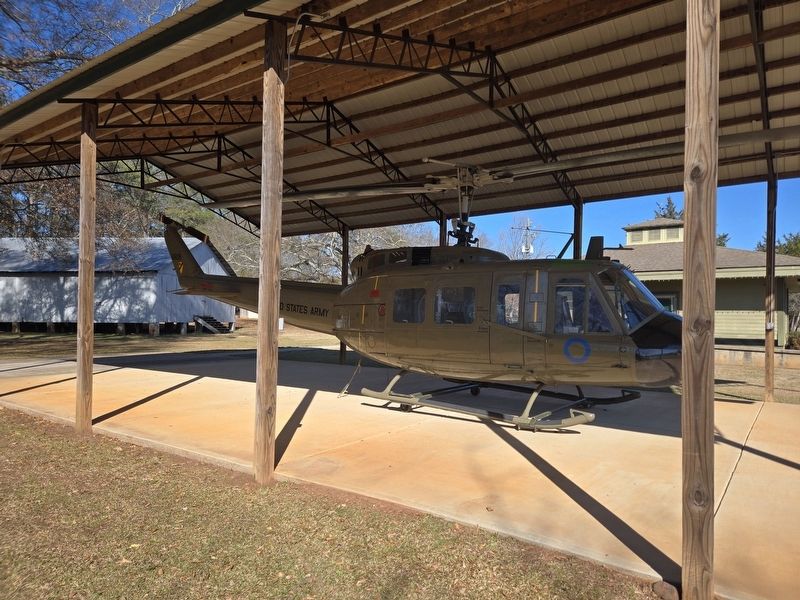
Photographed by Mark Parker, January 7, 2025
5. Right side of 1968 Bell Iroquois UH-1
Credits. This page was last revised on January 11, 2025. It was originally submitted on January 10, 2025, by Mark Parker of Hickory, North Carolina. This page has been viewed 852 times since then and 103 times this year. Photos: 1, 2, 3, 4, 5. submitted on January 10, 2025, by Mark Parker of Hickory, North Carolina. • Bernard Fisher was the editor who published this page.
