Historic District in Wilmington in New Hanover County, North Carolina — The American South (South Atlantic)
Bell House
1893
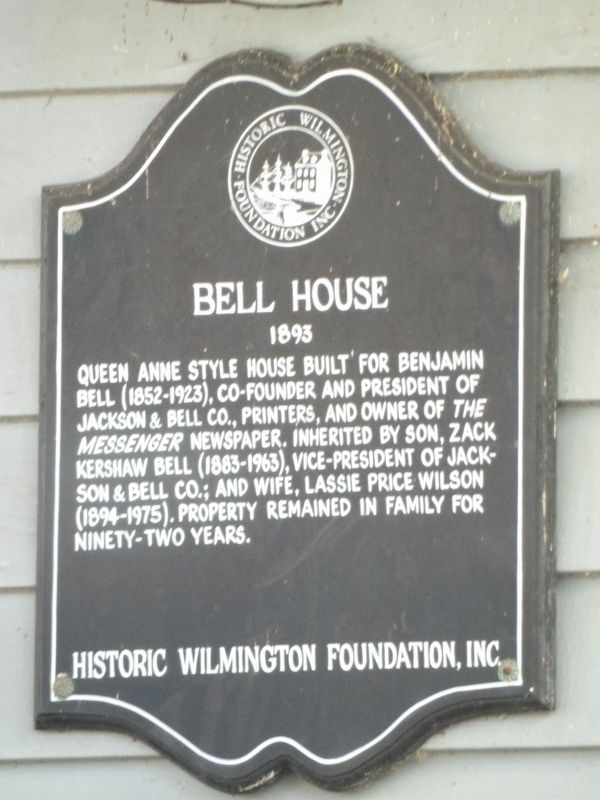
Photographed by Duane and Tracy Marsteller, November 23, 2024
1. Bell House Marker
Erected by Historic Wilmington Foundation, Inc.
Topics and series. This historical marker is listed in these topic lists: Architecture • Communications • Industry & Commerce. In addition, it is included in the National Register of Historic Places (NRHP), and the North Carolina, Historic Wilmington Foundation series lists. A significant historical year for this entry is 1893.
Location. 34° 13.894′ N, 77° 56.664′ W. Marker is in Wilmington, North Carolina, in New Hanover County. It is in the Historic District. It is on South 4th Street south of Ann Street, on the right when traveling south. Touch for map. Marker is at or near this postal address: 306 S 4th St, Wilmington NC 28401, United States of America. Touch for directions.

Regionally, this marker is in the Coastal Plain and
this page online
Other nearby markers. At least 8 other markers are within walking distance of this marker: Storm House (a few steps from this marker); Martha Munds House (within shouting distance of this marker); Hankins-Bannerman House (within shouting distance of this marker); DeRosset-Farriss House (within shouting distance of this marker); Edward P. Bailey House (within shouting distance of this marker); Howey-Wiard House (within shouting distance of this marker); Benton House (within shouting distance of this marker); Tileston School (within shouting distance of this marker). Touch for a list and map of all markers in Wilmington.
Also see . . .
1. Wilmington Historic District (PDF).
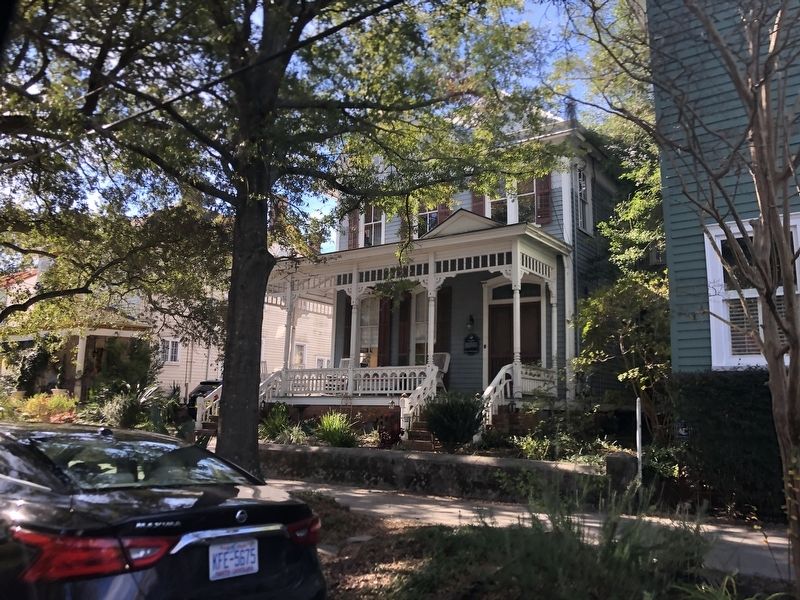
Photographed by Duane and Tracy Marsteller, November 24, 2024
2. Bell House Marker
2. Wilmington Historic District Boundary Expansion and Additional Documentation (PDF). National Register nomination that expanded the district in 2003. (Prepared by Sherry Joines Wyatt and L. Robbie King; via North Carolina State Historic Preservation Office) (Submitted on January 11, 2025, by Duane and Tracy Marsteller of Murfreesboro, Tennessee.)
Additional commentary.
1. The Wilmington Messenger
Excerpt from Chronicles of the Cape Fear River, 1660-1916 by James Sprunt (1916):
The Wilmington Messenger, which was founded by Julius A. Bonitz, was removed to Wilmington from Goldsboro in May, 1887, at the solicitation of a number of Wilmington's most influential business men, and the first issue was printed June 29 of the same year in the old Journal Building onPrincess Street. Mr. Bonitz was induced to move to Wilmington after his plant had twice been destroyed by fire within a few years. It was said that he gave Wilmington the most progressive Democratic daily paper of its period. He continued as owner and editor up to the time of his death, February 7, 1891, and on April 5 of the same year the plant and good will were purchased under foreclosure by Messrs. J. W. Jackson and Benjamin Bell, and the paper was published under the firm name of Jackson & Bell.Biographical sketches of Wilmington citizens, R.H. Fisher; via E. Carolina University (Public Domain)3. Benjamin Bell, Sr. (1852-1923)
The Messenger was printed without missing a single issue from Mr. Bonitz's death until it was taken over by the new proprietors, and it was continued as an eight-page publication.
The paper under its new ownership was improved from time to time, and for many years was one of the best edited and most influential newspapers in eastern North Carolina. As a leader in the campaign for white supremacy in 1898, under the editorship of Dr. T. B. Kingsbury, the Messenger did commendable service and was recognized throughout the State as a powerful factor in aiding the Democratic party to accomplish the political reforms of that period. [See note below]
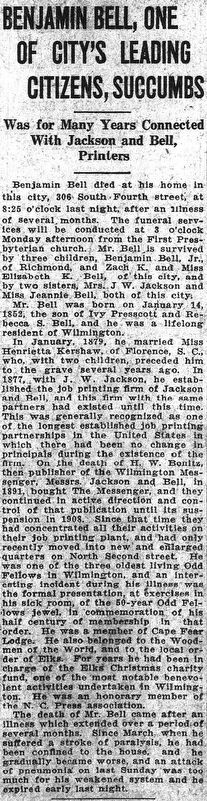
Dr.Kingsbury was succeeded in the editorial chair by Samuel T. Ashe, another experienced editor, who remained with the Messenger until its suspension.Photographed by Duane and Tracy Marsteller4. Benjamin Bell, Sr. obituaryAppeared in the Dec. 16, 1923 edition of the Wilmington Morning Star.
The Messenger suspended publication June 5, 1907, after serving well its day and generation for twenty years. The proprietors discontinued the paper in order to give closer attention to the job department of the plant, this feature of the business having greatly increased and having become more profitable than the newspaper.

Note: The "political reforms" was a deadly coup d'état, engineered by avowed white supremacist Democrats, that overthrew the democratically elected, multi-racial Fusionist city government. Many African Americans – estimates range from 40 to over 300 – were killed by armed whites during the Nov. 10, 1898 event, which remains the only coup to occur on American soil. Most of Wilmington's African-American population fled and never returned to the city, which became a white supremacist bastion and early adopter of Jim Crow laws. The Messenger and other newspapers falsely portrayed the violence as a "race riot" by African Americans. The episode later was rarely mentioned, if at all, in history books for more than a century.
— Submitted January 11, 2025, by Duane and Tracy Marsteller of Murfreesboro, Tennessee.
Credits. This page was last revised on January 11, 2025. It was originally submitted on January 11, 2025, by Duane and Tracy Marsteller of Murfreesboro, Tennessee. This page has been viewed 242 times since then and 88 times this year. Photos: 1, 2, 3, 4. submitted on January 11, 2025, by Duane and Tracy Marsteller of Murfreesboro, Tennessee.
