Hot Springs in Garland County, Arkansas — The American South (West South Central)
Visitors Chapel AME
Photographed by Cosmos Mariner, September 15, 2024
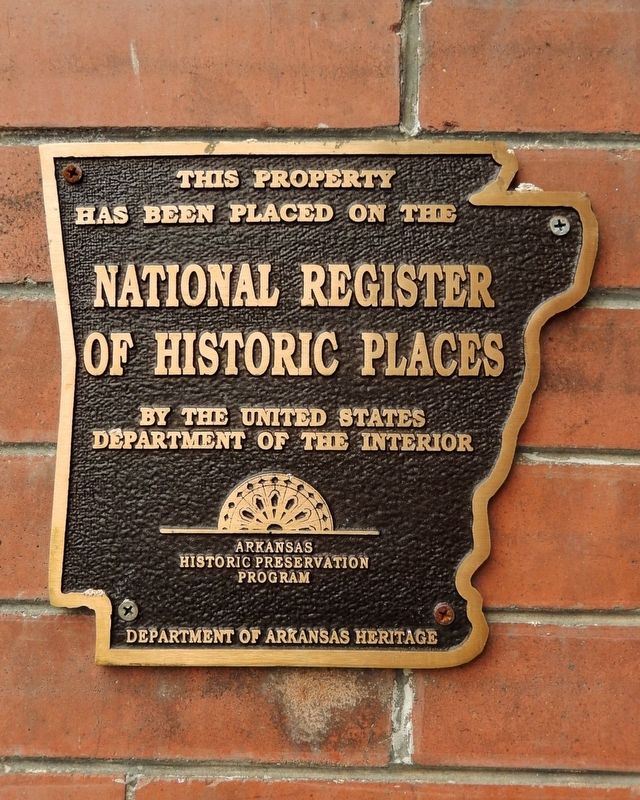
1. Visitors Chapel AME Marker
has been placed on the
National Register
of Historic Places
by the United States
Department of the Interior
Arkansas Historic Preservation Program
Department of Arkansas Heritage
Topics and series. This historical marker is listed in these topic lists: African Americans • Architecture • Notable Buildings • Religion & Religious Structures. In addition, it is included in the National Register of Historic Places (NRHP) series list. A significant historical year for this entry is 1913.
Location. 34° 30.524′ N, 93° 3.025′ W. Marker is in Hot Springs, Arkansas, in Garland County. It is on Church Street just east of Cottage Street, on the left when traveling east. The marker is mounted at eye-level between the doors at the southwest corner of the subject building. Touch for map. Marker is at or near this postal address: 319 Church Street, Hot Springs National Park AR 71901, United States of America. Touch for directions.

Regionally, this marker is in the Ouachita Mountains. It is also in the American South and specifically in the Upper South. Globally, it is in North America, the Western Hemisphere,
this page online
Other nearby markers. At least 8 other markers are within walking distance of this marker: The Great Fire of 1913 Left this City in Ruins (about 500 feet away, measured in a direct line); Arkansas Blarney Stone (about 500 feet away); Kenji Miyazawa (about 500 feet away); Old Post Office (about 700 feet away); National Baptist Hotel (about 800 feet away); Switchmen's Union of North America (about 800 feet away); Hot Springs Intracity Transit National Historic Register (about 800 feet away); United Transportation Union (about 800 feet away). Touch for a list and map of all markers in Hot Springs.
Regarding Visitors Chapel AME. National Register of Historic Places № 95000682. Also a contributing property in Hot Springs Pleasant Street Historic District, NRHP № 03000532.
From the National Register Nomination prepared by Ken Story, 4/18/1995:
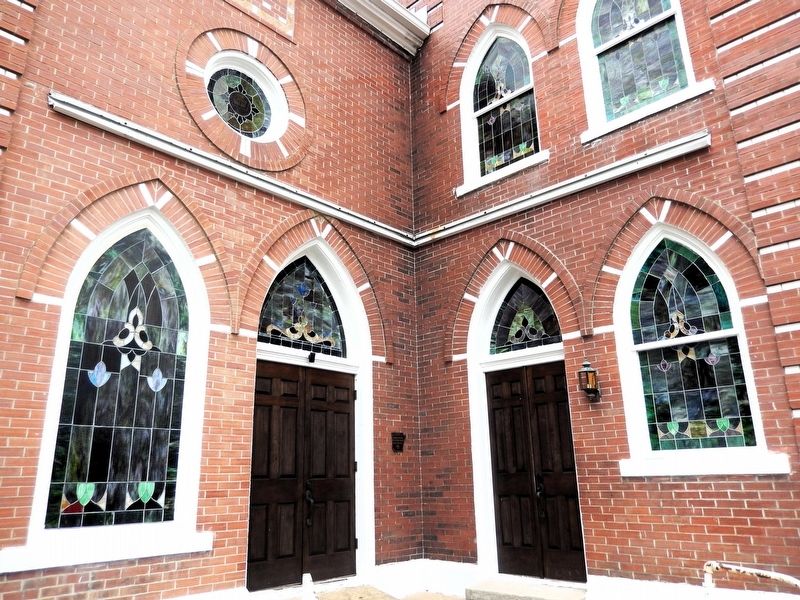
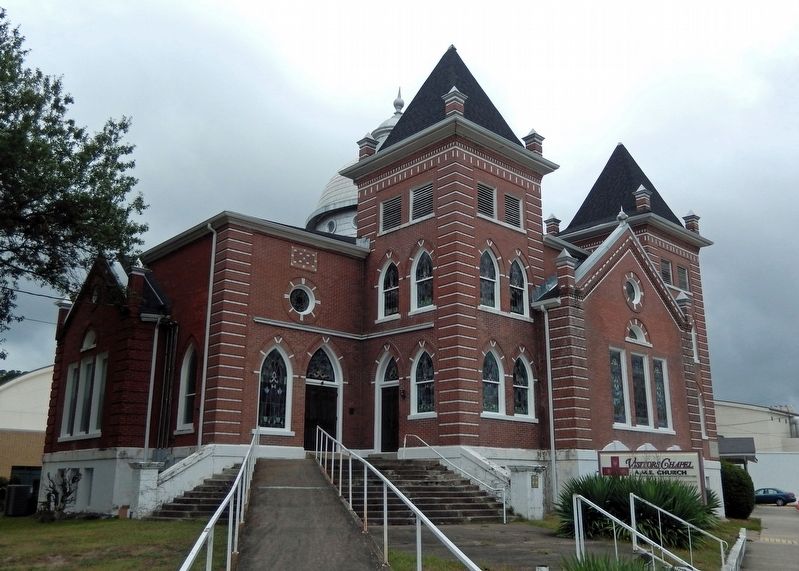
Little is known about the earliest African American settlementin the area, though it is certain that there was at least a small community of some size in 1868, as it was in that year that the Rev. Henderson Patillo and Rev. B. W. Whitlow came to Hot Springs from Malvern via the old highway in a wagon to preach to a small group of Negro worshippers that met outdoors. Reportedly the first church was a "log cabin" structure that burned in 1878, as did the next two buildings constructed, the first in 1905 and the second in 1913. Construction on the present building was begun that year under the Pastorate of the Rev. H. G. Montgomery (at some point the congregation had aligned themselves with the African Methodist Episcopal Church, the large African American church that had organized congregations nationwide, though particularly in the South).Photographed by Cosmos Mariner, September 15, 20242. Visitors Chapel AME MarkerThe marker is mounted between the doors at the southwest corner of the church.The Visitors Chapel A. M. E. is architecturally significant by virtue of its status as a unique synthesis of both the Gothic Revival styles and the Classical Revival styles. Overall, the church is primarily Gothic Revival in style, to which the pyramidal towers, lancet window and door openings, and stained-glass attest. The round, metal-clad dome, however, is
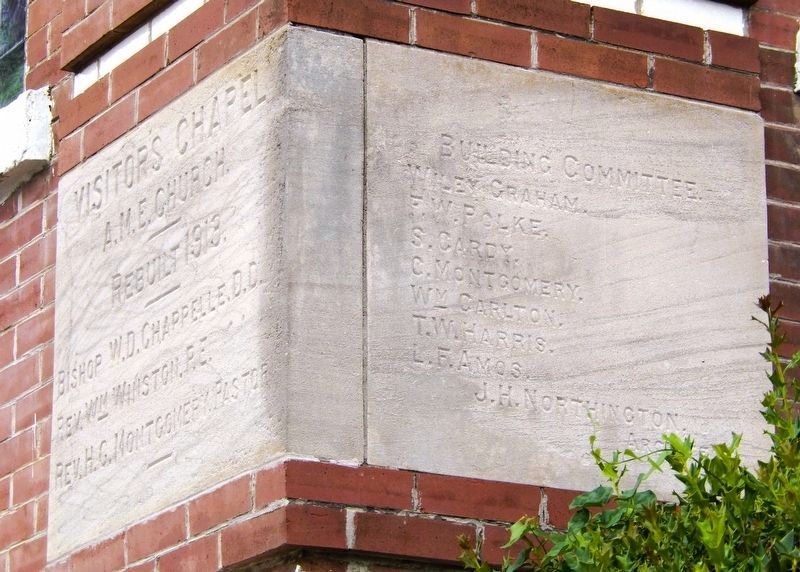
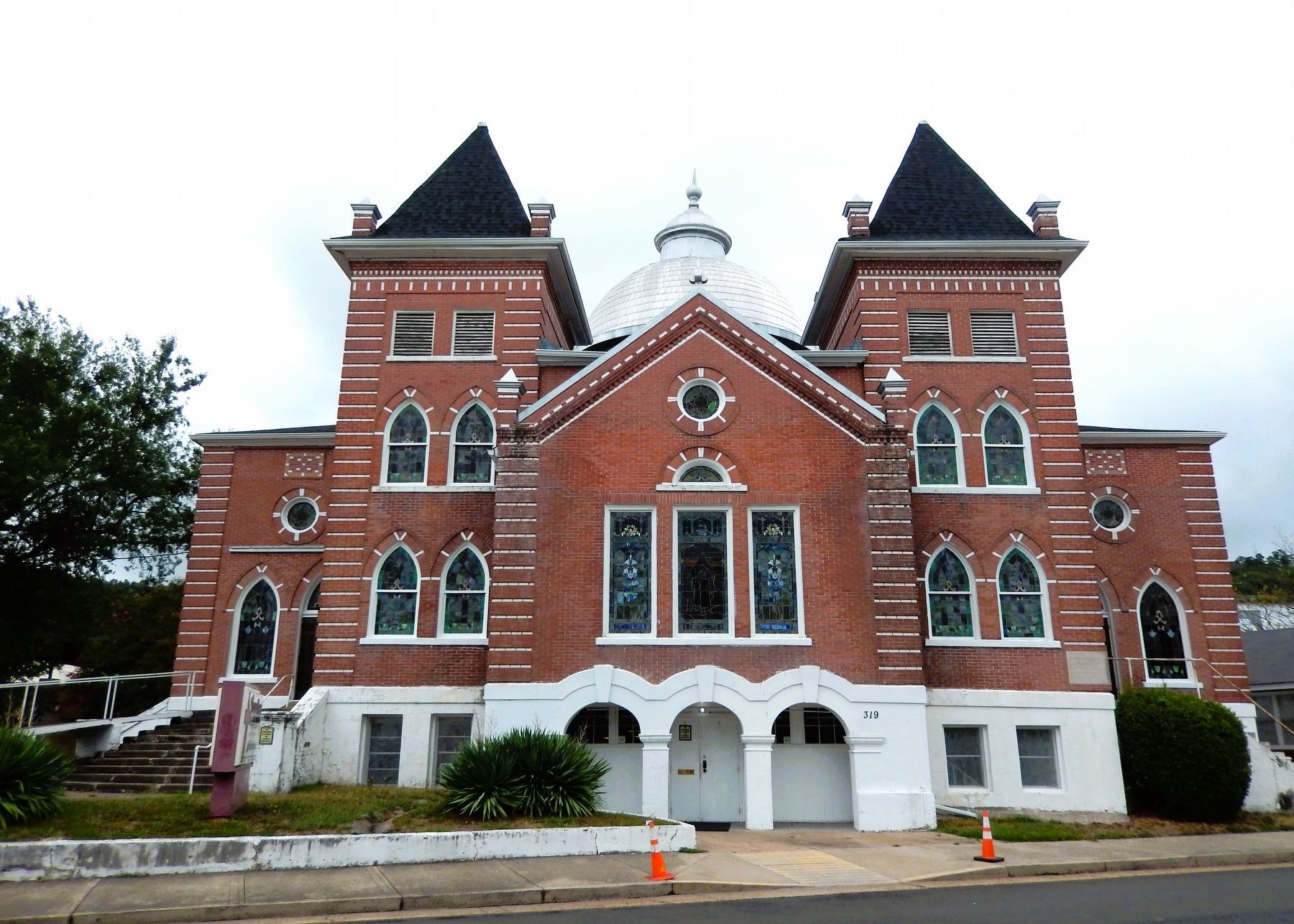
distinctly of Classical origin. The combination lends the composition an almost Byzantine appearance, an effect quite possibly intended by the architect, as African American congregations, though Christian, frequently identified with Moslem symbols and forms. Whatever its origins, this marriage of the Classical and Gothic traditions is most remarkable by virtue of how aesthetically successful it is. Rather than looking like one style crudely pasted on top of another, the rising of the low, hipped roof into the round dome strikes the eye as a perfectly natural resolution of the roof, and of the design as a whole. This effect is carried over into the interior also, as the round base of the dome is echoed by the rounded arches that punctuate the loft spaces directly behind the dais.Photographed by Cosmos Mariner, September 15, 20243. Visitors Chapel AME Cornerstone(at the southeast corner of the building)
Visitor’s Chapel
A.M.E. Church.
Rebuilt 1913.
Bishop W.D. Chappelle, D.D.
Rev. Wm Winston, P.E.
Rev. H.G. Montgomery, Pastor
———
Building Committee
Wiley Graham • F.W Polke • S. Cardy • C. Montgomery •
Wm Carlton • T.W. Harris • L.F. Amos
J.H. Northington, Architect
Also see . . . Visitors Chapel AME (Wikipedia).
Excerpt: The Visitors Chapel AME is a three-story brick building, designed in a distinctive combination of Classical and Gothic Revival styles by J.H. Northington and built in 1913. The church has a Greek cruciform plan with a dome at the center, with a Classical gable-front flanked by towers(Submitted on January 13, 2025, by Cosmos Mariner of Cape Canaveral, Florida.)with Gothic windows. An African Methodist Episcopal congregation is believed to have existed in Hot Springs since the 1870s; this building is the fourth it is known to have built. It is named in honor of the many outsiders who come to worship with the regular congregants. The building was listing on the National Register of Historic Places in 1995.Photographed by Cosmos Mariner, September 15, 20244. Visitors Chapel AME (southwest elevation)
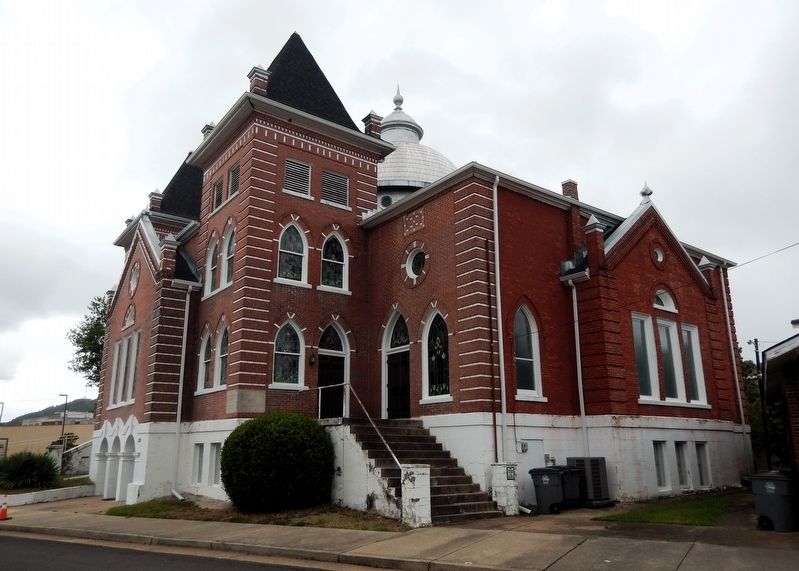
Photographed by Cosmos Mariner, September 15, 2024
5. Visitors Chapel AME (southeast elevation)
Photographed by Cosmos Mariner, September 15, 2024
6. Visitors Chapel AME (south/front elevation)
From the National Register Nomination: The southern or front elevation is composed of the pair of tall, pyramidal-roof towers that flank the central gable and the side walls of the main hipped roof section behind. The central gable displays a recessed basement entrance fronted by three concrete entrance arches. Placed centrally above are three rectangular stained-glass windows, which in turn are surmounted by a small semi-circular window, followed by a full oculus window placed near the gable peak. The flanking towers each contain two rectangular basement windows, two pair of stained-glass lancet windows on each of the two levels above and are finished by a pair of rectangular louvered vents placed just below the cornice. Directly behind the central gable rises the metal-roofed dome.
Credits. This page was last revised on January 13, 2025. It was originally submitted on January 13, 2025, by Cosmos Mariner of Cape Canaveral, Florida. This page has been viewed 239 times since then and 63 times this year. Photos: 1, 2, 3, 4, 5, 6. submitted on January 13, 2025, by Cosmos Mariner of Cape Canaveral, Florida.
