Hot Springs in Garland County, Arkansas — The American South (West South Central)
Walter Beauchamp House
Photographed by Cosmos Mariner, September 13, 2024
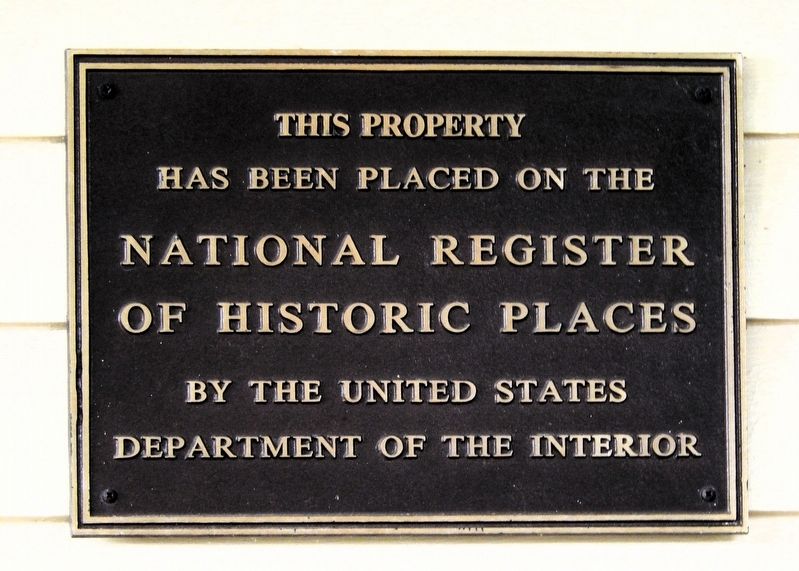
1. Walter Beauchamp House Marker
has been placed on the
National Register
of Historic Places
by the United States
Department of the Interior
Topics and series. This historical marker is listed in these topic lists: Architecture • Notable Buildings. In addition, it is included in the National Register of Historic Places (NRHP) series list. A significant historical year for this entry is 1905.
Location. 34° 30.447′ N, 93° 3.634′ W. Marker is in Hot Springs, Arkansas, in Garland County. It is at the intersection of Prospect Avenue and Hawthorne Lane, on the right when traveling west on Prospect Avenue. The marker is mounted at eye-level, directly on the subject house, on the right side of the front entrance. Touch for map. Marker is at or near this postal address: 492 Prospect Avenue, Hot Springs National Park AR 71901, United States of America. Touch for directions.

Regionally, this marker is in the Ouachita Mountains. It is also in the American South and specifically in the Upper South. Globally, it is in North America, the Western Hemisphere, the Western World, and the Anglosphere. Historically, it finds itself in what was once the
this page online
Other nearby markers. At least 8 other markers are within walking distance of this marker: Hot Springs Baseball Grounds (approx. 0.2 miles away); The Ed. B. Mooney Tree (approx. 0.2 miles away); Garland County Courthouse (approx. 0.2 miles away); Orange Street Presbyterian Church (approx. ¼ mile away); Central Methodist Church (approx. 0.3 miles away); Honus Wagner (approx. 0.3 miles away); Confederate Memorial Park (approx. 0.3 miles away); Dr. and Mrs. D.E. Kloss (approx. 0.3 miles away). Touch for a list and map of all markers in Hot Springs.
Regarding Walter Beauchamp House. National Register of Historic Places № 94000470. Also a contributing property in the Quapaw-Prospect Historic District, NRHP № 99000821.
From the National Register Nomination prepared by Kenneth Story, 3/29/1994:
It was in 1905, on the spacious lot at the northeast corner of Prospect Avenue and Hawthorne Lane, that Walter Beauchamp, a conductor for the Chicago, Rock Island and Pacific Railroad, erected thisresidence for himself and his family. Unfortunately, no other information has survived about either the architect/builder of this structure, or about Walter Beauchamp. It is unfortunate chiefly because of the uniqueness of this design considered within the context of the historic fabric of Hot Springs and the fact that virtually nothing else like it exists or has been known to exist in the entire city.Photographed by Cosmos Mariner, September 13, 20242. Walter Beauchamp House MarkerThe marker is mounted on the right side of the front entrance. The entrance is at the southwest corner of the building, facing Prospect Avenue.
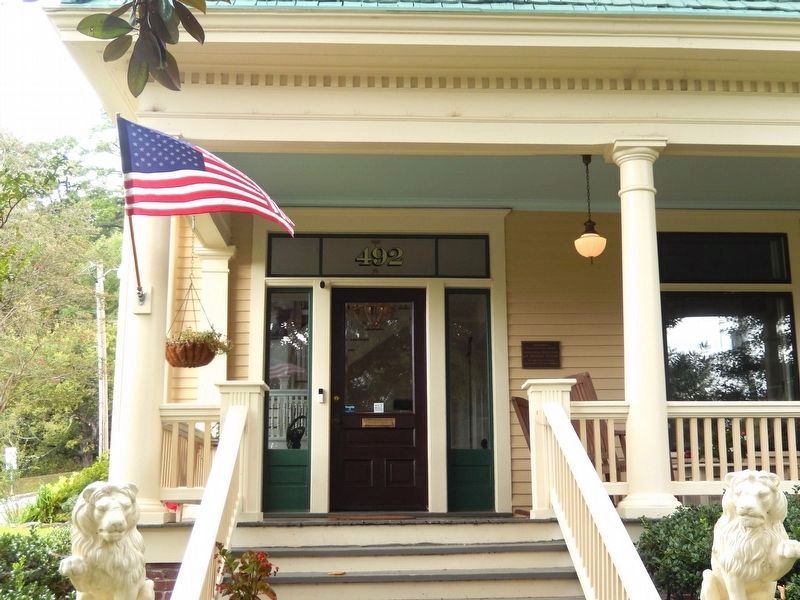
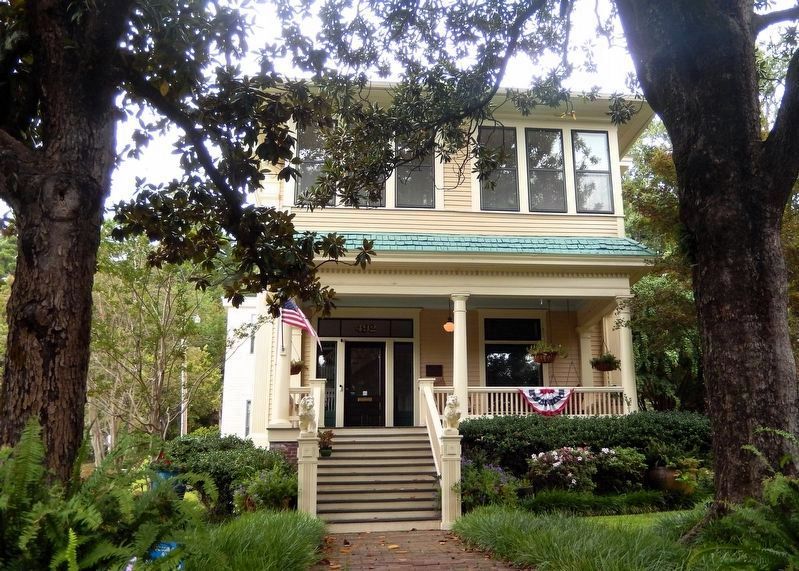
The Walter Beauchamp House is an example of an historic residential building type known as a "Double-Decker." Found in abundance in such industrial northern cities as Boston and Chicago, this type became popular there around the turn of the century as urban, multi-unit tenant housing. The identical porches on both the first and second storys, facing the street, provided residents of each flat with their own porch. However, given that Arkansas's cities tended not to experience the same density of urban population, this housing type did not become as popular here. Its construction on this relatively spacious lot — the dimensions of which are typical of the surrounding historic residential lots — renders its narrow, axial floor plan unnecessary,and thus its choice inexplicable; nevertheless, it remains unusual, even rare. The most likely explanation is that either the architect/builder or Beauchamp himself brought the idea for this design from one of the cities in which this particular type was popular. Regardless of such speculation, it is certain that the Walter Beauchamp House remains the only known example of this uncommon residential building type in Hot Springs.Photographed by Cosmos Mariner, September 13, 20243. Walter Beauchamp House (front/south elevation)From the National Register Nomination: The southern or front facade is dominated by the two-story, front porch that extends almost the full width of the elevation. Resting upon a raised brick foundation that responds to the drop in grade toward this end of the lot, the first story roof is supported upon three free-standing Classical wood columns that are symmetrically placed across the front. Two pilasters support the roof at the rear of the porch. The entrance is formed by a single-leaf wood door that is flanked by three-quarter sidelights and surmounted by a three-pane, stationary transom. On the second story the porch has been enclosed, but from interior structural analysis was originally constructed as an open porch and was enclosed later.
Also see . . . Walter Beauchamp House (Wikipedia).
Excerpt: Built in 1905, it is a "double decker" single-family house, unusual both for its setting on a spacious lot, and for the style, which is uncommon in Hot Springs. The house was listed on the National Register of Historic Places in 1994.(Submitted on January 15, 2025, by Cosmos Mariner of Cape Canaveral, Florida.)
Photographed by Cosmos Mariner, September 13, 2024
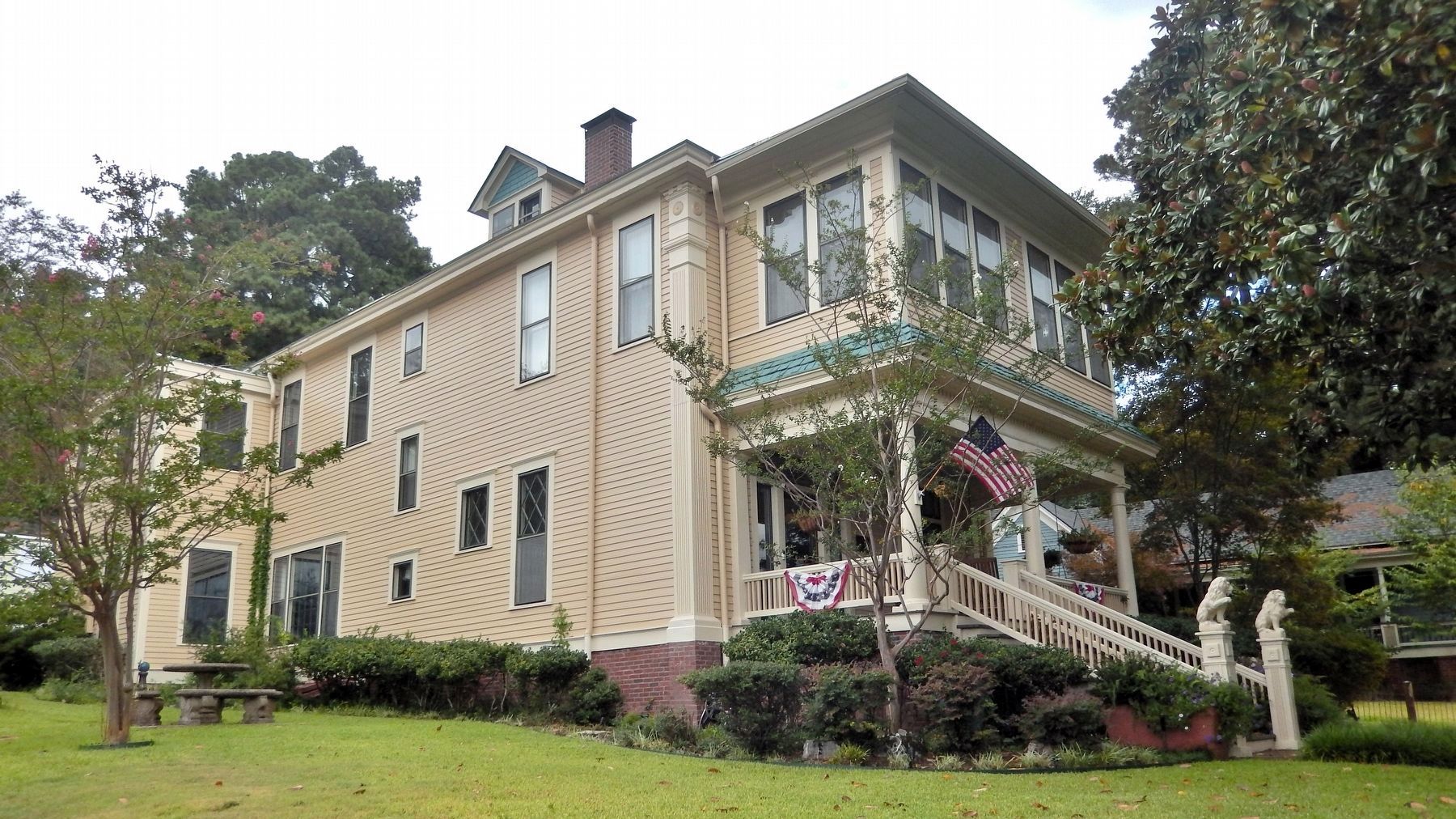
4. Walter Beauchamp House (southwest elevation)
From the National Register Nomination: The western elevation is composed of the side wall of the original structure to the south and the end wall of the later rear "T" to the north. A single gabled dormer, containing two six-pane windows, completes the elevation. Significant exterior details are limited to the Colonial Revival details, most of which are concentrated on or around the front porch. Of particular note are the Classical corner pilasters that frame the elevation, each of which sits upon a base, features a fluted shaft, and terminates in a capital molding that is ornamented with a central patera, and the round Classical columns and the Classical pilasters that support the front porch.
Credits. This page was last revised on January 15, 2025. It was originally submitted on January 14, 2025, by Cosmos Mariner of Cape Canaveral, Florida. This page has been viewed 212 times since then and 32 times this year. Photos: 1, 2, 3, 4. submitted on January 14, 2025, by Cosmos Mariner of Cape Canaveral, Florida.
