Hot Springs in Garland County, Arkansas — The American South (West South Central)
Freeman Harrison Owens
Cinematographer
| — | Hot Springs Arkansas Walk of Fame | — |

Photographed by Cosmos Mariner, September 14, 2024
1. Freeman Harrison Owens Marker
World renowned inventor • Filmed for Essanay, Universal & Fox studios • Had 11,812 inventions & 200 patents including sound for motion pictures, slow motion, 3-D, Neilson Rating System, 16, 35 & 70 mm cameras, Kodak plastic lens making the Brownie camera affordable • Was official U.S. Marine photographer in World War I
Pine Bluff, Arkansas • Inducted 2003
Erected by Hot Springs Arkansas Walk of Fame.
Topics. This historical marker is listed in these topic lists: Entertainment • Industry & Commerce • War, World I.
Location. 34° 30.654′ N, 93° 3.232′ W. Marker is in Hot Springs, Arkansas, in Garland County. It is on Central Avenue (State Highway 7) just north of Spring Street, on the right when traveling north. The marker is embedded in the sidewalk on the north side of the Hot Springs City Visitor Center. Touch for map. Marker is at or near this postal address: 629 Central Avenue, Hot Springs National Park AR 71901, United States of America. Touch for directions.

Regionally, this marker is in the Ouachita Mountains. It is also in the American South and
this page online
Other nearby markers. At least 8 other markers are within walking distance of this marker: Paul Runyan (here, next to this marker); The Martins (here, next to this marker); B. J. Sams (here, next to this marker); Lon Warneke (here, next to this marker); Robert Holthus (here, next to this marker); Carroll Cloar (here, next to this marker); Brent M. Jennings (here, next to this marker); George Hunt (here, next to this marker). Touch for a list and map of all markers in Hot Springs.
Also see . . . Freeman Harrison Owens (1890–1979) (Encyclopedia of Arkansas).
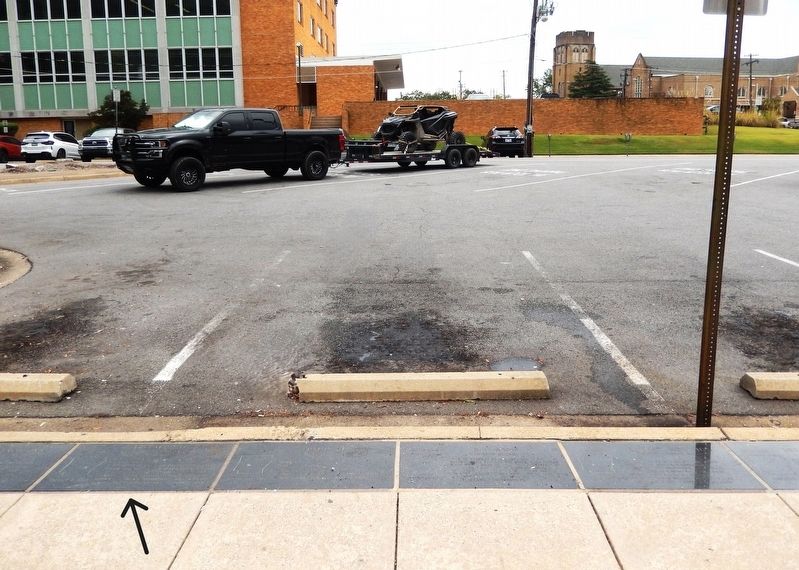
(By Brenda J. Hall) Excerpt: Freeman Owens was born on July 20, 1890, in Pine Bluff, Arkansas. He attended Sixth and Beech Street Elementary School, but he dropped out during his senior year at Pine Bluff High School. He went to work for a movie theater(Submitted on January 15, 2025, by Cosmos Mariner of Cape Canaveral, Florida.)when he was twelve years old. Owens constructed his first movie camera around 1908.Photographed by Cosmos Mariner, September 13, 20242. Freeman Harrison Owens MarkerLooking east from Central Avenue; it is the leftmost of four markers in this photo. The Hot Springs City Visitor Center parking lot is in the background.
In 1910, Owens went to work for producer Carl Laemmle of Independent Moving Pictures, now known as Universal Studios. Owens was hired to film news and special events wherever they occurred in the United States. These were called “newsreels” and were played before the movies.
In 1912, Owens left Universal Studios and went to work for Essanay Studio. Owens filmed special documentaries and worked for AdFilm, a commercial department of Essanay Studio, where he patented inventions for an improved version of motion picture cameras and projectors. Owens worked with movie stars such as Charlie Chaplin, Mary Pickford, Douglas Fairbanks Sr., Wallace Beery, Gloria Swanson, and Ben Turpin.
Owens joined the U.S. Marine Corps Reserve as a quartermaster sergeant on March 26, 1918. He was appointed as an official cameraman, and he filmed Flying with the Marines and immortalized the World War I Battle of Chateau Thierry in France.
Owens invented slow motion for motion picture cameras and projectors in 1920. On August 17, 1920, he filmed in slow motion the great Babe Ruth swatting his home run during the Yankees versus Cleveland game.
After Owens was honorably discharged from the marines on March 25, 1922, he went to work for the “father of radio,” Dr. Lee De Forest of New York. Owens invented and filed a patent application for Phonofilm—the first synchronized sound and film apparatus—on June 4, 1923. De Forest filed for this same patent, and a legal battle for the rights began. Owens won in the lower two courts, but De Forest won in the New York Supreme Court. The ruling was a landmark decision that stated that the company owned all rights to the inventions that were made by the inventor.
Credits. This page was last revised on January 15, 2025. It was originally submitted on January 15, 2025, by Cosmos Mariner of Cape Canaveral, Florida. This page has been viewed 199 times since then and 34 times this year. Photos: 1, 2. submitted on January 15, 2025, by Cosmos Mariner of Cape Canaveral, Florida.
