Altstadt in Koblenz, Rhineland-Palatinate, Germany — Central Europe
Festungsbaukunst des 19.Jahrhunderts in Koblenz
Photographed by Steve Stoessel, December 16, 2024
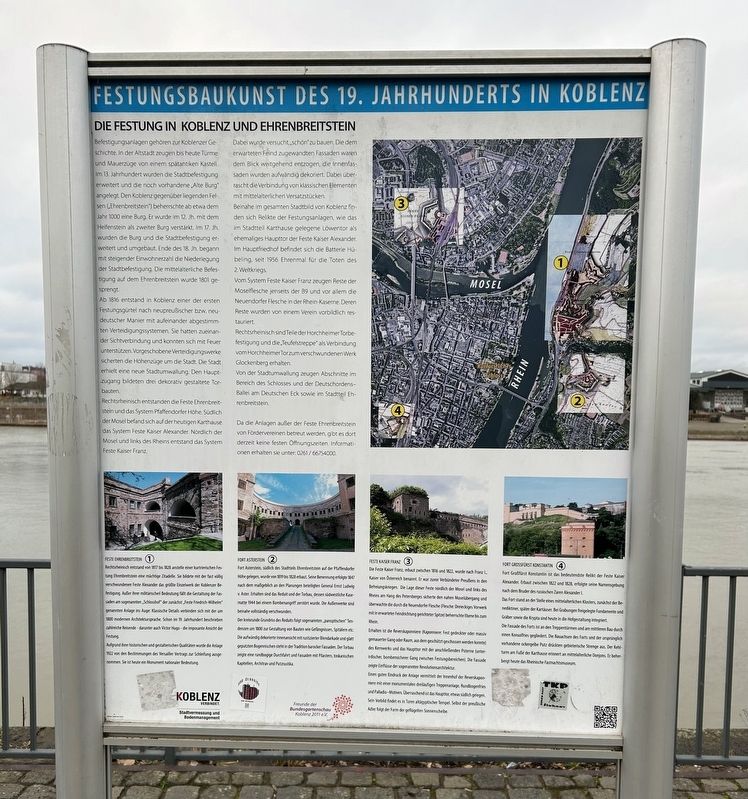
1. FESTUNGSBAUKUNST DES 19. JAHRHUNDERTS IN KOBLENZ Marker

Die Festung in Koblenz and Ehrenbreitstein
Befestigungsanlagen gehören zur Koblenzer Geschichte. In der Altstadt zeugen bis heute Türme und Mauerzüge von einem spätantiken Kastell. Im 13.Jahrhundert wurden die Stadtbefestigung erweitert und die noch vorhandene „Alte Burg" angelegt. Das Koblenz gegenüber liegenden Felsen („Ehrenbreitstein") beherrschte ab etwa dem Jahr 1000 eine Burg. Er wurde im 12.Jh. mit dem Helfenstein als zweiter Burg verstärkt. Im 17.Jh. wurden die Burg und die Stadtbefestigung erweitert und umgebaut. Ende des 18.Jh. begann mit steigender Einwohnerzahl die Niederlegung der Stadtbefestigung. Die mittelalterliche Befestigung auf dem Ehrenbreitstein wurde 1801 gesprengt.
Ab 1816 entstand in Koblenz einer der ersten Festungsgürtel nach neupreußischer bzw. neudeutscher Manier mit aufeinander abgestimmten Verteidigungssystemen. Sie hatten zueinander Sichtverbindung und konnten sich mit Feuer unterstützen. Vorgeschobene Verteidigungswerke sicherten die Höhenzüge um die Stadt. Die Stadt erhielt eine neue Stadtumwallung. Den Hauptzugang bildeten drei dekorativ gestaltete Torbauten.
Rechtsrheinisch
this page online
Dabei wurde versucht, „schön" zu bauen. Die dem erwarteten Feind zugewandten Fassaden waren dem Blick weitgehend entzogen, die Innenfassaden wurden aufwändig dekoriert. Dabei überrascht die Verbindung von klassischen Elementen mit mittelalterlichen Versatzstücken.
Beinahe im gesamten Stadtbild von Koblenz finden sich Relikte der Festungsanlagen, wie das im Stadtteil Karthause gelegene Löwentor als ehemaliges Haupttor der Feste Kaiser Alexander. Im Hauptfriedhof befindet sich die Batterie Hübeling, seit 1956 Ehrenmal für die Toten des 2.Weltkriegs.
Vom System Feste Kaiser Franz zeugen Reste der Moselflesche jenseits der B9 und vor allem die Neuendorfer Flesche in der Rhein-Kaserne. Deren Reste wurden von einem Verein vorbildlich restauriert.
Rechtsrheinisch sind Teile der Horchheimer ‚Torbefestigung‘ und die „Teufelstreppe" als Verbindung vom Horchheimer Torzum verschwundenen Werk Glockenberg
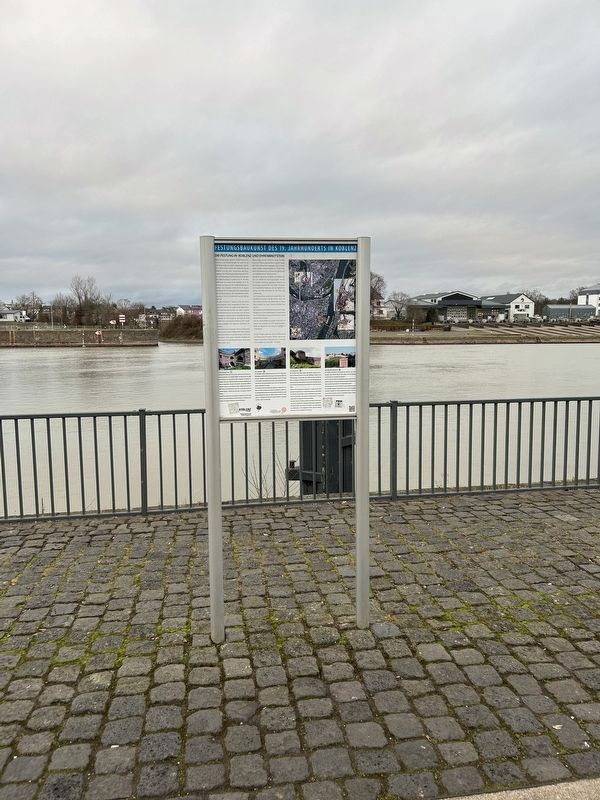
Photographed by Steve Stoessel, December 16, 2024
2. FESTUNGSBAUKUNST DES 19. JAHRHUNDERTS IN KOBLENZ Marker
Von der Stadtumwallung zeugen Abschnitte im Bereich des Schlosses und der DeutschordensBallei am Deutschen Eck sowie im Stadtteil Ehrenbreitstein. Da die Anlagen außer der Feste Ehrenbreitstein von Fördervereinen betreut werden, gibt es dort derzeit keine festen Öffnungszeiten. Informationen erhalten sie unter: 0261 / 66754000.
1. Feste Ehrenbreitstein
Rechtsrheinisch entstand von 1817 bis 1828 anstelle einer kurtrierischen Festung Ehrenbreitstein eine mächtige Zitadelle. Sie bildete mit der fast völlig verschwundenen Feste Alexander das größte Einzelwerk der Koblenzer Befestigung. Außer ihrer militärischer Bedeutung fällt die Gestaltung der Fassaden am sogenannten „Schlosshof" der zunächst „Feste Friedrich-Wilhelm“ genannten Anlage ins Auge: Klassische Details verbinden sich mit der um 1800 modernen Architektursprache. Schon im 19. Jahrhundert beschrieben zahlreiche Reisende - darunter auch Viktor Hugo - die imposante Ansicht der Festung
Aufgrund ihrer historischen und gestalterischen Qualitäten wurde die Anlage 1922 von den Bestimmungen des Versailler Vertrags zur Schleifung ausgenommen. Sie ist heute ein Monument
Photographed by Steve Stoessel, December 16, 2024
3. FESTUNGSBAUKUNST DES 19. JAHRHUNDERTS IN KOBLENZ Marker
2. Fort Asterstein
Fort Asterstein, südlich des Stadtteils Ehrenbreitstein auf der Pfaffendorfes Höhe gelegen, wurde von 1819 bis 1828 erbaut. Seine Benennung erfolgte 1847 nach dem maßgeblich an den Planungen beteiligten General Ernst Ludwig v. Aster. Erhalten sind das Reduit und der Torbau, dessen südwestliche Kasematte 1944 bei einem Bombenangriff zerstört wurde. Die Außenwerke sind beinahe vollständig verschwunden.
Der kreisrunde Grundriss des Reduits folgt sogenannten „panoptischen“ Tendenzen um 1800 zu Gestaltung von Bauten wie Gefängnissen, Spitälern etc. Die aufwändig dekorierte Innenansicht mit rustizierter Blendarkade und glatt geputzten Bogennischen steht in der Tradition barocker Fassaden. Der Torbau zeigte eine rundbogige Durchfahrt und Fassaden mit Pilastern toskanischen Kapitellen, Architrav und Putzrustika
3. Feste Kaiser Franz
Die Feste Kaiser Franz, erbaut zwischen 1816 und 1822, wurde nach Franz L Kaiser von Österreich benannt. Er war zuvor Verbündeter Preußens in den Befreiungskriegen. Die Lage dieser Feste nördlich der Mosel und links des Rheins am Hang des Petersberges sicherte den nahen Moselübergang und überwachte die durch die Neuendorfer Flesche (Flesche: Dreieckiges Vorwerk mit in erwarteter Feindrichtung gerichteter Spitze) beherrschte Ebene bis zum Rhein.
Erhalten ist die Reverskaponniere (Kaponniere: Fest gedeckter oder massiv gemauerter Gang oder Raum, aus dem geschützt geschossen werden konnte) des Kernwerks und das Haupttor mit der anschließenden Poterne (unterirdischer, bombensicherer Gang zwischen Festungsbereichen). Die Fassade zeigte Einflüsse der sogenannten Revolutionsarchitektur.
Einen guten Eindruck der Anlage vermittelt der Innenhof der Reverskaponniere mit einer monumentalen dreiläufigen Treppenanlage, Rundbogenfries und Palladio-Motiven Überraschend ist das Haupttor, etwas südlich gelegen. Sein Vorbild findet es in Toren altägyptischer Tempel. Selbst der preußische Adler folgt der Form der geflügelten Sonnenscheibe.
4. Fort Großfürst Konstantin
Fort Großfürst Konstantin ist das bedeutendste Relikt der Feste Kaiser Alexander. Erbaut zwischen 1822 und 1828, erfolgte seine Namensgebung nach dem Bruder des russischen Zaren Alexander I.
Dus fort stand an der Stelle eines mittelalterlichen Klosters, zunächst der Benediktiner, später der Kartäuser. Bei Grabungen freigelegte Fundamente und Graber sowie die Krypta sind heute in die Hofgestaltung integriert.
Die Fassade des Forts ist an den Treppentürmen und am mittleren Bau durch einen Konsolfries gegliedert. Die Bauachsen des Forts und der ursprünglich vorhandene ockergelbe Putz drückten gebieterische Strenge aus. Der Kehlturm am Fuße der Karthause erinnert an mittelalterliche Donjons. Er beherbergt heute das Rheinische Fastnachtsmuseum.
The fortress in Koblenz and Ehrenbreitstein
Fortifications are part of Koblenz's history. In the old town, towers and walls still bear witness to a late antique fort. In the 13th century, the city fortifications were expanded and the still existing "Old Castle" was built. The rock opposite Koblenz ("Ehrenbreitstein") was dominated by a castle from around the year 1000. It was reinforced in the 12th century with the Helfenstein as a second castle. In the 17th century, the castle and the city fortifications were expanded and rebuilt. At the end of the 18th century, as the population increased, the city fortifications began to be demolished. The medieval fortification on the Ehrenbreitstein was blown up in 1801.
From 1816, one of the first fortification belts in the New Prussian or New German style with coordinated defense systems was built in Koblenz. They had a line of sight to each other and could support each other with fire. Forward defensive works secured the hills around the city. The city received a new city wall. The main entrance was formed by three decoratively designed gate buildings.
The Ehrenbreitstein Fortress and the Pfaffendorfer Höhe system were built on the right side of the Rhine. The Kaiser Alexander Fortress system was located south of the Moselle on what is now the Karthause. The Kaiser Franz Fortress system was built north of the Moselle and to the left of the Rhine.
The attempt was made to build "beautifully". The facades facing the expected enemy were largely hidden from view, the interior facades were lavishly decorated. The combination of classical elements with medieval elements is surprising.
Relics of the fortifications can be found almost throughout the entire cityscape of Koblenz, such as the Löwentor (Lion’s Gate) in the Karthause district, the former main gate of the Kaiser Alexander Fortress. The Hübeling Battery is located in the main cemetery, which has been a memorial to the dead of the Second World War since 1956.
The remains of the Moselle Flesche beyond the B9 and especially the Neuendorfer Flesche in the Rhine barracks are evidence of the Kaiser Franz Fortress system. The remains of these were restored in an exemplary manner by an association.
On the right of the Rhine are parts of the Horchheimer 'gate fortification' and the The "Devil's Staircase" has been preserved as a connection from the Horchheim Gate to the now gone Glockenberg factory.
Sections in the area of the castle and the Teutonic Order Ballei at the Deutsches Eck and in the Ehrenbreitstein district are evidence of the city walls. As the facilities, apart from the Ehrenbreitstein Fortress, are looked after by support associations, there are currently no fixed opening times. For information, call: 0261 / 66754000.
1. Ehrenbreitstein Fortress
On the right bank of the Rhine, a mighty citadel was built between 1817 and 1828 in place of the Electorate of Trier's Ehrenbreitstein fortress. Together with the almost completely disappeared Alexander Fortress, it formed the largest single work of Koblenz's fortifications. In addition to its military significance, the design of the facades in the so-called "Schlosshof" of the complex, initially called "Feste Friedrich-Wilhelm", is striking: Classic details combine with the architectural language that was modern around 1800. As early as the 19th century, numerous travelers - including Victor Hugo - described the impressive view of the fortress. Due to its historical and design qualities, the complex was exempted from the provisions of the Treaty of Versailles in 1922 for demolition. Today it is a monument of national importance.
2. Fort Asterstein
Fort Asterstein, located south of the Ehrenbreitstein district on the Pfaffendorfes Höhe, was built between 1819 and 1828. It was named in 1847 after General Ernst Ludwig von Aster, who played a key role in its planning. The redoubt and the gate building have been preserved, the southwest casemate of which was destroyed in a bombing raid in 1944. The outer works are almost complete. disappeared.
The circular floor plan of the Reduit follows so-called "panoptic" tendencies around 1800 for the design of buildings such as prisons, hospitals, etc. The lavishly decorated interior with rusticated blind arcade and smoothly plastered arched niches is in the tradition of baroque facades. The gate building showed a round-arched passageway and facades with pilasters, Tuscan capitals, architraves and plaster rustication.
3. Kaiser Franz Fortress
The Kaiser Franz Fortress, built between 1816 and 1822, was named after Franz I, Emperor of Austria. He had previously been an ally of Prussia in the Wars of Liberation. The location of this fortress north of the Moselle and to the left of the Rhine on the slope of the Petersberg secured the nearby Moselle crossing and monitored the plain dominated by the Neuendorfer Flesche (Flesche: triangular outwork with a point pointing in the expected enemy direction) up to the Rhine.
The lapel caponier (caponier: a firmly covered or solidly bricked corridor or room from which one could shoot in safety) of the core structure and the main gate with the adjoining postern (underground, bomb-proof corridor between fortress areas) have been preserved. The facade showed influences of the so-called revolutionary architecture.
The inner courtyard of the lapel caponier with a monumental three-flight staircase, round-arch frieze and Palladian motifs gives a good impression of the complex. The main gate, located a little to the south, is surprising. It is modeled on gates of ancient Egyptian temples. Even the Prussian eagle follows the shape of the winged sun disk.
4. Fort Grand Duke Constantine
Fort Grand Duke Constantine is the most important relic of the Emperor Alexander Fortress. Built between 1822 and 1828, it was named after the brother of the Russian Tsar Alexander I.
This fort stood on the site of a medieval monastery, initially of the Benedictines, later of the Carthusians. Foundations and graves uncovered during excavations, as well as the crypt, are now integrated into the courtyard design.
The facade of the fort is divided by a console frieze on the stair towers and the middle building. The building axes of the fort and the original ochre-yellow plaster expressed imperious severity. The throat tower at the foot of the Carthusian monastery is reminiscent of medieval donjons. It now houses the Rhenish Carnival Museum.
Topics. This historical marker is listed in this topic list: Forts and Castles.
Location. 50° 21.778′ N, 7° 36.012′ E. Marker is in Koblenz, Rheinland-Pfalz (Rhineland-Palatinate). It is in Altstadt. It is on Pieter Altmeier Ufer east of Kornpfortstraße, on the right when traveling east. Marker is on a walkway facing the Moselle river. Touch for map. Marker is in this post office area: Koblenz RP 56, Germany. Touch for directions.

Regionally, this marker is in the German Rhineland, in the Upper Middle Rhine Valley, and specifically in the Moselle Valley. Globally, it is in Europe, the European Union, Atlantic Europe, Central Europe, the Schengen Area, Western Europe, and the Western World. Historically, it finds itself in what was once the Roman Empire, the Holy Roman Empire, and the former West Germany.
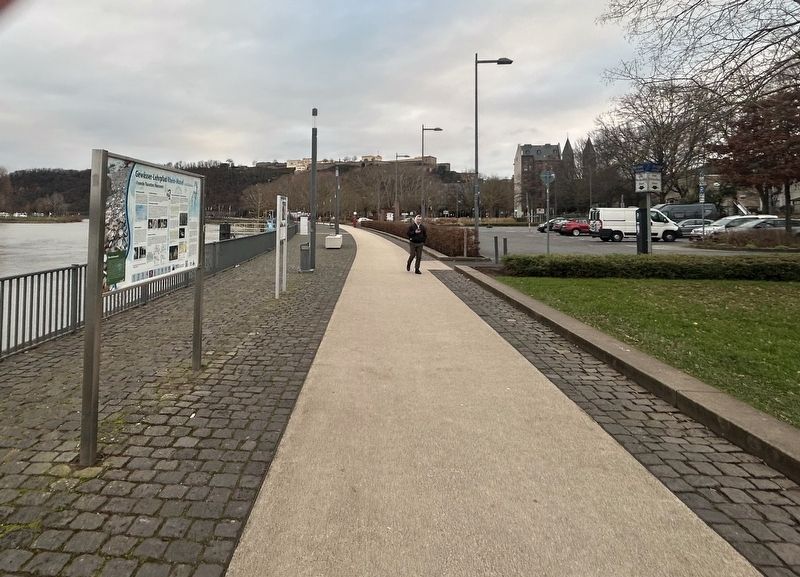
Other nearby markers. At least 8 other markers are within walking distance of this marker: Gewässer-Lehrpfad Rhein-Mosel / Rhine Mosel Water Trail (here, next to this marker); Peter Altmeier (about 90 meters away, measured in a direct line); Schöffenhaus / Aldermen’s House (about 240 meters away); Kastorbrunnen Memorial (about 240 meters away); Kastorbrunnen (about 240 meters away); Altes Kauf- und Danzhaus / Old Trading and Dance Hall (approx. 0.2 kilometers away); “Pfarrhaus Liebfrauen” / Church of Our Lady Rectory (approx. 0.2 kilometers away); Kastorhof (approx. 0.3 kilometers away). Touch for a list and map of all markers in Koblenz.
Also see . . . Ehrenbreitstein Fortress (Wikipedia). (Submitted on January 21, 2025, by Steve Stoessel of Niskayuna, New York.)
Credits. This page was last revised on February 10, 2025. It was originally submitted on January 16, 2025, by Steve Stoessel of Niskayuna, New York. This page has been viewed 137 times since then and 31 times this year. Photos: 1, 2, 3. submitted on January 16, 2025, by Steve Stoessel of Niskayuna, New York.
