Original Downtown in Plano in Collin County, Texas — The American South (West South Central)
Creating a Community
Photographed by James Hulse, January 7, 2025
1. Creating a Community Marker
Fixing Up Farmland
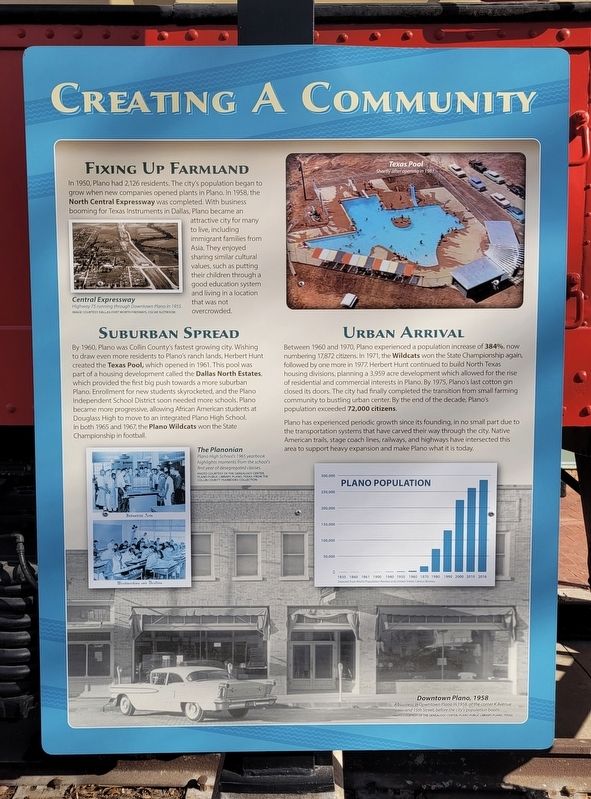
In 1950, Plano had 2,126 residents. The city's population began to grow when new companies opened plants in Plano. In 1958, the North Central Expressway was completed. With business booming for Texas Instruments in Dallas, Plano became an attractive city for many to live, including immigrant families from Asia. They enjoyed sharing similar cultural values, such as putting their children through a good education system. and living in a location that was not overcrowded.
Suburban Spread
By 1960, Plano was Collin County's fastest growing city. Wishing to draw even more residents to Plano's ranch lands, Herbert Hunt created the Texas Pool, which opened in 1961. This pool was part of a housing development called the Dallas North Estates, which provided the first big push towards a more suburban Plano. Enrollment for new students skyrocketed, and the Plano Independent School District soon needed more schools. Plano became more progressive, allowing African American students at Douglass High to move to an integrated Plano High School. In both 1965 and 1967, the Plano Wildcats won the State Championship
this page online
Urban Arrival
Between 1960 and 1970, Plano experienced a population increase of 384%, now numbering 17,872 citizens. In 1971, the Wildcats won the State Championship again, followed by one more in 1977. Herbert Hunt continued to build North Texas housing divisions, planning a 3,959 acre development which allowed for the rise of residential and commercial interests in Plano. By 1975, Plano's last cotton gin closed its doors. The city had finally completed the transition from small farming community to bustling urban center. By the end of the decade, Plano's population exceeded 72,000 citizens.
Plano has experienced periodic growth since its founding, in no small part due to the transportation systems that have carved their way through the city. Native American trails, stage coach lines, railways, and highways have intersected this area to support heavy expansion and make Plano what it is today.
Captions
(Photo #1) Central Expressway
Highway 75 running through Downtown Plano in 1955. Image courtesy of Dallas-Fort Worth Freeways, Oscar Slotboom
(Photo #2) The Planonian
Plano High School's 1965 yearbook highlights moments from the school's first year of desegregated classes. Photo courtesy of the Genealogy Center, Plano Public Library, Plano, Texas. From the Collin County Yearbooks Collection.
(Photo #3) Downtown Plano, 1958
A business in downtown Plano in 1958, at the corner K Avenue and 15th Street, before the city's population boom. Photo courtesy of the Genealogy Center, Plano Public Library, Plano, Texas.
Erected by Interurban
Photographed by James Hulse, January 7, 2025
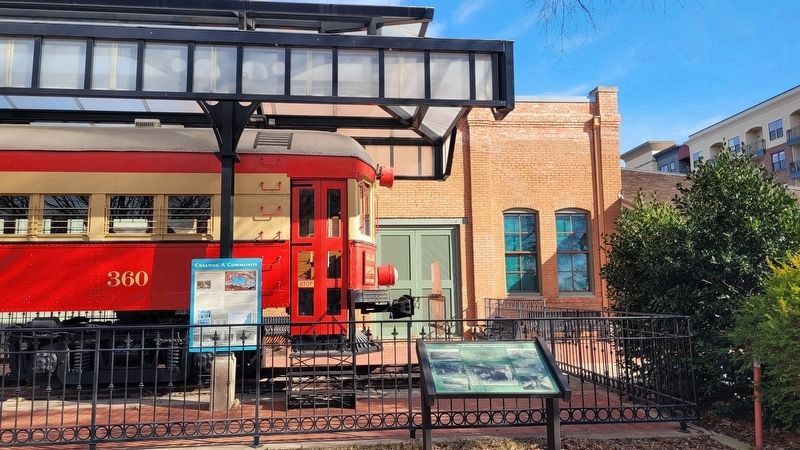
2. The Creating a Community Marker is the left marker of the two markers
Topics. This historical marker is listed in this topic list: Notable Places. A significant historical year for this entry is 1950.
Location. 33° 1.197′ N, 96° 42.114′ W. Marker is in Plano, Texas, in Collin County. It is in Original Downtown. It is at the intersection of East 15th Street and I Ave on East 15th Street. The marker is located on the grounds of the Interurban Railway Museum. Touch for map. Marker is at or near this postal address: 901 E 15th St, Plano TX 75074, United States of America. Touch for directions.

Regionally, this marker is in the Prairies & Lakes Region and in the Dallas-Fort Worth Metropolitan Area. Globally, it is in North America, a Gulf of Mexico state, the Western Hemisphere, the Western World, and the Anglosphere. Historically, it finds itself in what was once New Spain, the Republic of Texas, one of the Confederate States of America, and the Antebellum South.
Other nearby markers. At least 8 other markers are within walking distance of this marker: Streets of Historic Downtown Plano (here, next to this marker); Tayshas to Texas (here, next to this marker); Rail Switch (here,
Photographed by James Hulse, January 7, 2025
3. Texas Electric Railway Car 360
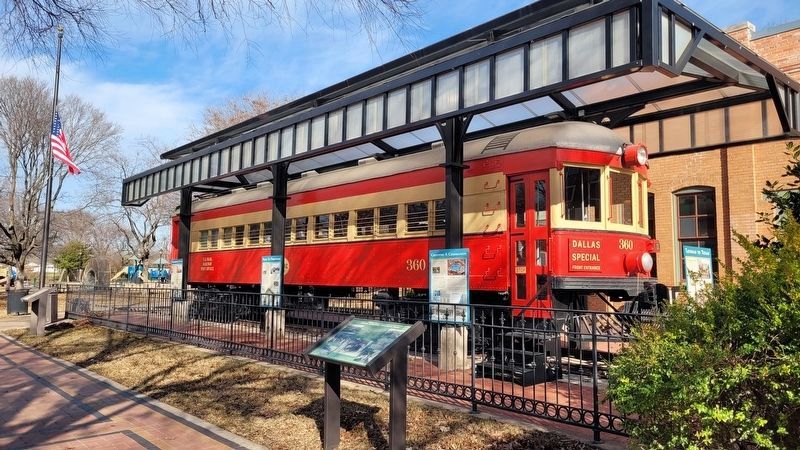
The marker is the second marker from the right side
Also see . . . Interurban Railway Museum - Discover Texas History. (Submitted on January 18, 2025, by James Hulse of Medina, Texas.)
Credits. This page was last revised on January 26, 2026. It was originally submitted on January 18, 2025, by James Hulse of Medina, Texas. This page has been viewed 196 times since then and 27 times this year. Photos: 1, 2, 3. submitted on January 18, 2025, by James Hulse of Medina, Texas.
