Whitneyville in Hamden in South Central Region, Connecticut — The American Northeast (New England)
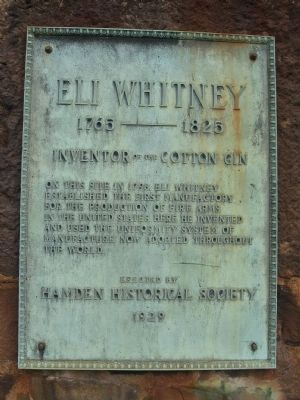
Eli Whitney
1765 - 1825
| — | Inventor of the Cotton Gin | — |
Photographed by Michael Herrick, March 11, 2010
1. Eli Whitney Marker
Erected 1929 by the Hamden Historical Society.
Topics. This historical marker is listed in this topic list: Industry & Commerce. A significant historical year for this entry is 1765.
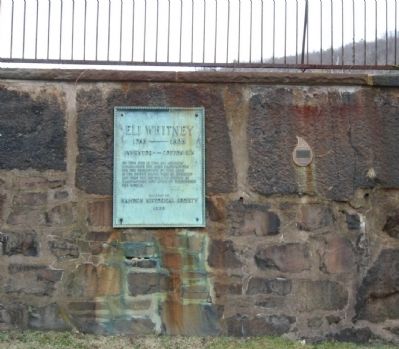
Location. 41° 20.224′ N, 72° 54.667′ W. Marker is in Hamden in South Central Region, Connecticut. It is in Whitneyville. It is at the intersection of Whitney Avenue and Armory Street, on the right when traveling north on Whitney Avenue. Located on the wall of the Lake Whitney Dam at the Eli Whitney Museum. Touch for map. Marker is in this post office area: Hamden CT 06518, United States of America. Touch for directions.

Regionally, this marker is in the Connecticut River Valley, on the Connecticut Shoreline, and in Greater New Haven. It is also in the American Northeast and in New England. Globally, it is in North America, the Western Hemisphere, the Western World, and the Anglosphere. Historically, it finds
this page online
Other nearby markers. At least 8 other markers are within walking distance of this marker: The Turbine (within shouting distance of this marker); The Dam (within shouting distance of this marker); The Second Armory (about 300 feet away, measured in a direct line); The Painting (about 400 feet away); The Boarding House (about 400 feet away); The Town Bridge (about 400 feet away); A. Frederick Oberlin Bridge (about 400 feet away); Transition (about 400 feet away). Touch for a list and map of all markers in Hamden.
Also see . . .
1. Eli Whitney, Jr. Wikipedia entry (Submitted on March 17, 2010, by Michael Herrick of Southbury, Connecticut.)
2. Eli Whitney Museum. Wikipedia entry (Submitted on January 14, 2021, by Larry Gertner of New York, New York.)
Photographed by Michael Herrick, March 11, 2010
2. Eli Whitney Marker
Photographed by Michael Herrick, March 11, 2010
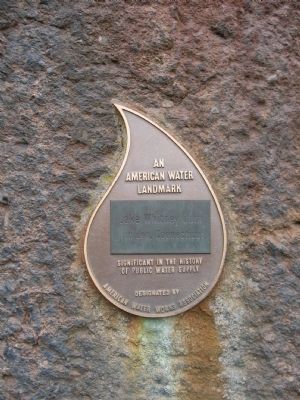
3. Small Plaque next to the Marker
American Water
Landmark
Lake Whitney Dam
Hamden, Connecticut
Significant In The History
Of Public Water Supply
Designated By
American Water Works Association
Photographed by Michael Herrick, March 11, 2010
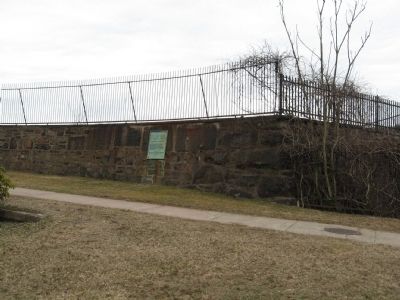
4. Marker on the Lake Whitney Dam Wall
Photographed by Allen C. Browne, July 17, 2018
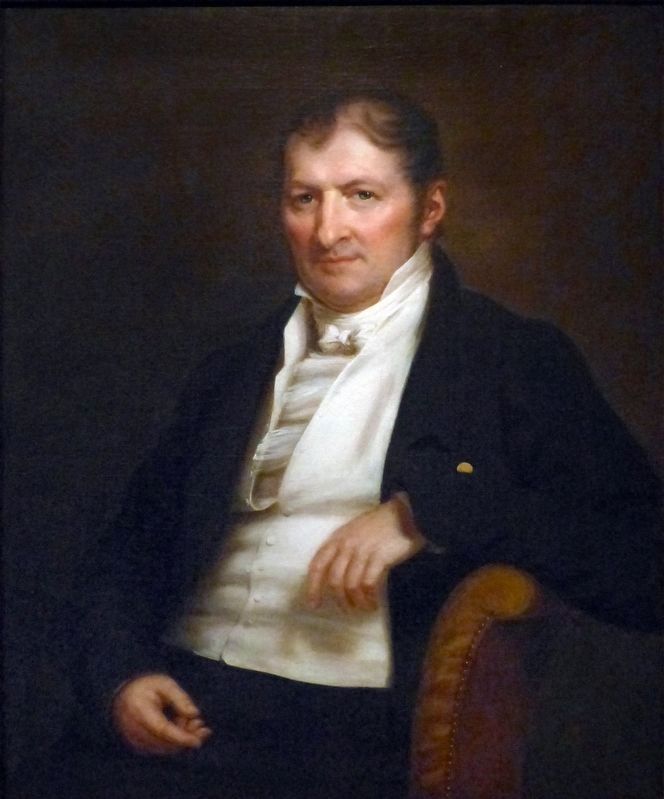
5. Eli Whitney
This 1821 portrait of Eli Whitney by Charles Bird King hangs in the National Portrait Gallery in Washington, DC.
“Eli Whitney, the son of a Massachusetts farmer, played an instrumental role in inventing the cotton gin and in creating standardized parts for firearms. These two important developments not only impacted manufacturing in the United States but also influenced nineteenth-century American society. The cotton gin (‘gin’ is short for ‘engine’) is a device that separates cotton fibers from their seeds. Whitney fabricated the first prototype around 1792 while working as a tutor on a plantation in Georgia. Its efficiency permitted the tremendous expansion of cotton cultivation, fueling the spread of the slave system and the industrial revolution in textile production.
Because the gin was such a simple device, it was easily pirated by Southern planters and Whitney never profited from it. Almost as important was Whitney's subsequent pioneering development of a process for making muskets by having an assembly line put together standardized parts. According to family history, this portrait of Whitney was painted in the summer of 1821.” -- NPG
“Eli Whitney, the son of a Massachusetts farmer, played an instrumental role in inventing the cotton gin and in creating standardized parts for firearms. These two important developments not only impacted manufacturing in the United States but also influenced nineteenth-century American society. The cotton gin (‘gin’ is short for ‘engine’) is a device that separates cotton fibers from their seeds. Whitney fabricated the first prototype around 1792 while working as a tutor on a plantation in Georgia. Its efficiency permitted the tremendous expansion of cotton cultivation, fueling the spread of the slave system and the industrial revolution in textile production.
Because the gin was such a simple device, it was easily pirated by Southern planters and Whitney never profited from it. Almost as important was Whitney's subsequent pioneering development of a process for making muskets by having an assembly line put together standardized parts. According to family history, this portrait of Whitney was painted in the summer of 1821.” -- NPG
Photographed by Michael Herrick, March 11, 2010
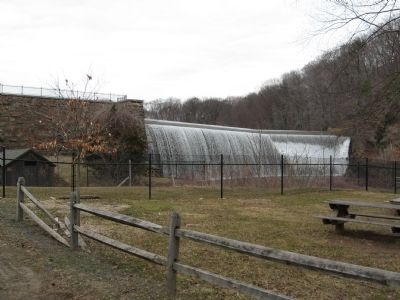
6. Lake Whitney Dam Spillway
Credits. This page was last revised on May 19, 2026. It was originally submitted on March 17, 2010, by Michael Herrick of Southbury, Connecticut. This page has been viewed 1,499 times since then and 25 times this year. Last updated on January 19, 2025, by Conrad Ward of Guilford, Connecticut. Photos: 1, 2, 3, 4. submitted on March 17, 2010, by Michael Herrick of Southbury, Connecticut. 5. submitted on July 21, 2018, by Allen C. Browne of Silver Spring, Maryland. 6. submitted on March 17, 2010, by Michael Herrick of Southbury, Connecticut.
