Whitneyville in Hamden in South Central Region, Connecticut — The American Northeast (New England)
The Barn

Photographed by Conrad Ward, August 11, 2024
1. The Barn Marker
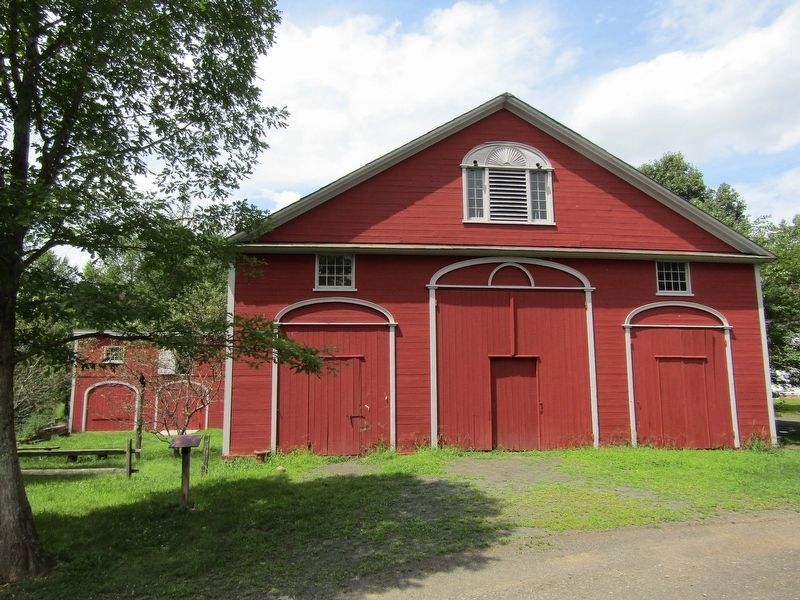
Eli Whitney completed this Barn in 1816. He had contemplated the design during a year that was full of transitions. The War of 1812 had ended. His Armory had won a new federal contract. He had turned 50. When Whitney wrote his friend Josiah Stebbins in Maine for help in securing the timbers for the new barn, Stebbins rightly guessed that Whitney was beginning to construct a life for himself. Stebbins taunted that perhaps a proper house would follow, and then a wife. The solitary bachelor' Whitney would marry Henrietta Frances Edwards in 1817.
The Barn is our largest artifact of Whitney's mind at work. It's Square Rule Construction is an early application of precision and interchangeability practices to barn construction. The Barn housed the draft animals—horses and oxen—that moved materials and products back and forth from this site to the harbor. Its New England style end-gable orientation allowed farmers to drive their wagons through the Barn. Its four levels allowed efficient unloading, storage and feeding of hay and fodder. Its inventive details impressed travel writers and visiting American Presidents.
The
this page online
Preservation & Evolution
Serendipity and devotion have preserved the spirit of the Barn again the ravages of time and changing needs. A brief history.
1816: Eli Whitney's 10 year old nephew, Philos Blake, makes simple drawings of the Barn that have guided preservation efforts for 200 years.
1860: Whitney's son built the large Dam and the New Haven Water Company. Whitney Avenue moved closer to the Barn. The Water company used the Barn and maintained it without significant changes until 1979.
1904: The Water Company built New Haven's first filtration plant in the hillside behind the Barn. A slate roof replaced the barn's cedar shake roof. A gabled wing replaced the original oxen wing on the south.
1930: The last of the Barn's draft horses retired.
1950: The floor decking was replaced.
1979: The Water Authority contributed the Barn to help establish the Museum. Music, dance, theater and cultural programs are presented in the Barn.
2001: The Water Authority constructed the new Whitney Water Treatment Plant. The landscape plan resembles the Barn's original setting.
2012: The CT Dept of Economic and Community Development funded a major restoration of the Barn. The South Wing was rebuilt to resemble its original configuration. The Wing was configured to accommodate an independent Artist-in-Residence.
(sketch caption)
Philos
Photographed by Conrad Ward, August 11, 2024
2. The Barn
Erected by Eli Whitney Museum and Workshop.
Topics. This historical marker is listed in these topic lists: Animals • Architecture • Charity & Public Work • Industry & Commerce. A significant historical year for this entry is 1816.
Location. 41° 20.155′ N, 72° 54.701′ W. Marker is in Hamden in South Central Region, Connecticut. It is in Whitneyville. It is on Whitney Avenue south of Armory Street, on the right when traveling south. Located in the Regional Water Authority Recreational Area in Edgerton Park. Touch for map. Marker is in this post office area: Hamden CT 06517, United States of America. Touch for directions.

Regionally, this marker is in the Connecticut River Valley, on the Connecticut Shoreline, and in Greater New Haven. It is also in the American Northeast and in New England. Globally, it is in North America, the Western Hemisphere, the Western World, and the Anglosphere. Historically, it finds itself in what was once New Haven County and also one of the original Thirteen Colonies.
Other nearby markers. At least 8 other markers are within walking distance of this marker: The Boarding House

Photographed by Conrad Ward, August 11, 2024
3. The Barn
Also see . . .
1. Eli Whitney Museum and Workshop. (Submitted on January 19, 2025.)
2. Eli Whitney (Wikipedia). (Submitted on January 19, 2025.)
3. Eli Whitney Museum (Wikipedia). (Submitted on January 19, 2025.)
Credits. This page was last revised on May 19, 2026. It was originally submitted on January 19, 2025, by Conrad Ward of Guilford, Connecticut. This page has been viewed 139 times since then and 18 times this year. Photos: 1, 2, 3. submitted on January 19, 2025, by Conrad Ward of Guilford, Connecticut. • Michael Herrick was the editor who published this page.
