Rione IV Campo Marzio in Roma in Città metropolitana di Roma Capitale, Latium, Rome, Italy — Central Italy (Tyrrhenian Coast)
Chiesa di Sant'Atanasio
⎯⎯⎯
Church of St. Athanasius
Photographed by James Hulse, February 26, 2024
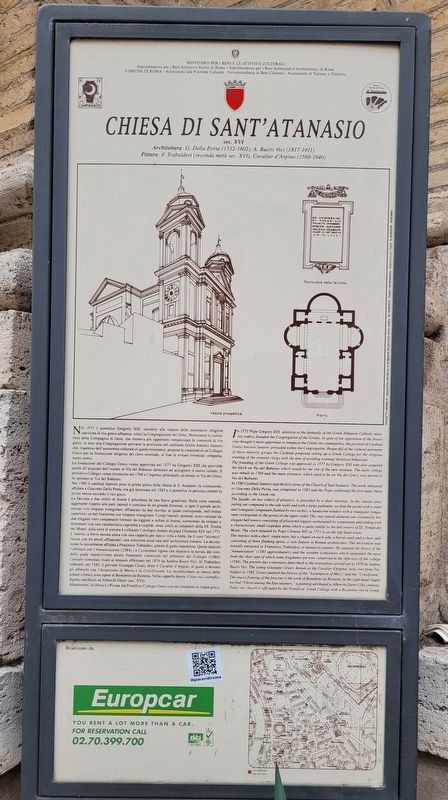
1. Chiesa di Sant'Atanasio / Church of St. Athanasius Marker

Architettura: G. Della Porta (1532-1602), A. Busiri Vici (1817-1911) Pittura: F. Trabaldesi (seconda metà sec. XVI), Cavalier d'Arpino (1568-1640)
Nel 1573 il pontefice Gregorio XIII, sensibile alle istanze delle minoranze religiose cattoliche di rito greco-albanese, istituì la Congregazione dei Greci. Nonostante la contrarietà della Compagnia di Gesù, che riteneva più opportuno romanizzare le comunità di rito greco, in seno alla Congregazione prevalse la posizione del cardinale Giulio Antonio Santoro che, rispettoso dell'autonomia culturale di quelle minoranze, propose la creazione di un Collegio Greco per la formazione religiosa del clero orientale, al fine di evitare eventuali comportamenti eretici.
La fondazione del Collegio Greco venne approvata nel 1577 da Gregorio XIII che provvide anche all'acquisto dell'isolato in Via del Babuino destinato ad accogliere il nuovo istituto. Il primitivo Collegio venne ricostruito nel 1769 e l'ingresso principale, un tempo in Via dei Greci, fu spostato in Via del Babuino.
Nel 1580 il cardinal Santoro pose la prima pietra della chiesa di S. Atanasio: la costruzione, affidata a Giacomo Della Porta, era già terminata nel 1583 e il pontefice in persona celebrò la prima messa secondo il rito greco.
La facciata a due ordini di lesene è preceduta da una breve gradinata. Nella zona centrale, aggettante rispetto alle parti laterali e conclusa da un grande frontone, si apre il portale architravato con timpano triangolare, affiancato da due nicchie, al quale corrisponde, nell'ordine superiore, un bel finestrone con timpano triangolare. I corpi laterali, arretrati, sono coronati da due eleganti torri campanarie formate da loggiati a ordine di lesene, sormontati da timpani e terminanti con una caratteristica cupoletta a cuspide, assai simili
this page online
Attualmente, la chiesa è officiata dal Pontificio Collegio Greco con rito bizantino in lingua greca.
Didascalie
(Foto #1) Veduta prospettica
(Foto #2) Particolare della facciata
(Foto #3) Pianta
Architecture:
Photographed by James Hulse, February 26, 2024
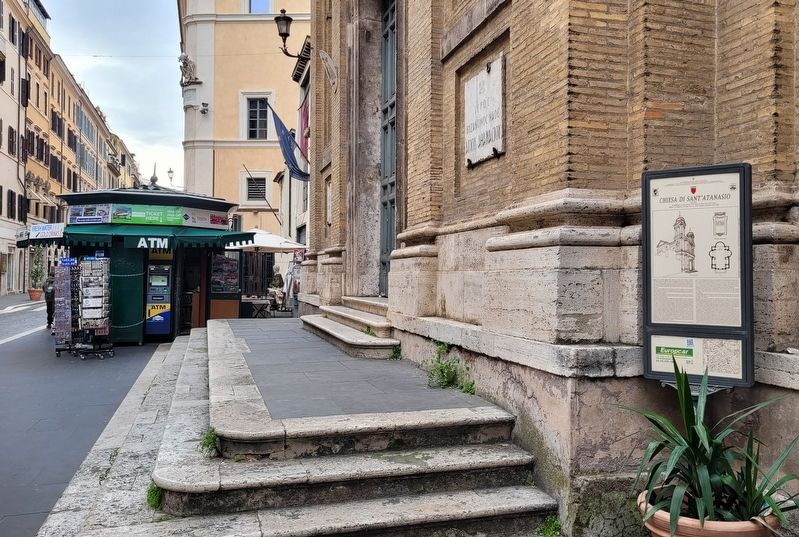
2. The view of the Church of St. Athanasius and Marker
In 1573 Pope Gregory XIII, sensitive to the demands of the Greek-Albanian Catholic minority orders, founded the Congregation of the Greeks. In spite of the opposition of the Jesuits who thought it more opportune to romanise the Greek rite communities, the position of Cardinal Giulio Antonio Santoro prevailed within the Congregation. Respectful of the cultural autonomy of these minority groups the Cardinal proposed setting up a Greek College for the religious training of the oriental clergy with the aim of avoiding eventual heretical behaviour.
The founding of the Greek College was approved in 1577 by Gregory XIII who also acquired the block on Via del Babuino which would be the site of the new institute. The early college was rebuilt in 1769 and the main entrance, which used to be on Via del Greci, was moved to Via del Babuino.
In 1580 Cardinal Santoro laid the first stone of the Church of Sant'Atanasio. The work, entrusted to Giacomo Della Porta, was completed in 1583 and the Pope
Photographed by James Hulse, February 26, 2024
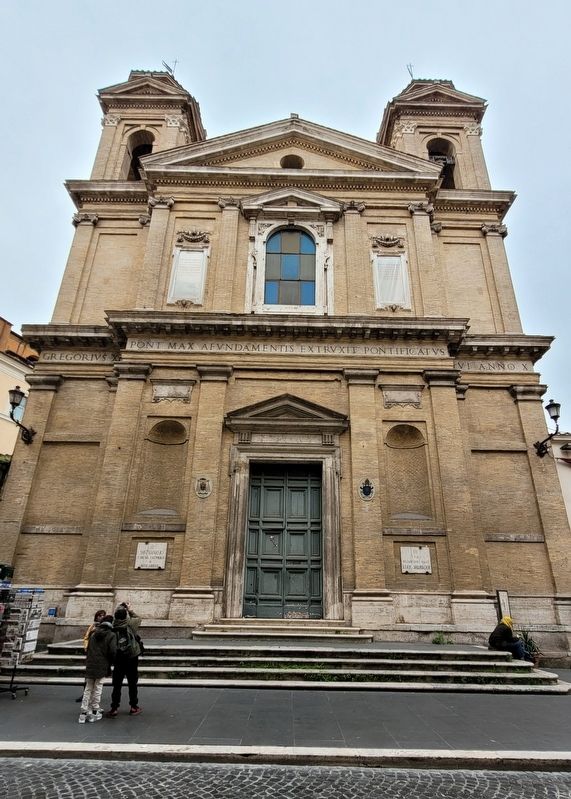
3. The front view of the Church of St. Athanasius
The façade, on two orders of pilasters, is preceded by a short stairway. In the central area, jutting out compared to the side walls and with a large pediment, we find the portal with a lintel and triangular tympanum flanked by two niches; a handsome window with a triangular tympanum corresponds to the portal on the upper order. The rear lateral elements are crowned by two elegant bell towers consisting of pilastered loggias surmounted by tympanums and ending with a characteristic small cuspidate dome which is quite similar to the bell towers of SS. Trinità dei Monti. The clock donated by Pope Clement XIV in 1771 is on the left-hand tower.
The interior, with a short single nave, has a chapel on each side, a barrel-vault and a choir stall consisting of three flanking apses, a rare feature in Roman architecture. The decoration was initially entrusted to Francesco Trabaldesi, a mannerist painter. He painted the fresco of the "Annunciation" (1583 approximately) and the wooden iconostasis which separated the nave from the choir and of which some fragments are now conserved in the refectory of the college (1584). The present-day iconostasis dates back to the restoration carried out in 1876 by Andrea Busiri Vici. The young Giuseppe Cesari, known as the Cavalier d'Arpino, took over from Trabaldesi in 1585. Cesari painted the frescos of the "Assumption of Mary" and the "Crucifixion" The stucco framing of the frescoes is the work of Benedetto da Romena. In the right hand chapel we find "Christ among the Executioners," a painting attributed to Albrecht Durer (16h century). Today the church is officiated by the Pontifical Greek College with a Byzantine rite in Greek.
Captions
(Photo #1) Perspective view
(Photo #2) Detail of the facade
(Photo #3) Floor Plan
Erected by Ministry of Cultural Heritage and Activities Superintendence for the Artistic and Historical Heritage of Rome Superintendence for the Environmental and Architectural Heritage of Rome Municipality of Rome Department of Cultural Policies - Superintendence for Cultural Heritage - Department of Tourism and Jubilee.
Topics. This historical marker is listed in this topic list: Religion & Religious Structures. A significant historical year for this entry is 1573.
Location. 41° 54.479′ N, 12° 28.764′ E. Marker is in Roma, Lazio (Latium, Rome), in Città metropolitana di Roma Capitale. It is in Rione IV Campo Marzio. It is at the intersection of Via del Babuino and Via di S. Giacomo, on the left when traveling north on Via del Babuino. The marker is located at the northeast corner of the church. Touch for map. Marker is at or near this postal address: Via del Babuino 149, Roma, Lazio 00187, Italy. Touch for directions.

Regionally, it is in Europe, the European Union, the Schengen Area, a coastal Mediterranean country, and the Western World. Historically, it finds itself in what was once the Roman Empire.
Other nearby markers. At least 8 other markers are within walking distance of this marker: Carlos Federico Sáez (about 120 meters away, measured in a direct line); Juliusz Słowacki (about 120 meters away); Official connection between Via Del Babuino and Madison Avenue (about 120 meters away); Gomez Palace Stables / Scuderie di Palazzo Gomez (about 120 meters away); C'eravamo tanto amati / We All Loved Each Other So Much (about 120 meters away); Franz Ludwig Catel (approx. 0.2 kilometers away); Giovanni Sgambati (approx. 0.2 kilometers away); Hotel Palazzo Nainer (approx. 0.2 kilometers away). Touch for a list and map of all markers in Roma.
Also see . . . Sant'Atanasio. Wikipedia
The church was built in 1577 for use of a Greek College for the formation of Catholic clergy in the Eastern Rite. Construction was patronized by the Pope Gregory XIII and the Jesuit order to promulgate and serve the interests forming a Congregation of the Greeks.(Submitted on January 21, 2025, by James Hulse of Medina, Texas.)
Credits. This page was last revised on January 22, 2025. It was originally submitted on January 20, 2025, by James Hulse of Medina, Texas. This page has been viewed 230 times since then and 52 times this year. Photos: 1, 2, 3. submitted on January 21, 2025, by James Hulse of Medina, Texas.
