San Marco in Venezia in Città Metropolitana di Venezia, Venetia, Italy — Southern and Western Europe (Mediterranean)
Laurentius Perosi
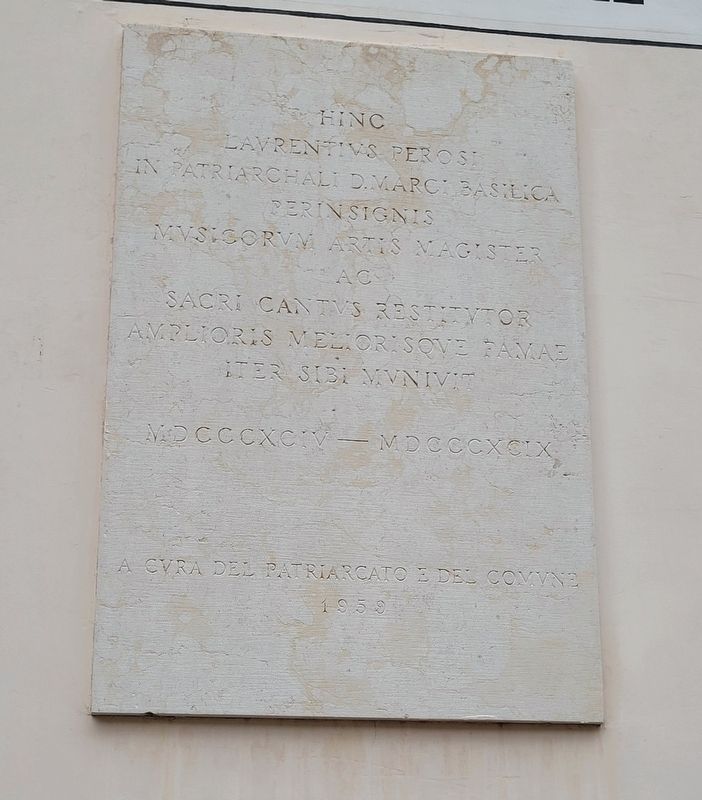
Photographed by James Hulse, March 7, 2024
1. Laurentius Perosi Marker

Hinc Laurentius Perosi in patriarchali d.Marci Basilica perinsignis musicorum artis magister ac sacri cantus restitutor amplioris meliorisque famae iter sibi muniuit MDCCCXCIV — MDCCCXCIX
From this point, Lorenzo Perosi, in the patriarchal Basilica of Saint Mark, a distinguished master of the art of music and restorer of sacred chant, paved the way for himself to greater and better fame, in the years 1894–1899.
Erected 1959 by By the Patriarchate and the Municipality.
Topics. This historical marker is listed in these topic lists: Arts, Letters, Music • Religion & Religious Structures. A significant historical year for this entry is 1894.
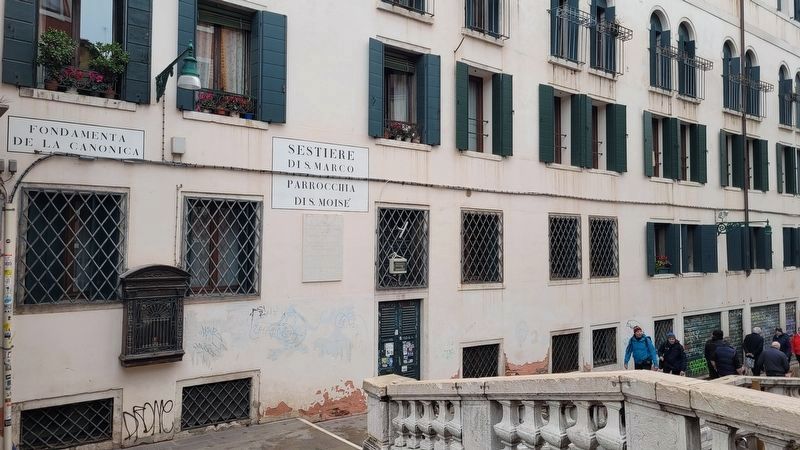
Location. 45° 26.098′ N, 12° 20.429′ E. Marker is in Venezia, Veneto (Venetia), in Città Metropolitana di Venezia. It is in San Marco. It is at the intersection of Calle de la Canonica and Ponte de Canonica on Calle de la Canonica. The marker is located along the wall of the building next to the bridge. Touch for map. Marker is in this post office area: Venezia, Veneto 30122, Italy. Touch for directions.

Regionally, it is in Europe, the
this page online
Other nearby markers. At least 8 other markers are within walking distance of this marker: Piazzetta dei Leoncini (about 90 meters away, measured in a direct line); Torre dell'Orologio / Clock Tower (about 120 meters away); Basilica San Marco / St. Mark's Basilica (about 150 meters away); Loggetta e Campanile / Loggetta and Bell-Tower (about 150 meters away); Libreria Sansoviniana / Sansovino's Library (about 150 meters away); Palazzo Ducale / Doge's Palace (about 150 meters away); Enrico Cosenz (about 150 meters away); Procuratie Nuove (about 210 meters away). Touch for a list and map of all markers in Venezia.
Also see . . . Lorenzo Perosi. Wikipedia
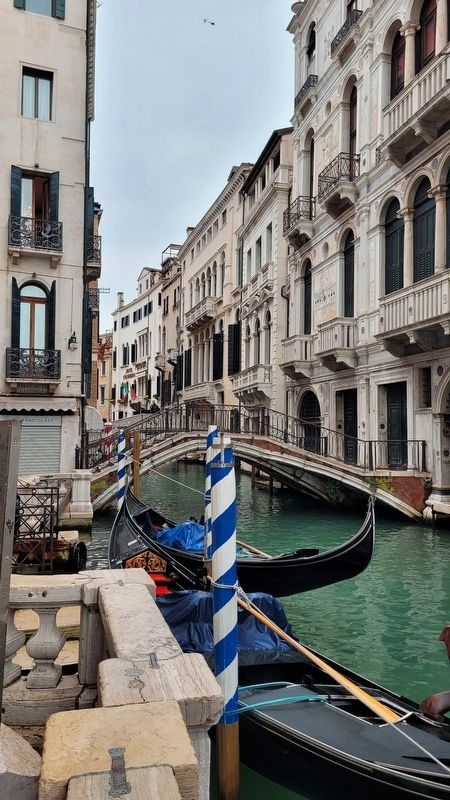
Monsignor Lorenzo Perosi (21 December 1872 – 12 October 1956) was an Italian composer of sacred music and the only member of the Giovane Scuola who did not write opera. In the late 1890s, while he was still only in his twenties, Perosi was an internationally celebrated(Submitted on January 21, 2025, by James Hulse of Medina, Texas.)composer of sacred music, especially large-scale oratorios. Nobel Prize winner Romain Rolland wrote, "It's not easy to give you an exact idea of how popular Lorenzo Perosi is in his native country." Perosi's fame was not restricted to Europe. A 19 March 1899 New York Times article entitled "The Genius of Don Perosi" began, "The great and ever-increasing success which has greeted the four new oratorios of Don Lorenzo Perosi has placed this young priest-composer on a pedestal of fame which can only be compared with that which has been accorded of late years to the idolized Pietro Mascagni by his fellow-countrymen." Gianandrea Gavazzeni made the same comparison: "The sudden clamors of applause, at the end of the [19th] century, were just like those a decade earlier for Mascagni." Perosi worked for five Popes, including Pope Pius X who greatly fostered his rise.Photographed by James Hulse, March 7, 20242. Laurentius Perosi MarkerThe marker is located along the wall of the building next to the canal and bridge.
Photographed by James Hulse, March 7, 2024
3. The view of the canal by the marker
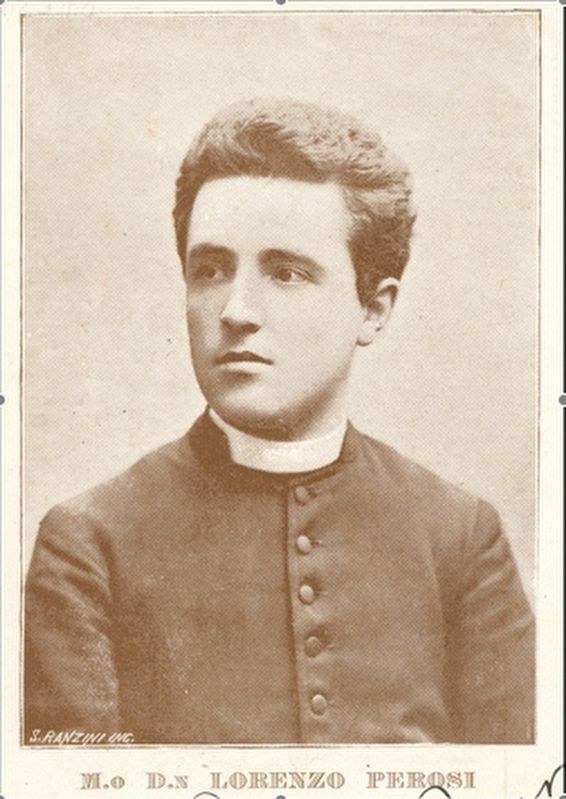
Public Domain - Photo-postcard - Wikipedia Commons, circa 1900
4. M.o Don Lorenzo Perosi
Credits. This page was last revised on January 21, 2025. It was originally submitted on January 21, 2025, by James Hulse of Medina, Texas. This page has been viewed 97 times since then and 7 times this year. Photos: 1, 2, 3, 4. submitted on January 21, 2025, by James Hulse of Medina, Texas.
