
Burano in Venezia in Città Metropolitana di Venezia, Venetia, Italy — Southern and Western Europe (Mediterranean)
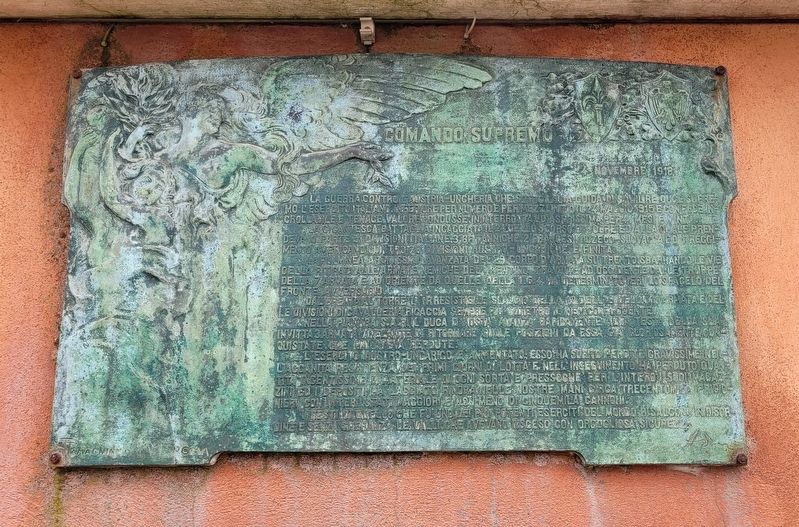
Comando Supremo
⎯⎯⎯
Supreme Command
Photographed by James Hulse, March 7, 2024
1. Comando Supremo / Supreme Command Marker

4 novembre 1918,
La guerra contro l’Austria-Ungheria che, sotto l'alta guida S.M. il Re duce supremo l'esercito italiano, inferiore per numero e per mezzi inizio il 24 maggio 1915 e con fede incrolllabile e tenage valore condusse, ininterrotta ed asprissima per 41 mesi e vinta. La gigantesca battaglia ingaggiata il 24 dello scorso ottobre ed alla quale prendevano parte 51 divisioni italiane, 3 britanniche, 2 francesi, 1 czeco-slovacca ed 1 reggimento americano contro 73 divisioni austro-ungarchi, è finita. La fulminea arditissima a avanzata del 29 corpo d'armata su trento, sbarhando le vie della ritirata alle armate nemiche del trentino, travolte ad occidente dalle truppe della 7 armata e ad oriente da quelle della 1.6.4. Ha determinato ieri lo sfacelo del fronte avversario. Dal brenta al torre l irresistibile slancio della 12 dell 8 della 10 armata e delle divisioni di cavalleria rigaccia sempre piu indietro il nemico fuggente. Nella pianura S.A.R. il duca d’aosta avanza rapidamente alla testa della sua invitta 3 armata anelante di ritornare sulle posizioni da essa gia gloriosamente conquistate,
this page online
November 4, 1918,
The war against Austria-Hungary, which, under the high command of H.M. the King, supreme leader of the Italian army, inferior in numbers and means, began on May 24, 1915, and with unshakable faith and tenacious courage, was carried out, uninterrupted and fiercest, for 41 months and victories. The gigantic battle engaged on October 24 of the past year, in which 51 Italian divisions, 3 British, 2 French, 1 Czechoslovak, and 1 American regiment participated against 73 Austro-Hungarian divisions, has ended. The lightning-fast and daring advance of the 29th Army Corps on Trento, blocking the retreat routes of the enemy armies in Trentino, overwhelmed to the west by the troops of the 7th Army and to the east by those of the 1st,
Photographed by James Hulse, March 7, 2024
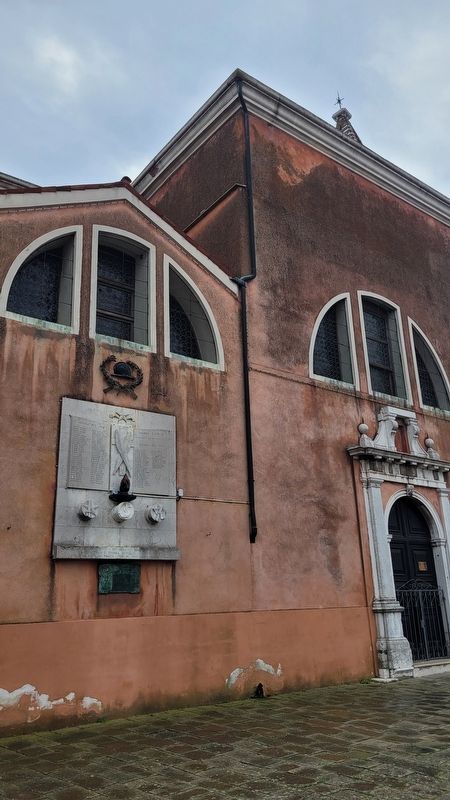
2. The Supreme Command Marker is below the War Memorial
Topics. This historical marker is listed in this topic list: War, World I. A significant historical date for this entry is October 24, 1918.
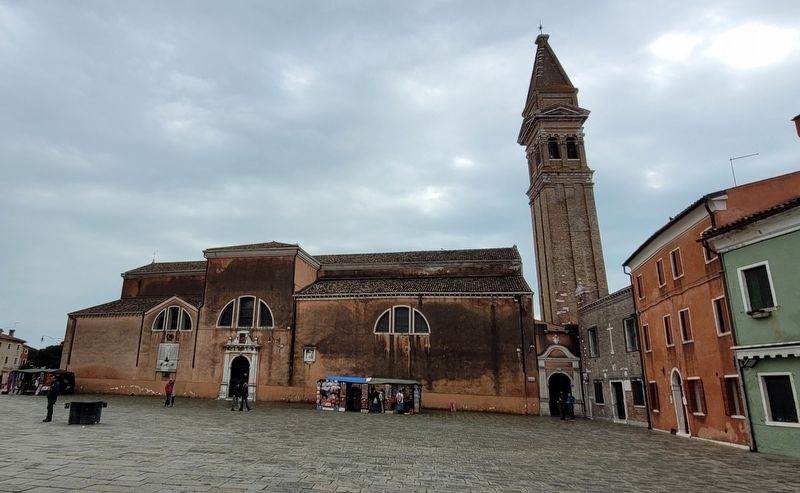
Location. 45° 29.06′ N, 12° 25.138′ E. Marker is in Venezia, Veneto (Venetia), in Città Metropolitana di Venezia. It is in Burano. It is on Piazza Baldassarre Galuppi. The marker is located along the wall of the Church of Saint Martin
Photographed by James Hulse, March 7, 2024
3. Supreme Command Marker
The view of the church and plaza with the marker on the left side

Regionally, it is in Europe, the European Union, the Schengen Area, a coastal Mediterranean country, and the Western World. Historically, it finds itself in what was once the Byzantine Empire, the Roman Empire, and specifically the Holy Roman Empire.
Other nearby markers. At least 8 other markers are within 8 kilometers of this marker, measured as the crow flies: Monumento ai Caduti di Burano / Burano War Memorial (here, next to this marker); Chiesa di S. Martino Vescovo / Church of St. Martin Bishop (within shouting distance of this marker); Baldassare Galuppi (within shouting distance of this marker); Chiesa di S. Martino Vescovo (approx. 7.8 kilometers away); Scuola Dalmata S.ti Giorgio e Trifone (approx. 7.8 kilometers away); Emilio Bandiera e Domenico Moro (approx. 7.9 kilometers away); Antonio Vivaldi (approx. 7.9 kilometers away); Giacinto Gallina (approx. 7.9 kilometers away). Touch for a list and map of all markers in Venezia.
More about this marker. The passage describes Italy’s involvement in World War I, focusing on its conflict with Austria-Hungary. It highlights the initial challenges faced by the Italian army, which was inferior in numbers and equipment but fought with remarkable determination. The text emphasizes a key victory on October 24, 1918, during the Battle of Vittorio Veneto, where Italy, alongside its allies, decisively defeated the Austro-Hungarian forces. This battle marked the collapse of the Austro-Hungarian army and contributed to the end of the war. The passage also references the sacrifice and valor of the Italian troops, the losses suffered by Austria-Hungary, and the strategic importance of the victory in shaping the outcome of the war.
Also see . . . Battle of Vittorio Veneto. Wikipedia
The Battle of Vittorio Veneto was fought from 24 October to 3 November 1918 (with an armistice taking effect 24 hours later) near Vittorio Veneto on the Italian Front during World War I. After having thoroughly defeated Austro-Hungarian troops during the defensive Battle of the Piave River, the Italian army launched a great counter-offensive: the Italian victory marked the end of the war on the Italian Front, secured the dissolution of the Austro-Hungarian Empire and contributed to the end of the First World War just one week later. The battle led to the capture of over 5,000 artillery pieces and over 350,000 Austro-Hungarian troops, including 120,000 Germans, 83,000 Czechs and Slovaks, 60,000 South Slavs, 40,000 Poles, several tens of thousands of Romanians and Ukrainians, and 7,000 Austro-Hungarian loyalist Italians and Friulians.(Submitted on January 22, 2025, by James Hulse of Medina, Texas.)
Credits. This page was last revised on January 22, 2025. It was originally submitted on January 21, 2025, by James Hulse of Medina, Texas. This page has been viewed 155 times since then and 41 times this year. Photos: 1, 2, 3. submitted on January 22, 2025, by James Hulse of Medina, Texas.
