Ballston Spa in Saratoga County, New York — The American Northeast (Mid-Atlantic)
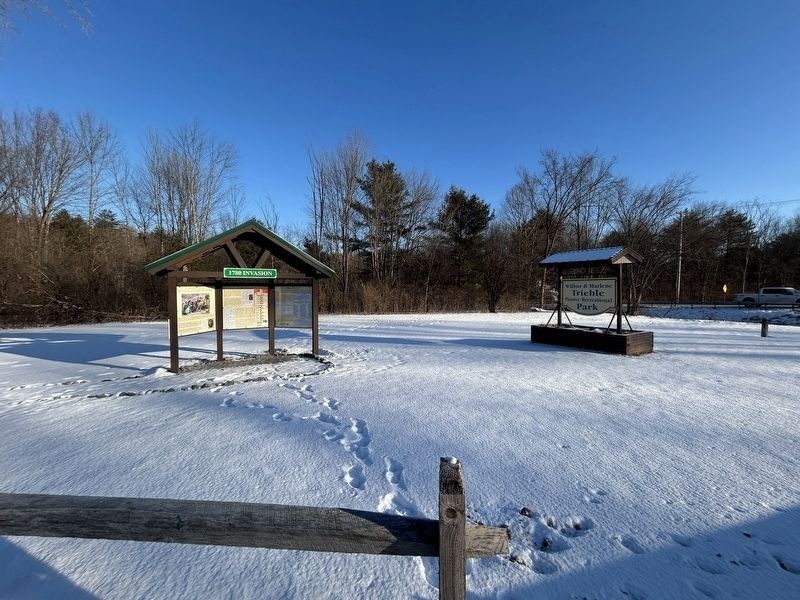
1780 Invasion

Photographed by Steve Stoessel, January 22, 2025
1. 1780 Invasion Marker
War comes to "Balls Town"
In the early morning hours of October 17, 1780, flames licked the night sky over the burning homes of settlers along Middle Line Road in the present day towns of Ballston and Milton. This was the result of an attack perpetrated by a small British force of about 200 men operating out of a base in Canada.
When war came to the English Colonies in 1775, the residents of "Balls Town" had to choose sides, and tensions grew between once friendly neighbors. In October 1775, sixteen regiments of militia were organized for the defense of Albany County. Men from the towns of Bailstown and Halfmoon made up the 12th Regiment serving under the command of Colonel Jacobus Van Schoonhoven and Lt. Colonel James Gordon.
Following the British surrender at Saratoga on October 17, 1777, exactly three years before the attack on Balistown, British forces out of Canada utilized hit and run atiacks on settlements along the Mohawk and Hudson Valleys, Some of these raids could rightly be called massacres, and the term "Bloody Mohawk' came to characterize this stage of the war.
Militiamen garrisoned at the fort in Ballstown
this page online
[Inset]
James Gordon was a prosperous mill owner and farmer from Ballstown. He served as a Colonel in the the 12th Regiment of the Albany Coúnty Militia, and served 2 terms in the newly established US Congress.
The 1780 raid
American Loyalists, including former residents of Ballstown and about 30 Mohawk warriors under the command of Captain John Munro, conducted the raid on Ballstown. This party was part of a larger force engaged in a three pronged attack against communities in the upper Hudson and Mohawk Valleys.
On October 12th the raiders encamped on the northside of the Kayaderosseras Creek, in present day West Milton. Initially, their plan had been to attack the settlement at Schenectady, but reports of increased reinforcements at the fort in Ballstown led Munro to change plans. His new mission was to attack the homesteads of many known patriots and militia leaders. along Middle Line Road in

Photographed by Steve Stoessel, January 22, 2025
2. 1780 Invasion Marker
On October 16th Munro's troops broke camp and traveled southward on a parallel route, west of Middle Line Road, to avoid detection by the local militia. Their first action began about 1:00 a.m. on October 17th, at the homestead of Lt. Colonel James Gordon. Four-year-old Melinda Gordon stated: "We were awakened by the breaking of both the windows in the room and looking up saw a number of muskets with bayonets protruding into the room. My father arose and in his shirt went to the hall and opening [the door] he found the hall filled with armed men and Indians."
As they moved northward along Middle Line Road, the raiders amplified their attacks by destroying recently harvested stores of grain, taking any livestock, and setting fire to homes. Over the course of the raid they took the men and older boys captive, while the women and younger children fled into the darkness. Residents, seeing the flames of burning homesteads in the night sky, fled into the surrounding woods, making their way to the safety of the fort in the dark.
[Insets]
The success of the raid can be attributed in part to the local knowledge of the two leaders of the raid, Captain John Munro and Captain William Fraser. Munro had served in the 48th Regiment of Foot during the French and Indian War. Retiring on half-pay, he settled in Albany and married into the influential Brouwer family. He became a merchant and political connections landed him the position of Albany County Justice of the Peace. Munro and James Gordon traveled in the same social circles in the years leading up to the Revolution.
Fraser, a recent Scottish immigrant, settled as a tenant farmer on land owned by Sir William Johnson. In 1772 both he and Gordon bought lots in the Town of Ballston. Fraser's knowledge of the settlers along the raiders route made it possible to approach Middle Line Road undetected.
Casualties of the Raid
John

Photographed by Steve Stoessel, January 22, 2025
3. 1780 Invasion Marker
Isaac Stow was employed as James Gordon's miller. Captured early in the raid, he was speared in the back as he attempted to escape and warn his employer "of the attack. After being taken prisoner himself, Gordon witnessed Isaac being scalped by one of his attackers.
George Scott, brother-in-law of Gordon, was attacked defending his home and family. He was ordered to drop his weapon by Captain Frasier, but was slow in responding and was struck in the head by tomahawks hurled by Mohawk warriors. His attackers left him for dead, but he survived for five more years.
Aftermath of the Raid
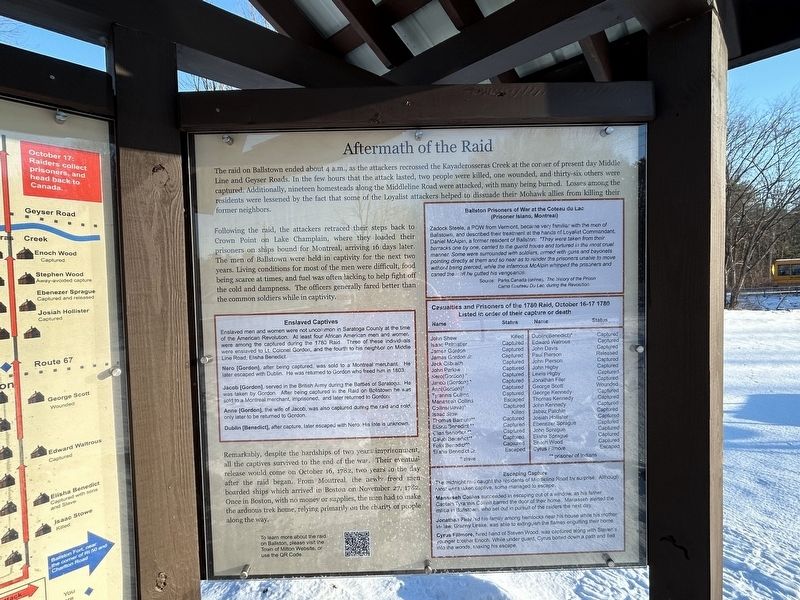
The raid on Ballstown ended about 4 a.m., as the attackers recrossed the Kayaderosseras Creek at the corner of present day Middle Line and Geyser Roads. In the few hours that the attack lasted, two people were killed,
Photographed by Steve Stoessel, January 22, 2025
4. 1780 Invasion Marker
Following the raid, the attackers retraced their steps back to Crown Point on Lake Champlain, where they loaded their prisoners on ships bound for Montreal, arriving 16 days later. The men of Ballstown were held in captivity for the next two years. Living conditions for most of the men were difficult, food being scarce at times, and fuel was often lacking to help fight off the cold and dampness. The officers generally fared better than the common soldiers while in captivity.
Remarkably, despite the hardships of two years imprisonment, all the captives survived to the end of the war. Their eventual release would come on October 16, 1782, two years to the day after the raid began. From Montreal, the newly freed men boarded ships which arrived in Boston on Noveniber 27, 1782. Once in Boston, with no money or supplies, the
Photographed by Steve Stoessel, January 22, 2025
5. 1780 Invasion Marker
To learn more about the raid on Baliston, please visit the Town of Milton Website, or use the QR Code.
[Insets]
Ballston Prisoners of War at the Coteau du Lac
(Prisoner Isiana, Montreai)
Zadock Steele, a POW from Vermont, became very familiar with the men of Ballstown, and described their treatment at the hands of Loyalist Commandant, Daniel McAipin, a former resident of Ballston: "They were taken from their barracks one by one, carried to the guard house and tortured in the most cruel manner. Some were surrounded with soldiers, armed with guns and bayonets pointing directly at them and so near as to render the prisoners unable to move without being pierced, while the infamous McAlpin whipped the prisoners and caned then till he gutted his vengeance." Source: Parks Canada (online), The history of the Prison Camo Couteau Du Lac, during the Revolution.
Enslaved Captives
Enslaved men and women were not uncommon in Saratoga County at the time of the American Revolution. At least four African American men and women. were among the captured during the 1780 Raid. Three of these individuals were enslaved to Lt. Colonel Gordon, and the fourth to his neighbor on Middle Line Road, Elisha Benedict.
Nero [Gordon], after being captured, was sold to a Montreal merchant. He later escaped with Dublin. He was returned to Gordon who freed him in 1803.
Jacob [Gordon], served in the British Army during the Battles of Saratoga. He was taken by Gordon. After being captured in the Raid on Balistown he was sold to a Montreal merchant, imprisoned, and later returned to Gordon.
Anne [Gordon], the wife of Jacob, was also captured during the raid and sold, only later to be returned to Gordon.
Dublin [Benedict], after capture, later escaped with Nero. His fate is unknown.
Escaping Capture
The midnight raid caught the residents of Middieline Road by surprise. Although most wace taken captive, some managed to escape.
Manasseh Collins succeeded in escaping out of a window, as his father Captain Tyrannis Collins barred the door of their home. Marasseh alerted the milita in Ballstown, who set out in pursuit of the raiders the next day.
Jonathan Flier hid his family among hemlocks near his house while his mother in-law, Granny Leake, was able to extinguish the flames engulfing their home.
Cyrus Fillmore, hired hand of Steven Wood, was captured along with Steven's younger brother Enoch. While under guard, Cyrus bolted down a path and fled into the woods, making his escape.
Casualties and Prisoners of the 1780 Raid, October 16-17 1780 Listed in order of their capture or death
Jolin Shew – Killed • Isaac Palmatier – Captured • James Gordon – Captured • James Gordon Jr. - Captured • Jack Gibraith - Captured • John Parlow - Captured • Nero(Gordon) * - Captured • Jaros (Serdon)* - Captured • Ann(Gordon)* - Captured • Tyrannis Collins - Captured • Manassen Collins - Escaped • Collins(slava)* - Captured • Isaac Stow - Killed • Thomas Barrun** - Captured • Elisha Benedict ** - Captured • Ellas Benedict ** - Captured • Calab Beredict** - Captured • Felix Benedict** - Capiured • Elisha Benedict Sr. - Escaped • Dublin(Benedict)* - Captured • Edward Watrous - Captured • John Davis - Captured • Paul Pierson - Released • John Pierson - Captured • John Higby - Captured • Lewis Higby - Captured • Jonathan Filer - Captured • George Scott - Wounded • George Kennedy - Captured • Thomas Kennedy - Captured • John Kennedy - Captured • Jabez Patchin - Captured • Josiah Hollister - Captured • Ebenezer Sprague - Captured • John Sprague - Captured • Elisha Sprague - Captured • Enoch, Wood - Captured • Cyrus Filmore – Escaped
** prisoner of Indians *slave
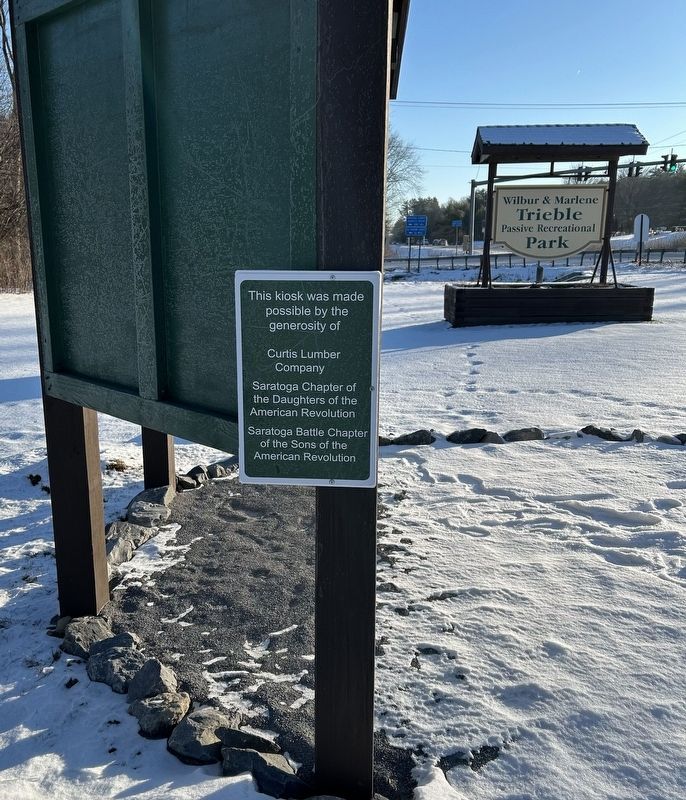
Erected by Curtis
Photographed by Steve Stoessel, January 22, 2025
6. 1780 Invasion Marker
Topics. This historical marker is listed in this topic list: War, US Revolutionary. A significant historical date for this entry is October 17, 1780.
Location. 42° 59.88′ N, 73° 53.085′ W. Marker is in Ballston Spa, New York, in Saratoga County. It is at the intersection of Route 67 and Middleline Road, on the right when traveling west on Route 67. Touch for map. Marker is in this post office area: Ballston Spa NY 12020, United States of America. Touch for directions.

Regionally, this marker is in Upstate New York, in the Capital District, and in the Albany Metropolitan Area. It is also in the American Northeast and in the Mid-Atlantic. Globally, it is in North America, the Great North Woods, the Western Hemisphere, the Western World, and the Anglosphere. Historically, it finds itself in what was once New Netherland and also one of the original Thirteen Colonies.
Other nearby markers. At least 8 other markers are within 2 miles of this marker, measured as the crow flies: Home of George Scott (approx. 0.4 miles away); Home of Jonathan Filer (approx. 0.8 miles away); Site of (approx. 1.1 miles away); Colonial Inn (approx. 1.1 miles away); Here in 1800 / Here in 1900 (approx. 1.6 miles away); Rose Hill Water Tower (approx. 1.6 miles away); Captain Abner Doubleday (approx. 1.6 miles away); County Seat (approx. 1.7 miles away). Touch for a list and map of all markers in Ballston Spa.
Credits. This page was last revised on January 22, 2025. It was originally submitted on January 22, 2025, by Steve Stoessel of Niskayuna, New York. This page has been viewed 1,408 times since then and 364 times this year. Photos: 1, 2, 3, 4, 5, 6. submitted on January 22, 2025, by Steve Stoessel of Niskayuna, New York.
