Rione IV Campo Marzio in Roma in Città metropolitana di Roma Capitale, Latium, Rome, Italy — Central Italy (Tyrrhenian Coast)
Hotel Palazzo Nainer
Architetto/Architect: Giuseppe Valadier (1762-1839)
Photographed by James Hulse, February 26, 2024
1. Hotel Palazzo Nainer Marker

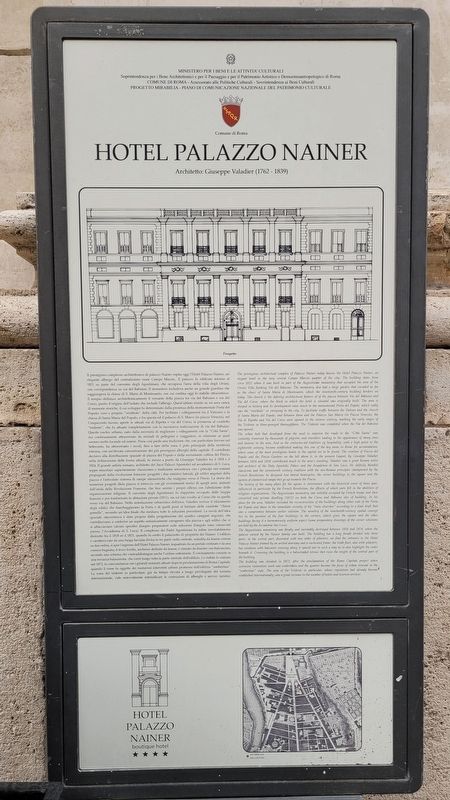
Il prestigioso complesso architettonico di palazzo Nainer ospita oggi l'Hotel Palazzo Nainer, un elegante albergo del centralissimo rione Campo Marzio, Il palazzo fu edificato intorno al 1821 su parte del convento degli Agostiniani, che occupava l'area della villa degli Orsini, con corrispondenza su via del Babuino. Il monastero includeva anche un grande giardino che raggiungeva la chiesa di S. Maria di Montesanto, con cui confina oggi lo stabille ottocentesco. Il tempio definisce architettonicamente il versante della piazza tra via del Babuino e via del Corso, punto d'origine dell'isolato che include l'albergo. Quest'ultimo insiste su un area carica di memorie storiche, il cui sviluppo fu determinato dalla presenza della monumentale Porta del Popolo: vero e proprio "vestibolo" della città. Per facilitare i collegamenti tra il Vaticano e la chiesa di Santa Maria del Popolo, e fra questa ed il palazzo di S. Marco (in piazza Venezia), nel Cinquecento furono aperte le attuali via di Ripetta e via del Corso, la premessa al cosidetto "tridente", che fu attuato completamente con la successiva realizzazione di via del Babuino. Questo nucleo urbano, nato dalla necessità di migliorare i collegamenti con la "Città Santa", era continuamente attraversato da miriadi di pellegrini e viaggiatori, in relazione ai quali sorsero molte locande ed osterie. Prese così piede una tradizione che, con particolare fervore nel Settecento, ha attraversato i secoli, fino a fare della zona il polo principale della ricettività romana, con un'elevata concentrazione dei più prestigiosi alberghi della capitale. Il contributo decisivo alla distribuzione spaziale di piazza del Popolo e della sovrastante collina del Pincio, nella delineazione delle forme attuali, fu messo a punto da Giuseppe Valadier tra il 1818 e il 1824. Il
this page online
Photographed by James Hulse, February 26, 2024
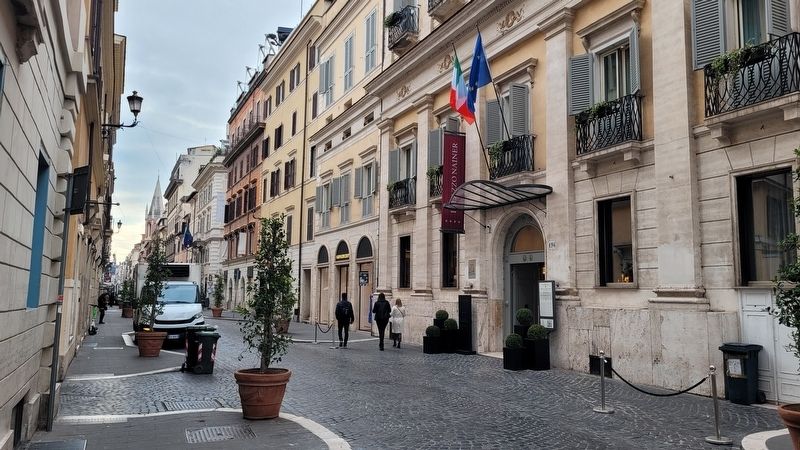
2. Hotel Palazzo Nainer and Marker
Photographed by James Hulse, February 26, 2024
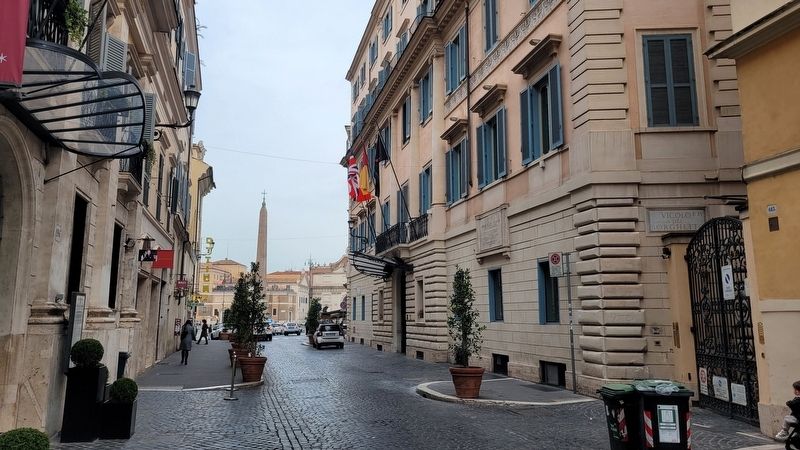
3. The view of the Hotel Palazzo Nainer and Marker looking toward the Piazza del Popolo
Didascalie
(Foto #1) Prospetto
The prestigious architectual complex of Palazzo Nainer today houses the Hotel Palazzo Nainer, an elegant hotel in the very central Campo Marzio quarter of the city. The building dates from circa 1821 when it was built in part of the Augustinian monastery that occupied the area of the Orsini Villa flanking Via del Babuino. The monastery also had a large garden that extended as far as the church of Santa Maria di Montesanto, which the nineteenth-century building borders on today. The church is the defining architectural feature of the piazza between Via del Babuino and Via del Corso, where the block in which the hotel is situated was originally built. The area is steeped in history and its development owes much to the monumental Porta del Popolo, which really was the "vestibule" or entryway to the city. To facilitate traffic between the Vatican and the church of Santa Maria del Popolo, and between them and the Palazzo San Marco (in Piazza Venezia), the Via di Ripetta and Via del
Photographed by James Hulse, February 26, 2024
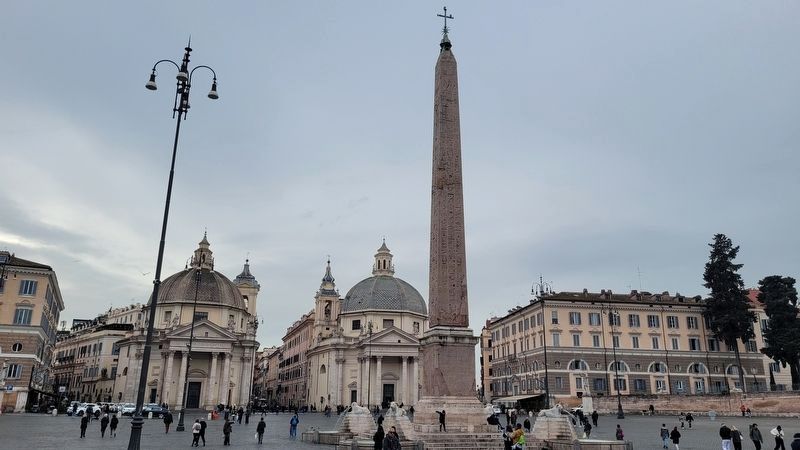
4. The view of the nearby Piazza del Popolo
The urban hub that developed from the need to improve the roads to the "Città Santa" was costantly traversed by thousands of pilgrims and travellers leading to the appearance of many inns and taverns in the area. And so the centuries-old tradition of hospitality, with a high point in the eighteenth century, became established making this one of the key areas in Rome for accommodation, where some of the most prestigious hotels in the capital ore to be found. The creation of Piazza del Popolo and the Pincio Gardens on the hill above it, in the present Layout, by Giuseppe Valadier between 1818 and 1824 contributed much to the area's standing. Valadier was a great Roman artist and architect of the Holy Apostolic Palace and the Acaademia di San Luca. He skilfully blended classicism and the seventeenth century tradition with the neo-Roman principles championed by the French Revolution: he designed two lateral hemicycles, the corner buildings in the square and the system of simmetrical ramps thet go up towards the Pincio.
The history of the many plans for the square is interwoven with the historical event of those year, influenced in particular by the French Revolution, the effects of which were felt in the abolition of religious organizations. The Augustinian monastery was initially occupied by French troops and then converted into private dwelling (1811) on both the Corso and Babuino sides of building. In his plans for the area, Valadier included the reconstruction of the buildings along either side of the Porta del Popolo and those in the immediate vicinity of the "twin churches" according to a final draft that was a compromise between earlier solution. The novelty of the nineteenth-century spatial concept lies in the position of the four buildings in the corners, which gives the square and the other buildings facing it a harmoniously uniform aspect (some preparatory drawings of the corner solutions are held by the Accademia San Luca).
The Augustinian monastery was finally and inevitably destroyed between 1818 and 1824, when the palazzo owned by the Nainer family was built. The building has a long facade divided into three parts: in the central part, decorated with two orders of pilasters, we find the entrance to the Hotel Palazzo Nainer framed by an arched doorway and a rusticated frame: the third floor, also with pilasters, has windows with balconies running along it spaced out in such a way as to also highlight the order beneath it. Crowning the building is a balustraded terrace that runs the length of the central part of the building.
The building was elevated in 1872, after the proclamation of the Roma Capitale project when extensive restoration work was undertaken and the quarter became the focus of urban renewal in the "umbertine" style. The area of the Tridente in particular, whose reputation had already become established internationally, saw a great increase in the number of hotels and tourism services.
Captions
(Photo #1) Front View
Erected by Ministry for Cultural Heritage and Activities Superintendence for Architectural Heritage, Landscape, and Artistic and Demoethnoanthropological Heritage of Rome Municipality of Rome - Department of Cultural Policies - Superintendence for Cultural Heritage Mirabilia Project - National Communication Plan for Cultural Heritage.
Topics. This historical marker is listed in this topic list: Notable Buildings. A significant historical year for this entry is 1821.
Location. 41° 54.583′ N, 12° 28.645′ E. Marker is in Roma, Lazio (Latium, Rome), in Città metropolitana di Roma Capitale. It is in Rione IV Campo Marzio. It is on Via del Babuino just north of Via della Fontanella, on the left when traveling north. The marker is located at the front entrance to the hotel. Touch for map. Marker is at or near this postal address: Via del Babuino 196, Roma, Lazio 00187, Italy. Touch for directions.

Regionally, it is in Europe, the European Union, the Schengen Area, a coastal Mediterranean country, and the Western World. Historically, it finds itself in what was once the Roman Empire.
Other nearby markers. At least 8 other markers are within walking distance of this marker: Prince Girolamo Napoleone (a few steps from this marker); Hotel de Russie (a few steps from this marker); Chiesa di Santa Maria di Montesanto / Church of Saint Mary of Montesanto (within shouting distance of this marker); Chiesa di Santa Maria dei Miracoli / Church of Saint Mary of Miracles (within shouting distance of this marker); Eleonora de Fonseca Pimentel (about 120 meters away, measured in a direct line); Official connection between Via Del Babuino and Madison Avenue (about 120 meters away); Juliusz Słowacki (about 120 meters away); Carlos Federico Sáez (about 180 meters away). Touch for a list and map of all markers in Roma.
Also see . . . Palazzo Nainer. Wikipedia
It was built between 1818 and 1821 on a former monastery of the Augustinians, as a part of the new urban and architectural plan created by Giuseppe Valadier for Piazza del Popolo and its Tridente. The building, which borders the church of Santa Maria in Montesanto, shows a characteristic long facade divided into three parts. The central part, where the entrance of the Piranesi Hotel is nowadays, has three orders and is marked by Lesenes: the upper order is punctuated by windows with small balconies and a beautiful bossage frame separates it from the two lower orders. A terrace with balustrade runs along the entire central part of the building.(Submitted on January 23, 2025, by James Hulse of Medina, Texas.)
Credits. This page was last revised on January 23, 2025. It was originally submitted on January 22, 2025, by James Hulse of Medina, Texas. This page has been viewed 127 times since then and 22 times this year. Photos: 1, 2, 3, 4. submitted on January 23, 2025, by James Hulse of Medina, Texas.
