Rione IV Campo Marzio in Roma in Città metropolitana di Roma Capitale, Latium, Rome, Italy — Central Italy (Tyrrhenian Coast)
Hotel de Russie
Photographed by James Hulse, February 26, 2024
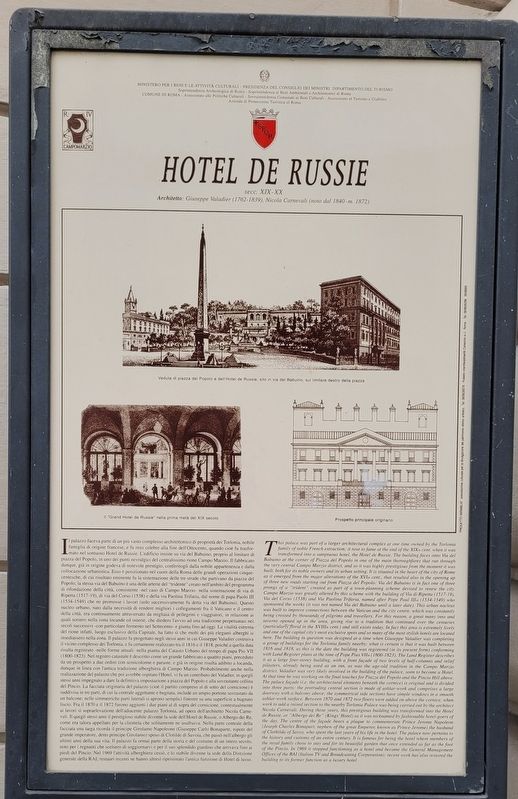
1. Hotel de Russie Marker

Architetto: Giuseppe Valadier (1762-1839), Nicola Carnevali (noto dal 1840-m. 1872)
Il palazzo faceva parte di un più vasto complesso architettonico di proprietà dei Torlonia, nobile famiglia di origine francese, e fu reso celebre alla fine dell'Ottocento, quando cioè fu trasformato nel sontuoso Hotel de Russie. L'edificio insiste su via del Babuino, proprio al limitare di piazza del Popolo, in uno dei punti nevralgici del centralissimo rione Campo Marzio. Il fabbricato dunque, già in origine godeva di notevole prestigio, conferitogli dalla nobile appartenenza e dalla collocazione urbanistica. Esso è posizionato nel cuore della Roma delle grandi operazioni cinquecentesche, di cui risultato eminente fu la sistemazione delle tre strade che partivano da piazza del Popolo; la stessa via del Babuino è una delle arterie del "tridente" creato nell'ambito del programma di rifondazione della città, consistente nel caso di Campo Marzio- nella sistemazione di via di Ripetta (1517-19), di via del Corso (1538) e della via Paolina Trifaria, dal nome di papa Paolo III (1534-1549) che ne promosse i lavori (solo successivamente fu detta via del Babuino). Questo nucleo urbano, nato dalla necessità di rendere migliori i collegamenti fra il Vaticano e il centro della città, era continuamente attraversato da migliaia di pellegrini e viaggiatori, in relazione ai quali sorsero nella zona locande ed osterie, che diedero l'avvio ad una tradizione perpetuatasi nei secoli successivi -con particolare fermento nel Settecento- e giunta fino ad oggi. La vitalità estrema del rione infatti, luogo esclusivo della Capitale, ha fatto sì che molti dei più eleganti alberghi si insediassero nella zona. Il palazzo fu progettato negli stessi anni in cui Giuseppe Valadier costruiva il vicino complesso dei Torlonia,
this page online
Photographed by James Hulse, February 26, 2024
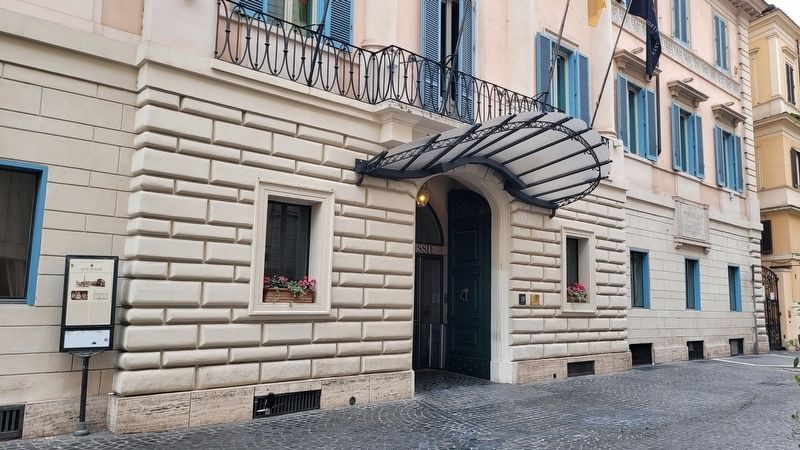
2. The entrance to the Hotel de Russie and Marker
Didascalie
(Foto #1) Veduta di piazza del Popolo e dell'Hotel de Russie, sito in via del Babuino, sul limitare destro della piazza.
(Foto #2) Il "Grand Hotel de Russie" nella prima metà del XIX secolo
(Foto #3) Prospetto principale originario
Architect: Giuseppe Valadier
Photographed by James Hulse
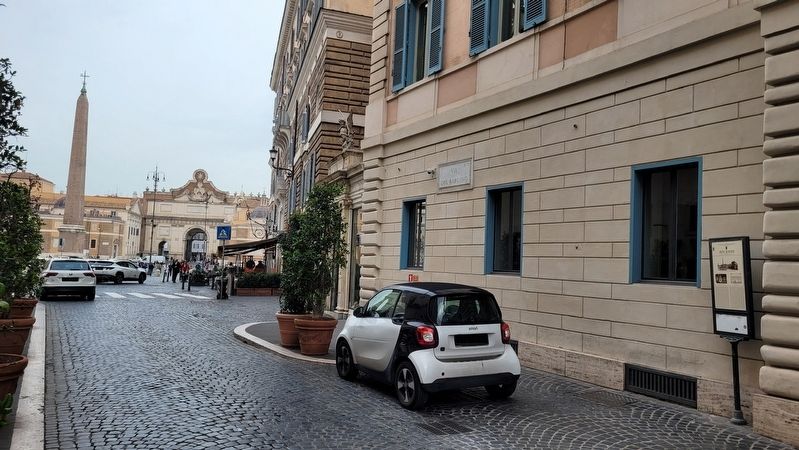
3. The view of the Hotel de Russie and Marker at the Piazza del Popolo
This palace was part of a larger architectural complex at one time owned by the Torlonia family of noble French extraction: it rose to fame at the end of the XIX cent. when it was transformed into a sumptuous hotel, the Hotel de Russie. The building faces onto Via del Babuino at the corner of Piazza del Popolo in one of the main thoroughfares that run through the very central Campo Marzio district, and so it was highly prestigious from the moment it was built, both for its noble owners and its urban setting. It is situated in the heart of the city of Rome as it emerged from the major alterations of the XVI cent., that resulted also in the opening up of three new roads starting out from Piazza del Popolo: Via del Babuino is in fact one of three prongs of a "trident created as part of a town-planning scheme devised to renew the city Campo Marzio was greatly altered by this scheme with the building of Via di Ripetta (1517-19). Via del Corso (1538) and Via Paolina Trifaria, named after Pope Paul III (1534-1549) who sponsored the works (it was not named Via del Babuino until a later date). This urban nucleus was built to improve connections between the Vatican and the city centre, which was constantly being crossed by thousands of pilgrims and travellers. For this reason, a great many inns and taverns opened up in the area, giving rise to a tradition that continued over the centuries (particularly florid in the XVIII cent.) and still exists today. In fact this area is extremely lively and one of the capital city's most exclusive spots and so many of the most stylish hotels are located here. The building in question was designed at a time when Giuseppe Valadier was completing a group of buildings for the Torlonia family nearby: what is certain is that it was built between 1816 and 1818, as this is the date the building was registered (in its present form) conforming with Land Register plans at the time of Pope Pius VII (1800-1823). The Land Register describes it as a large four-storey building, with a front façade of two levels of half-columns and relief pilasters, already being used as an inn, as was the age-old tradition in the Campo Marzio district. Valadier was very likely involved in the building of the palace, soon to become a Hotel. At that time he was working on the final touches for Piazza del Popolo and the Pincio Hill above. The palace façade (ie, the architectural elements beneath the cornice) is original and is divided into three parts: the protruding central section is made of ashlar-work and comprises a large doorway with a balcony above; the symmetrical side sections have simple windows in a smooth ashlar-work surface. Between 1870 and 1872 two floors were added on above the cornice, when work to add a raised section to the nearby Torlonia Palace was being carried out by the architect Nicola Carnevali. During those years, this prestigious building was transformed into the Hotel de Russie, or "Albergo dei Re" (Kings' Hotel) as it was nicknamed by fashionable hotel-goers of the day. The centre of the façade bears a plaque to commemorate Prince Jerome Napoleon (Joseph Charles Bonapart, nephew of the great Emperor, known as Prince Jerome) the husband of Clothilda of Savoy, who spent the last years of his life in the hotel. The palace now pertains to the history and customs of an entire century. It is famous for being the hotel where members of the royal family chose to stay and for its beautiful garden that once extended as far as the foot of the Pincio. In 1969 it stopped functioning as a hotel and became the General Management Offices of the RAI (Italian TV and Broadcasting Corporation); recent work has also restored the building to its former function as a luxury hotel.
Captions
(Photo #1) View of Piazza del Popolo and the Hotel de Russie, located in Via del Babuino, on the right edge of the square.
(Photo #2) The "Grand Hotel de Russie" in the first half of the 19th century.
(Photo #3) Original main façade.
Erected by Ministry of Cultural Heritage and Activities Presidency of the Council of Ministers Department of Tourism Archaeological Superintendence of Rome Superintendence of Environmental and Architectural Heritage of Rome Municipality of Rome - Department of Cultural Policies - Municipal Superintendence of Cultural Heritage - Department of Tourism and Jubilee Tourist Promotion Agency of Rome.
Topics. This historical marker is listed in this topic list: Notable Buildings. A significant historical year for this entry is 1816.
Location. 41° 54.595′ N, 12° 28.639′ E. Marker is in Roma, Lazio (Latium, Rome), in Città metropolitana di Roma Capitale. It is in Rione IV Campo Marzio. It is on Via del Babuino just south of Piazza del Popolo, on the right when traveling north. The marker is located at the entrance to the hotel. Touch for map. Marker is at or near this postal address: Via del Babuino 7, Roma, Lazio 00187, Italy. Touch for directions.

Regionally, it is in Europe, the European Union, the Schengen Area, a coastal Mediterranean country, and the Western World. Historically, it finds itself in what was once the Roman Empire.
Other nearby markers. At least 8 other markers are within walking distance of this marker: Prince Girolamo Napoleone (a few steps from this marker); Hotel Palazzo Nainer (a few steps from this marker); Chiesa di Santa Maria di Montesanto / Church of Saint Mary of Montesanto (within shouting distance of this marker); Chiesa di Santa Maria dei Miracoli / Church of Saint Mary of Miracles (within shouting distance of this marker); Eleonora de Fonseca Pimentel (about 120 meters away, measured in a direct line); Official connection between Via Del Babuino and Madison Avenue (about 150 meters away); Juliusz Słowacki (about 150 meters away); Chiesa di Santa Maria del Popolo / Church of Saint Mary of the People (about 180 meters away). Touch for a list and map of all markers in Roma.
More about this marker. The Hotel de Russie, located on Via del Babuino near Piazza del Popolo, was originally part of a larger architectural complex owned by the Torlonia family. Built between 1816 and 1818, the building was initially an inn in keeping with the area's long tradition of hospitality. It rose to prominence in the late 19th century when it was transformed into the luxurious Hotel de Russie. Designed during the same period as nearby projects by Giuseppe Valadier, the hotel became a favored residence for royalty and dignitaries. The palace also features a plaque commemorating Prince Jerome Napoleon, who spent his final years there. After ceasing operations as a hotel in 1969, it later became the headquarters of the Italian broadcasting company RAI, before being restored to its former glory as a luxury hotel.
Credits. This page was last revised on January 23, 2025. It was originally submitted on January 22, 2025, by James Hulse of Medina, Texas. This page has been viewed 136 times since then and 22 times this year. Photos: 1, 2, 3. submitted on January 23, 2025, by James Hulse of Medina, Texas.
