Rione IV Campo Marzio in Roma in Città metropolitana di Roma Capitale, Latium, Rome, Italy — Central Italy (Tyrrhenian Coast)
Chiesa di Santa Maria di Montesanto
⎯⎯⎯
Church of Saint Mary of Montesanto
Photographed by James Hulse, February 26, 2024
1. Chiesa di Santa Maria di Montesanto / Church of Saint Mary of Montesanto Marker

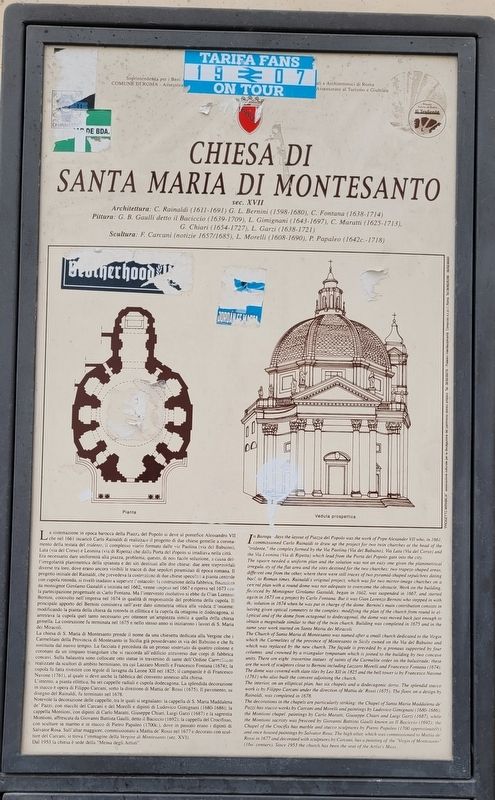
Architettura: C. Rainaldi (1611-1691) G. L. Bernini (1598-1680), C. Fontana (1638-1714) Pittura: G. B. Gaulli detto il Baciccio (1639-1709), L. Gimignani (1643-1697), C. Maratti (1625-1713), G. Chiari (1654-1727), L. Garzi (1638-1721) Scultura: F. Carcani (notizie 1657/1685), L. Morelli (1608-1690), P. Papaleo (1642c.-1718)
La sistemazione in epoca barocca della Piazza del Popolo si deve al pontefice Alessandro VII che nel 1661 incaricò Carlo Rainaldi di realizzare il progetto di due chiese gemelle a coronamento della testata del tridente, il complesso viario formato dalle vie Paolina (via del Babuino), Lata (via del Corso) e Leonina (via di Ripetta) che dalla Porta del Popolo si irradiava nella città. Era necessario dare uniformità alla piazza, problema, questo, di non facile soluzione, a causa dell'irregolarità planimetrica della spianata e dei siti destinati alle due chiese: due aree trapezoidali diverse tra loro, dove erano ancora visibili le tracce di due sepolcri piramidali di epoca romana. Il progetto iniziale del Rainaldi, che prevedeva la costruzione di due chiese speculari a pianta centrale con cupola rotonda, si rivelò inadatto a superare l'ostacolo: la costruzione della fabbrica, finanziata da monsignor Girolamo Gastaldi e iniziata nel 1662, venne sospesa nel 1667 e ripresa nel 1673 con la partecipazione progettuale di Carlo Fontana. Ma l'intervento risolutivo si ebbe da Gian Lorenzo Bernini, coinvolto nell'impresa nel 1674 in qualità di responsabile del problema della cupola. II principale apporto del Bernini consisteva nell'aver dato simmetria ottica alla veduta d'insieme: modificando la pianta della chiesa da rotonda in ellittica e la cupola da ottagona in dodecagona, si arretrava la cupola quel tanto necessario per ottenere un'ampiezza simile a quella della chiesa
this page online
La chiesa di S. Maria di Montesanto prende il nome da una chiesetta dedicata alla Vergine che i Carmelitani della Provincia di Montesanto in Sicilia già possedevano in via del Babuino e che fu sostituita dal nuovo tempio. La facciata è preceduta da un pronao sostenuto da quattro colonne e coronato da un timpano triangolare che si raccorda all'edificio attraverso due corpi di fabbrica concavi. Sulla balaustra sono collocate otto statue in travertino di sante dell'Ordine Carmelitano realizzate da scultori di ambito berniniano, tra cui Lazzaro Morelli e Francesco Fontana (1674); la cupola fu fatta rivestire con tegole di lavagna da Leone XII nel 1825; il campanile è di Francesco Navone (1761), al quale si deve anche la fabbrica del convento annesso alla chiesa.
L'interno, a pianta ellittica, ha sei cappelle radiali e cupola dodecagona. La splendida decorazione in stucco è opera di Filippo Carcani, sotto la direzione di Mattia de' Rossi (1675). Il pavimento, su disegno del Rainaldi, fu terminato nel 1678.
Notevole
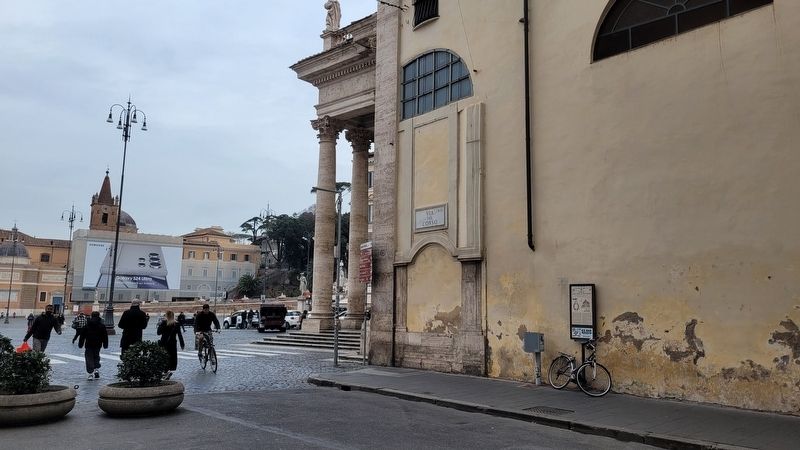
Photographed by James Hulse, February 26, 2024
2. The view of the Church of Saint Mary of Montesanto and Marker
Dal 1953 la chiesa è sede della "Messa degli Artisti".
Didascalie
(Foto #1) Pianta
(Foto #2) Veduta prospettica
Architecture: C. Rainaldi (1611-1691), G. L. Bernini (1598-1680), C. Fontana (1638-1714) Painting: G. B. Gaulli, known as il Baciccio (1639-1709), L. Gimignani (1643-1697), C. Maratti (1625-1713), G. Chiari (1654-1727), L. Garzi (1638-1721) Sculpture: F. Carcani (records from 1657/1685), L. Morelli (1608-1690), P. Papaleo (c. 1642-1718)
In
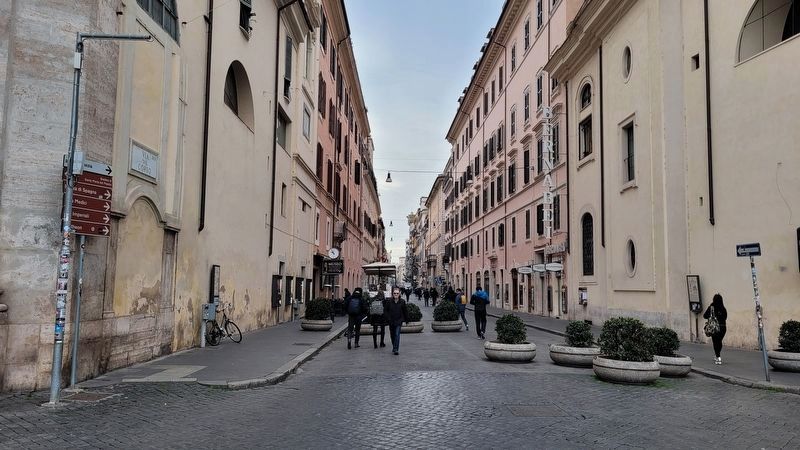
Photographed by James Hulse, February 26, 2024
3. The view of the road with the Church of Saint Mary of Montesanto and Marker on the left side
The square needed a uniform plan and the solution was not an easy one given the planimetrical irregularity of the flat area and the sites destined for the two churches: two trapeze-shaped areas, different one from the other, where there were still traces of two pyramid-shaped sepulchres dating back to Roman times. Rainaldi's original project, which was for two mirror-image churches on a central plan with a round dome was not adequate to overcome the obstacle. Work on the building, financed by Monsignor Girolamo Gastaldi, began in 1662, was suspended in 1667, and started again in 1673 on a project by Carlo Fontana. But it was Gian Lorenzo Bernini who stepped in with the solution in 1674 when he was put in charge of the dome. Bernini's main contribution consists in
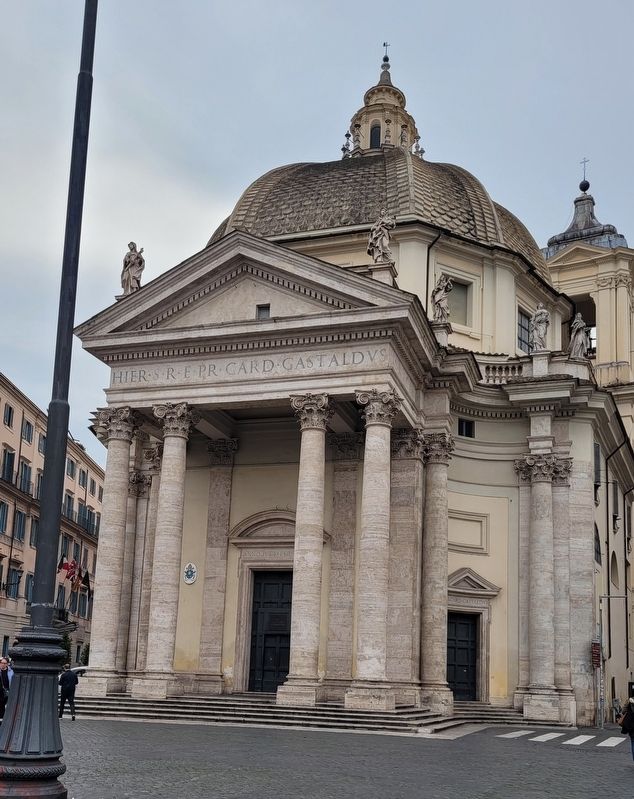
Photographed by James Hulse, February 26, 2024
4. Church of Saint Mary of Montesanto
The Church of Santa Maria di Montesanto was named after a small church dedicated to the Virgin which the Carmelites of the province of Montesanto in Sicily owned on the Via del Babuino and which was replaced by the new church. The façade is preceded by a pronaus supported by four columns and crowned by a triangular tympanum which is joined to the building by two concave units. There are eight travertine statues of saints of the Carmelite order on the balustrade; these are the work of sculptors close to Bernini including Lazzaro Morelli and Francesco Fontana (1674). The dome was covered with slate tiles by Leo XII in 1825 and the bell tower is by Francesco Navone (1761) who also built the convent adjoining the church.
The interior, on an elliptical plan, has six chapels and a dodecagonic dome. The
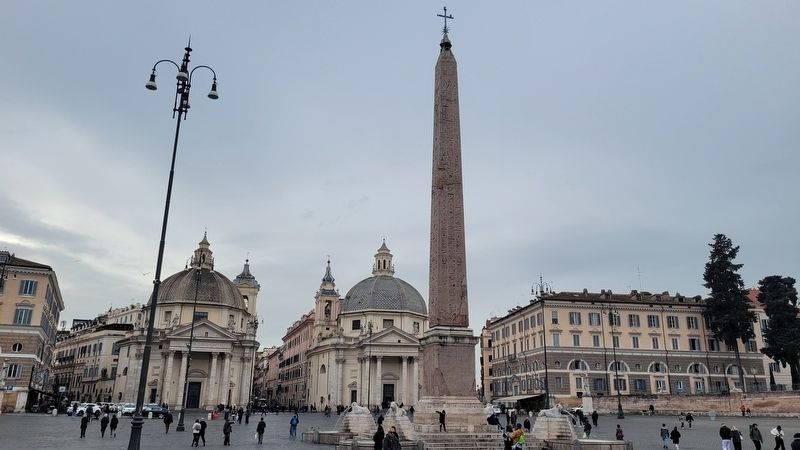
Photographed by James Hulse, February 26, 2024
5. The Church of Saint Mary of Montesanto is the church on the left side
The decorations in the chapels are particularly striking: the Chapel of Santa Maria Maddalena de'Pazzi has stucco works by Carcani and Morelli and paintings by Ludovico Gimignani (1680-1686); the Montioni chapel paintings by Carlo Maratti, Giuseppe Chiari and Luigi Garzi (1687), while the Montioni sacristy was frescoed by Giovanni Battista Gaulli known as Il Baciccio (1692): the Chapel of the Crocifix has marble and stucco sculptures by Pietro Papaleo (1700 approximately) and once housed paintings by Salvator Rosa. The high altar, which was commissioned to Mattia de' Rossi in 1677 and decorated with sculptures by Carcani, has a painting of the "Virgin of Montesanto" (16th century). Since 1953 the church has been the seat of the Artist's Mass.
Erected by Ministry of Cultural Heritage and Activities Superintendence for Artistic and Historical Heritage of Rome Superintendence for Environmental and Architectural Heritage of Rome Municipality of Rome - Department of Cultural Policies - Superintendence for Cultural Heritage - Department of Tourism and Jubilee.
Topics. This historical marker is listed in this topic list: Religion & Religious Structures. A significant historical year for this entry is 1661.
Location. 41° 54.592′ N, 12° 28.608′ E. Marker is in Roma, Lazio (Latium, Rome), in Città metropolitana di Roma Capitale. It is in Rione IV Campo Marzio. It is at the intersection of Via del Corso and Piazza del Popolo, on the right when traveling north on Via del Corso. The marker is located along the west side of the church. Touch for map. Marker is at or near this postal address: Via del Corso 1, Roma, Lazio 00187, Italy. Touch for directions.

Regionally, it is in Europe, the European Union, the Schengen Area, a coastal Mediterranean country, and the Western World. Historically, it finds itself in what was once the Roman Empire.
Other nearby markers. At least 8 other markers are within walking distance of this marker: Chiesa di Santa Maria dei Miracoli / Church of Saint Mary of Miracles (a few steps from this marker); Hotel de Russie (within shouting distance of this marker); Hotel Palazzo Nainer (within shouting distance of this marker); Prince Girolamo Napoleone (within shouting distance of this marker); Eleonora de Fonseca Pimentel (about 90 meters away, measured in a direct line); Chiesa di Santa Maria del Popolo / Church of Saint Mary of the People (about 150 meters away); Official connection between Via Del Babuino and Madison Avenue (about 180 meters away); Juliusz Słowacki (about 180 meters away). Touch for a list and map of all markers in Roma.
Credits. This page was last revised on January 23, 2025. It was originally submitted on January 22, 2025, by James Hulse of Medina, Texas. This page has been viewed 135 times since then and 25 times this year. Photos: 1, 2, 3, 4, 5. submitted on January 23, 2025, by James Hulse of Medina, Texas.
