Saint-Denis in Seine-Saint-Denis, Île-de-France, France — Western Europe
Découvrez Saint-Denis
⎯⎯⎯
Discover Saint-Denis
Photographed by Andrew Ruppenstein, April 18, 2024
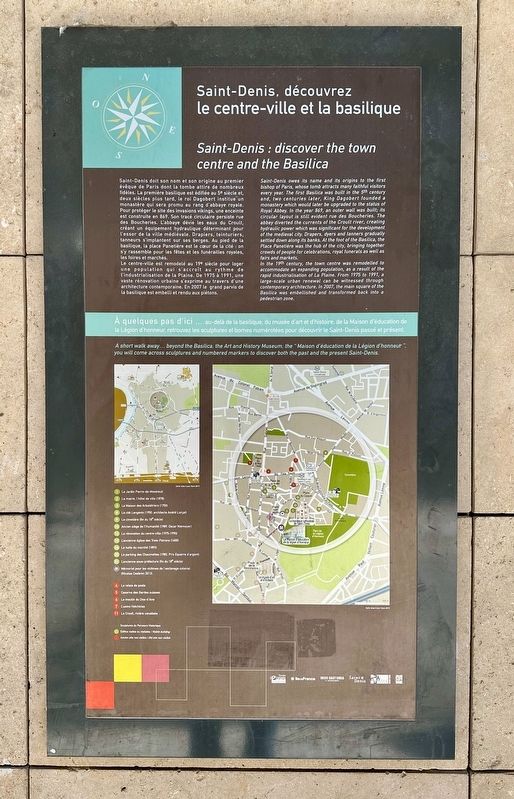
1. Découvrez Saint-Denis / Discover Saint-Denis Marker

Saint-Denis doit son nom et son origine au premier évêque de Paris dont la tombe attire de nombreux fidèles. La première basilique est édifiée au 5e siècle et, deux siècles plus tard, le roi Dagobert institue un monastère qui sera promu au rang d'abbaye royale. Pour protéger le site des invasions vikings, une enceinte est construite en 869. Son tracé circulaire persiste rue des Boucheries. L'abbaye dévie les eaux du Croult, créant un équipement hydraulique déterminant pour l'essor de la ville médiévale. Drapiers, teinturiers, tanneurs s'implantent sur ses berges. Au pied de la basilique, la place Panetière est le cœur de la cité: on s'y rassemble pour les fêtes et les funérailles royales, les foires et marchés.
Le centre-ville est remodelé au 19e siècle pour loger une population qui s'accroît au rythme de l'industrialisation de la Plaine. De 1975 à 1991, une vaste rénovation urbaine s'exprime au travers d'une architecture contemporaine. En 2007 le grand parvis de la basilique est embelli et rendu aux piétons.
Saint-Denis owes its name and its origins to the first bishop of Paris, whose tomb attracts many faithful visitors every year. The first Basilica was built in the 5th century and, two centuries later, King Dagobert founded a monastery which would later be upgraded to the status of Royal Abbey. In the year 869, an outer wall was built; its circular layout is still evident rue des Boucheries. The abbey diverted the currents of the Croult river, creating hydraulic power which was significant for the development of the medieval city. Drapers, dyers and tanners gradually settled down along its banks. At the foot of the Basilica, the Place Panetière
this page online
In the 19th century, the town centre was remodelled to accommodate an expanding population, as a result of the rapid industrialisation of La Plaine. From 1975 to 1991, a large-scale urban renewal can be witnessed through contemporary architecture. In 2007, the main square of the Basilica was embellished and transformed back into a pedestrian zone.
Topics. This historical marker is listed in this topic list: Settlements & Settlers. A significant historical year for this entry is 1975.
Location. 48° 56.188′ N, 2° 21.564′ E. Marker is in Saint-Denis, Île-de-France, in Seine-Saint-Denis. It is on Place du Caquet, on the right when traveling north. Touch for map. Marker is at or near this postal address: 2 Place du Caquet, Saint-Denis, Île-de-France 93200, France. Touch for directions.

Regionally, it is in the North Atlantic Region, Europe, the European Union, Atlantic Europe, the Schengen Area, Western Europe, a coastal Mediterranean country, and the Western World. Historically, it finds itself in
Photographed by Andrew Ruppenstein, April 18, 2024
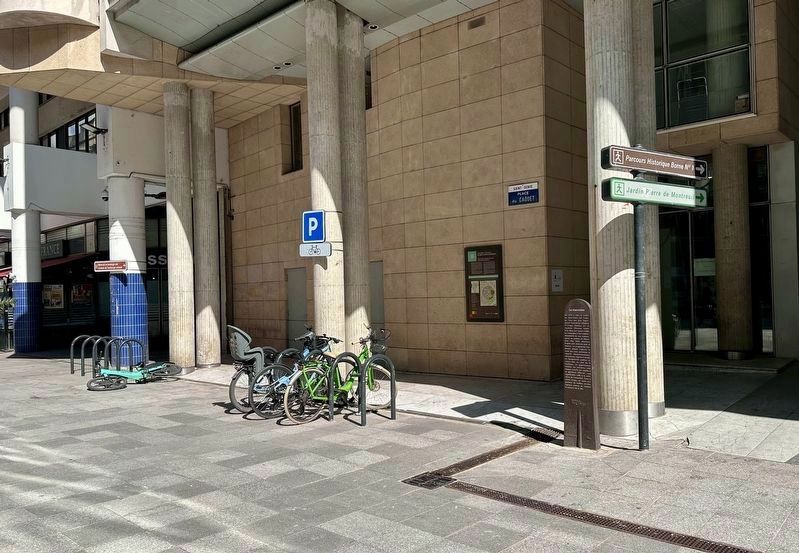
2. Découvrez Saint-Denis / Discover Saint-Denis Marker - wide view
The marker is mounted to the exterior of the Archives municipales de Saint-Denis.
Other nearby markers. At least 8 other markers are within walking distance of this marker: La rénovation (here, next to this marker); L’église des Trois-Patrons (within shouting distance of this marker); Jardin Pierre-de-Montreuil (within shouting distance of this marker); La Mairie / City Hall (about 120 meters away, measured in a direct line); École elementaire Jean Vilar Deported Jewish Students Memorial (approx. 0.3 kilometers away); La cimetière / The Cemetery (approx. 0.3 kilometers away); La Maison Aux Masques (approx. 0.4 kilometers away); Sétif, Guelma and Kherrata Massacres Memorial (approx. 0.4 kilometers away). Touch for a list and map of all markers in Saint-Denis.
Also see . . . Saint-Denis, Seine-Saint-Denis (Wikipedia). Excerpt:
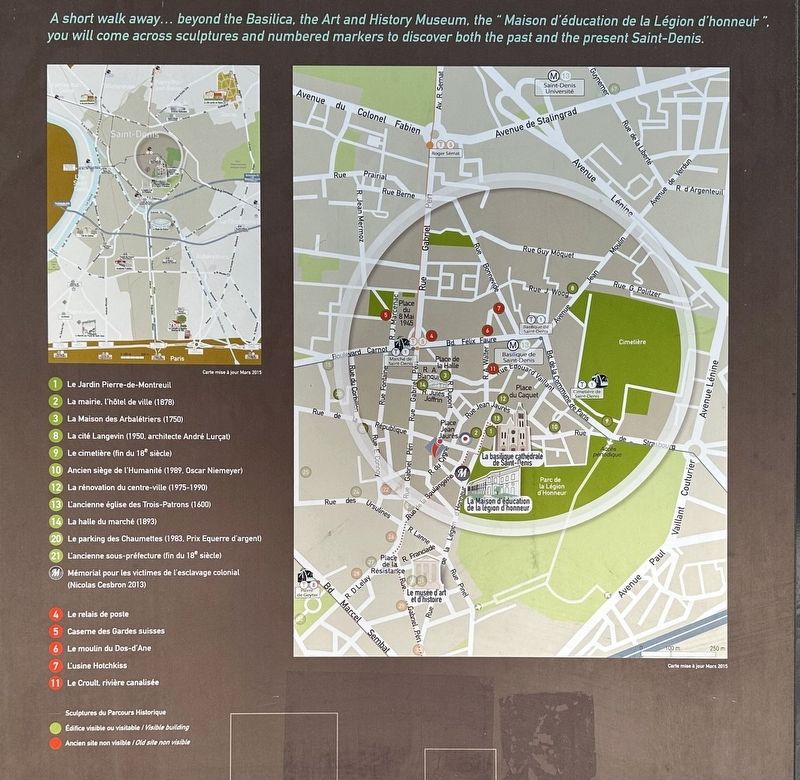
Saint-Denis is a commune in the northern suburbs of Paris, France. It is located 9.4 km (5.8 mi) from the centre of Paris. Saint-Denis is the second most populated suburb of Paris (after Boulogne-Billancourt), with a population of 113,116 at the 2020 census. It is a subprefecture (French: sous-préfecture) of the department(Submitted on January 25, 2025.)of Seine-Saint-Denis, being the seat of the arrondissement of Saint-Denis.Photographed by Andrew Ruppenstein, April 18, 20243. Marker detail: Map of Saint-Denis Historical markersThis marker provides a map that depicts the locations of the old series of historical markers. Saint-Denis actually has two series of historical markers. Both are white on brown, with the difference being that the newer ones are taller (roughly 1.5m v 1m), more elaborate, and include an English version of their text. The preceding picture incidentally shows one of the older style markers (#12 on the map), and also includes a directional sign (Parcours Historique Borne No. 1) to the first marker in the newer series, which is less than 100m to the east.
During its history, Saint-Denis has been closely associated with the French royal house. Starting from Dagobert I (c. 603–639), almost every French king was buried in the Basilica.
However, Saint-Denis is older than that. In the 2nd century, there was a Gallo-Roman village named Catolacus on the location that Saint-Denis occupies today. Saint Denis, the first bishop of Paris and patron saint of France, was martyred in about 250 AD and buried in the cemetery of Catolacus. Denis' tomb quickly became a place of worship. Around 475 AD, Sainte Geneviève had a small chapel erected on Denis' tomb, which by then had become a popular destination for pilgrims. It was this chapel that Dagobert I had rebuilt and turned into a royal monastery. Dagobert granted many privileges to the monastery: independence from the bishop of Paris, the right to hold a market, and, most importantly, he was buried in Saint-Denis; a tradition which was followed by almost all his successors. During the Middle Ages, because of the privileges granted by Dagobert, Saint-Denis grew to become very important. Merchants from all over Europe (and indeed from the Byzantine Empire) came to visit its market.
Credits. This page was last revised on January 25, 2025. It was originally submitted on January 24, 2025, by Andrew Ruppenstein of Lamorinda, California. This page has been viewed 116 times since then and 14 times this year. Photos: 1, 2. submitted on January 24, 2025, by Andrew Ruppenstein of Lamorinda, California. 3. submitted on January 25, 2025, by Andrew Ruppenstein of Lamorinda, California.
