
Meaux in Seine-et-Marne, Île-de-France, France — Western Europe
Construire
1916
Photographed by Steve Stoessel, November 16, 2024
1. Construire Marker
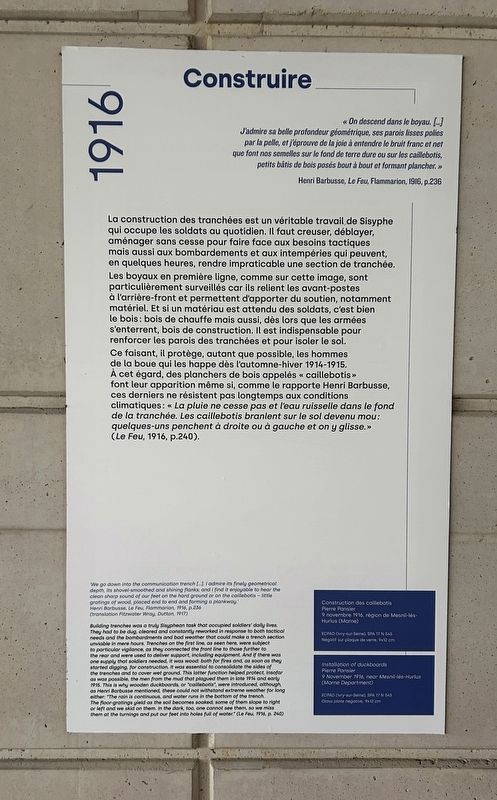
« On descend dans le boyau. [..) J'admire sa belle profondeur géométrique, ses parois lisses polies par la pelle, et j'éprouve de la joie à entendre le bruit franc et net que font nos semelles sur le fond de terre dure ou sur les caillebotis, petits bâtis de bois posés bout à bout et formant plancher. » - Henri Barbusse, Le Feu, Flammarion, 1916, p.236
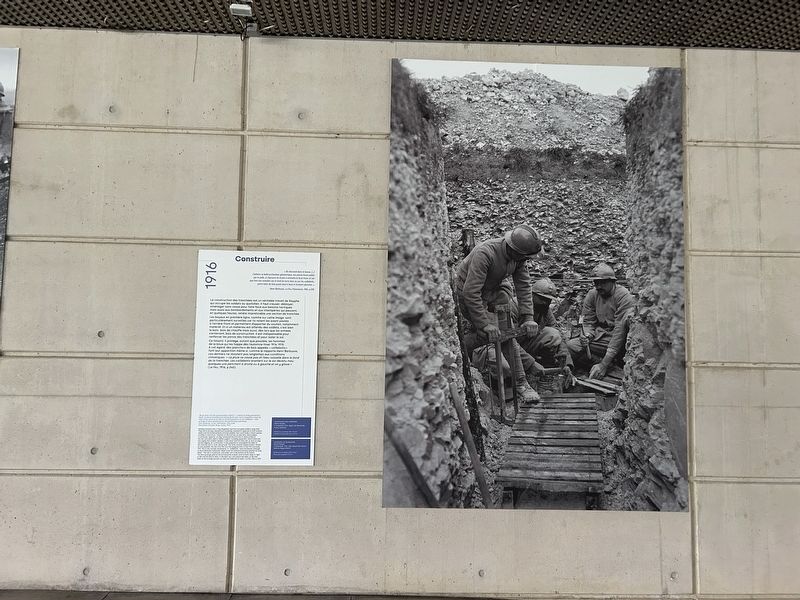
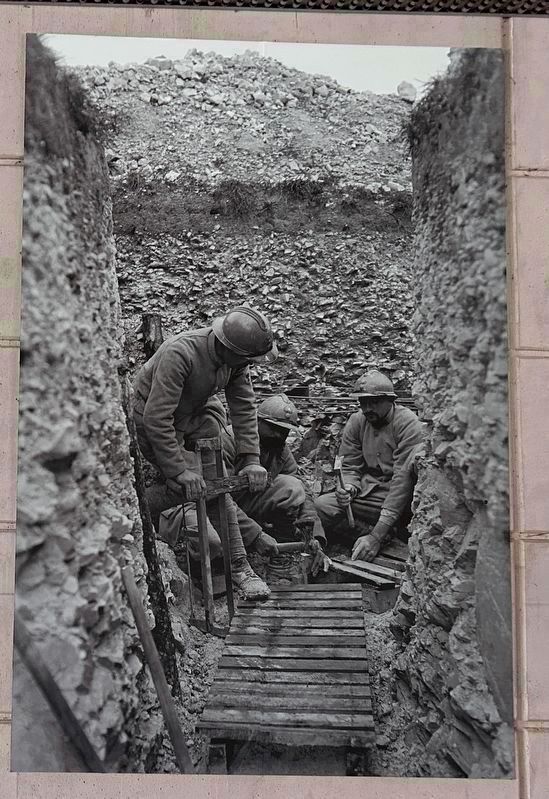
La construction des tranchées est un véritable travail de Sisyphe qui occupe les soldats au quotidien. Il faut creuser, déblayer, aménager sans cesse pour faire face aux besoins tactiques mais aussi aux bombardements et aux intempéries qui peuvent, en quelques heures, rendre impraticable une section de tranchée. Les boyaux en première ligne, comme sur cette image, sont particulièrement surveillés car ils relient les avant-postes à l'arrière-front et permettent d'apporter du soutien, notamment matériel. Et si un matériau est attendu des soldats, c'est bien le bois: bois de chauffe mais aussi, dès lors que les armées s'enterrent, bois de construction. Il est indispensable pour renforcer les parois des tranchées et pour isoler le sol.
Ce faisant, il protège, autant que possible, les hommes de la boue qui les happe des l'automne-hiver 1914-1915. À cet égard, des planchers de bois appelés « caillebotis» font leur apparition même si, comme le rapporte Henri Barbusse, ces derniers ne résistent pas longtemps aux conditions climatiques: « La pluie ne cesse pas et l'eau ruisselle dans le fond de la tranchée. Les caillebotis branlent sur le sol devenu mou: quelques-uns penchent à droite ou à gauche et on y glisse.» (Le Feu, 1916, p.240).
“We go down into the communication trench [...]. I admire its finely geometrical depth, its shovel-smoothed and shining flanks; and I find it enjoyable to hear the clean sharp sound of our feet on the hard ground or on the caillebotis
this page online
Photographed by Steve Stoessel, November 16, 2024
2. Construire Marker
Topics. This historical marker is listed in this topic list: War, World I. A significant historical date for this entry is November 9, 1916.
Location. 48° 58.283′ N, 2° 54.29′ E. Marker is in Meaux, Île-de-France, in Seine-et-Marne. It can be reached from the intersection of Rue Lazare Ponticelli and Route de Varreddes. Touch for map. Marker is in this post office area: Meaux, Île-de-France 77100, France. Touch for directions.

Regionally, it is in the North Atlantic Region, Europe, the European Union, Atlantic Europe, the Schengen Area, Western Europe, a coastal Mediterranean country, and the Western World. Historically, it finds itself in what was once a French colony and also the Roman Empire.
Other nearby markers. At least 8 other markers are within walking distance of this marker: A different marker also named Construire (here, next
November 16, 2024
3. Close Up of Marker Photo
Construction des caillebotis
9 novembre 1916, région de Mesnil-les-Hurlus (Marne)
Installation of duckboards
9 November 1916, near Mesnil-les-Hurtus (Marne Department)
- Pierre Pansier - ECPAD (Ivry-sur-Seine), SPA 17 N 545 , Glass plate negative, 9x12 cm
9 novembre 1916, région de Mesnil-les-Hurlus (Marne)
Installation of duckboards
9 November 1916, near Mesnil-les-Hurtus (Marne Department)
- Pierre Pansier - ECPAD (Ivry-sur-Seine), SPA 17 N 545 , Glass plate negative, 9x12 cm
Related marker. Click here for another marker that is related to this marker.
Photographed by Steve Stoessel, November 16, 2024
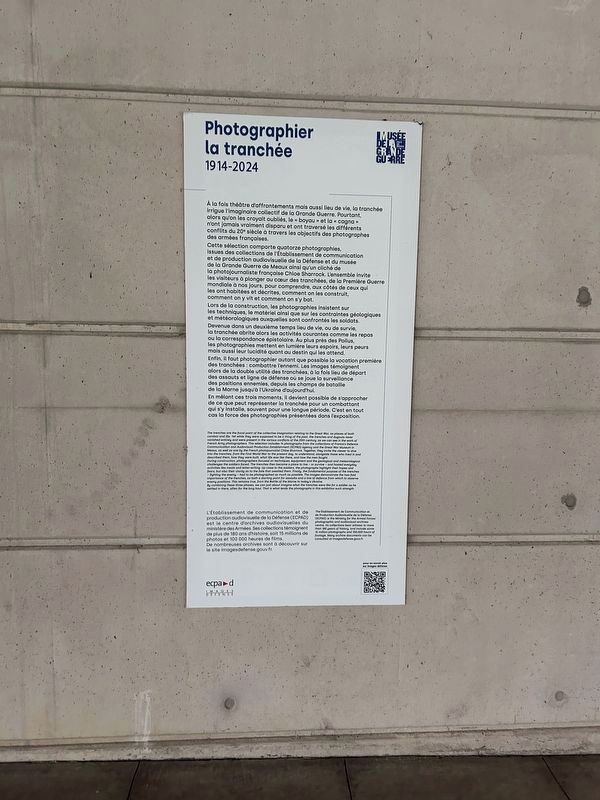
4. Photographier la tranchée 1914-2024
This is a collection of photos showing trench warfare from 1914 through present day Ukraine (2023) outside the Musée de Grande Guerreim Meaux, France.
Credits. This page was last revised on January 26, 2025. It was originally submitted on January 25, 2025, by Steve Stoessel of Niskayuna, New York. This page has been viewed 134 times since then and 11 times this year. Photos: 1, 2, 3, 4. submitted on January 25, 2025, by Steve Stoessel of Niskayuna, New York.
