
Meaux in Seine-et-Marne, Île-de-France, France — Western Europe
Construire
1916
Photographed by Steve Stoessel, November 16, 2024
1. Construire Marker
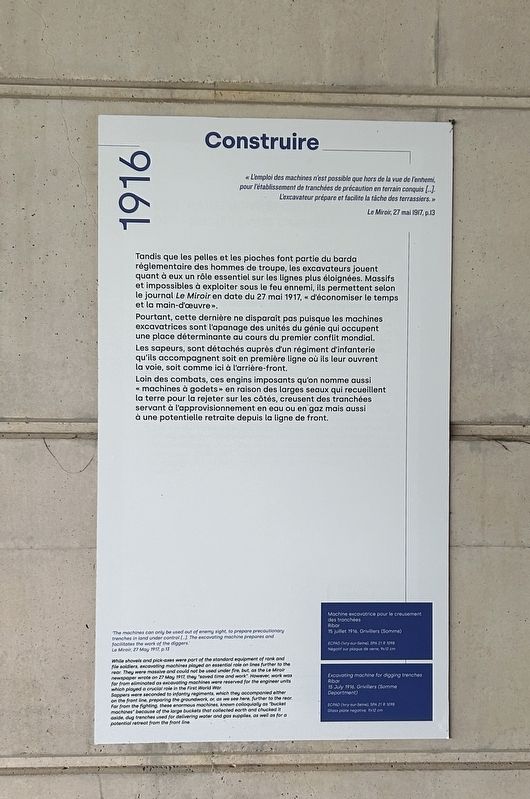
« L'emploi des machines n'est possible que hors de la vue de l'ennemi, pour l'établissement de tranchées de précaution en terrain conquis [...]. L'excavateur prépare et facilite la tâche des terrassiers.» Le Miroir, 27 mai 1917, p.13
Tandis que les pelles et les pioches font partie du barda réglementaire des hommes de troupe, les excavateurs jouent quant à eux un rôle essentiel sur les lignes plus éloignées. Massifs et impossibles à exploiter sous le feu ennemi, ils permettent selon le journal Le Miroir en date du 27 mai 1917, « d'économiser le temps et la main-d'œuvre».
Pourtant, cette dernière ne disparaît pas puisque les machines excavatrices sont l'apanage des unités du génie qui occupent une place déterminante au cours du premier conflit mondial. Les sapeurs, sont détachés auprès d'un régiment d'infanterie qu'ils accompagnent soit en première ligne où ils leur ouvrent la voie, soit comme ici à l'arrière-front.
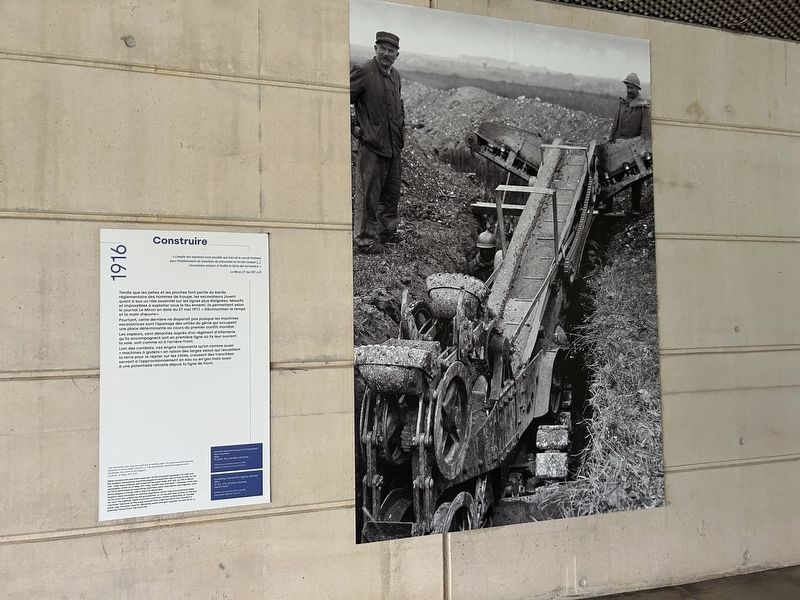
Loin des combats, ces engins imposants qu'on nomme aussi « machines à godets» en raison des larges seaux qui recueillent la terre pour la rejeter sur les côtés, creusent des tranchées servant à l'approvisionnement en eau ou en gaz mais aussi à une potentielle retraite depuis la ligne de front.
”The machines can only be used out of enemy sight, to prepare precautionary trenches in land under control…. The excavating machine prepares and facilitates the work of the diggers." Le Miroir,27 May 1917, p.13
While shovels and pick-axes were part of the standard equipment of rank-and-file soldiers, excavating machines played an essential role on lines further to the rear. They wore massive and could not be used under fire, but, as the Le Miroir newspaper wrote on 27 May 1917, they "saved time and work". However, work was far from eliminated as excavating machines were reserved for the engineer
this page online
Sappers wore seconded to infantry regiments, which they accompanied either on the front line, preparing the groundwork, or, as we see here, further to the rear.
Far from the fighting, these enormous machines, known colloquially as "bucket machines" because of the large buckets that collected earth and chucked it aside, dug trenches used for delivering water and gas supplies, as well as for a potential retreat from the front line.
Topics. This historical marker is listed in this topic list: War, World I. A significant historical date for this entry is May 27, 1917.
Location. 48° 58.296′ N, 2° 54.269′ E. Marker is in Meaux, Île-de-France, in Seine-et-Marne. It is on Route de Varreddes. Marker is outside of the entrance to the Musée Grand Guerre. Touch for map. Marker is at or near this postal address: 49 Bis Rte de Varreddes, Meaux, Île-de-France 77100, France. Touch for directions.

Regionally, it is in the North Atlantic Region, Europe, the European Union, Atlantic Europe, the Schengen Area, Western Europe, a coastal Mediterranean country, and the Western World. Historically,
Photographed by Steve Stoessel, November 16, 2024
2. Construire Marker
Other nearby markers. At least 8 other markers are within walking distance of this marker: Photographier La Tranchée (within shouting distance of this marker); La Tranchée (within shouting distance of this marker); a different marker also named Construire (within shouting distance of this marker); a different marker also named Construire (within shouting distance of this marker); a different marker also named Construire (within shouting distance of this marker); a different marker also named Construire (within shouting distance of this marker); Char Saint-Chamond modèle 1917 (within shouting distance of this marker); Le Rail Pendant la Grande Guerre (about 90 meters away, measured in a direct line). Touch for a list and map of all markers in Meaux.
Regarding Construire. This marker is part of series on trench warfare from 1916- to 2023.

November 16, 2024
3. Close Up of Marker Photo
Machine excavatrice pour le creusement des tranchées
Ribar 15 juillet 1916, Grivillers (Somme)
Excavating machine for digging trenches
Ribar 15 July 1916, Grivillers (Somme Department)
ECPAD (ivry-sur-Soine), SPA 21 R 1098 Glass plate negative, 9x12 cm
Ribar 15 juillet 1916, Grivillers (Somme)
Excavating machine for digging trenches
Ribar 15 July 1916, Grivillers (Somme Department)
ECPAD (ivry-sur-Soine), SPA 21 R 1098 Glass plate negative, 9x12 cm
Credits. This page was last revised on January 25, 2025. It was originally submitted on January 25, 2025, by Steve Stoessel of Niskayuna, New York. This page has been viewed 87 times since then and 7 times this year. Photos: 1, 2, 3. submitted on January 25, 2025, by Steve Stoessel of Niskayuna, New York.
