
Meaux in Seine-et-Marne, Île-de-France, France — Western Europe
Photographier La Tranchée
1914-2024
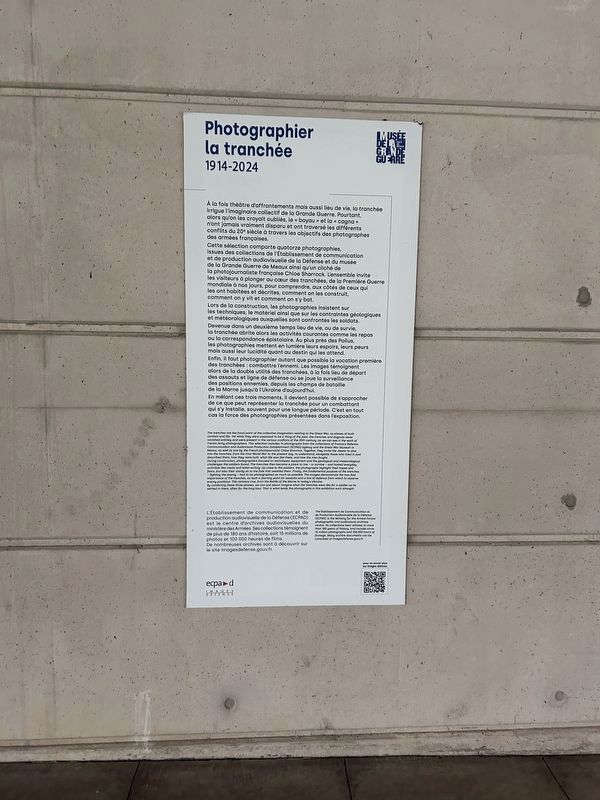
Photographed by Steve Stoessel, November 16, 2024
1. Photographier la Tranchée Marker
À la fois théâtre d'affrontements mais aussi lieu de vie, la tranchée irrigue l'imaginaire collectif de la Grande Guerre. Pourtant, alors qu'on les croyait oubliés, le « boyau » et la « cagna » n'ont jamais vraiment disparu et ont traversé les différents conflits du 20° siècle à travers les objectifs des photographes des armées françaises.
Cette sélection comporte quatorze photographies, issues des collections de l'Établissement de communication et de production audiovisuelle de la Défense et du musée de la Grande Guerre de Meaux ainsi qu'un cliché de la photojournaliste française Chloe Sharrock. L'ensemble invite les visiteurs à plonger au cœur des tranchées, de la Première Guerre mondiale à nos jours, pour comprendre, aux côtés de ceux qui les ont habitées et décrites, comment on les construit, comment on y vit et comment on s'y bat.
Lors de la construction, les photographies insistent sur les techniques, le matériel ainsi que sur les contraintes géologiques et météorologiques auxquelles sont confrontés les soldats. Devenue dans un deuxième temps lieu de vie, ou de survie, la tranchée abrite alors les activités courantes
this page online
Enfin, il faut photographier autant que possible la vocation première des tranchées: combattre l'ennemi. Les images témoignent alors de la double utilité des tranchées, à la fois lieu de départ des assauts et ligne de défense où se joue la surveillance des positions ennemies, depuis les champs de bataille de la Marne jusqu'à l'Ukraine d'aujourd'hui.
En mêlant ces trois moments, il devient possible de s'approcher de ce que peut représenter la tranchée pour un combattant qui s'y installe, souvent pour une longue période. C'est en tout cas la force des photographies présentées dans l'exposition.
Photographing the Trenches (1914-2024)
The trenches are the focal point of the collective imagination relating to the Great War, as places of both combat and life. Yet while they supposed to be a thing of the past, the trenches and dugouts never vanished entirely and were present in various conflicts of the 20th century, as we can see the work of French Army photographers. This selection includes 14 photographs from the collections of France’s Defence Communication and Audiovisual Production Establishment Agency and the Great War Museum in Meaux, as well as one by the French photojournalist Chloe Sharrock. Together, they invite the viewer to dive into the trenches, from the First World War to the present day, to understand, alongside those who lived in and described them, how they were built, what life was like there, and how the men fought.
During construction, photographers focused on techniques, equipment and the geological and meteorological challenges the soldiers faced. The trenches then became a place to live – orsurvive -- and hosted everyday activities like meals and letter-writing. Up close to the soldiers, the photographs highlight their hopes and fears, but also their clarity as to the fate that awaited them. Finally, the fundamental purpose of the trenches – fighting the enemy- had to be photographed as much as possible. The images demonstrate the two-fold importance of the trenches, both as a starting point for assaults and a line of defence from which to observe enemy positions. This remains true, from the Battle of the Marne to today’s Ukraine.
By combining these three phases, we can just about imagine what the trenches were like for a soldier as he settled in there, often for the long haul. That is what lends the photographs in this exhibition such strength.
The Établissement de Communication et Production Audiovisuelle de la Défense (ECPAD) is the Ministry of the Armed Forces photographic and audiovisual archives center. Its collections bear witness to more than 180 years of history, or 15 million photos and 100,000 hours of footage. Many archives can be consulted at imagesdefense.gouv.fr website.
Topics. This historical marker is listed in this topic list: War, World I.
Location. 48° 58.283′ N, 2° 54.278′ E. Marker is in Meaux, Île-de-France, in Seine-et-Marne. It can be reached from the intersection of D2405A and Rue Lazare Ponticelli. Marker is just outside the entrance to Musée de la Grand Guerre. Touch for map. Marker is at or near this postal address: Route de Varreddes, Meaux, Île-de-France 77100, France. Touch for directions.

Regionally, it is in the North Atlantic Region, Europe, the European Union, Atlantic Europe, the Schengen Area, Western Europe, a coastal Mediterranean country, and the Western World. Historically, it finds itself in what was once a French colony and also the Roman Empire.
Other nearby markers. At least 8 other markers are within walking distance of this marker: Construire (a few steps from this marker); a different marker also named Construire (a few steps from this marker); a different marker also named Construire (within shouting distance of this marker); a different marker also named Construire (within shouting distance of this marker); a different marker also named Construire (within shouting distance of this marker); La Tranchée (within shouting distance of this marker); Char Saint-Chamond modèle 1917 (within shouting distance of this marker); Le Rail Pendant la Grande Guerre (within shouting distance of this marker). Touch for a list and map of all markers in Meaux.
Credits. This page was last revised on January 27, 2025. It was originally submitted on January 25, 2025, by Steve Stoessel of Niskayuna, New York. This page has been viewed 131 times since then and 15 times this year. Photo 1. submitted on January 25, 2025, by Steve Stoessel of Niskayuna, New York.
