Verdun in Meuse, Alsace, Lorraine, Champagne-Ardenne, France — Western Europe
Ancienne abbaye Saint-Paul
(XVIe - XXe siècles)
Photographed by Steve Stoessel, November 18, 2024
1. Ancienne abbaye Saint-Paul Marker

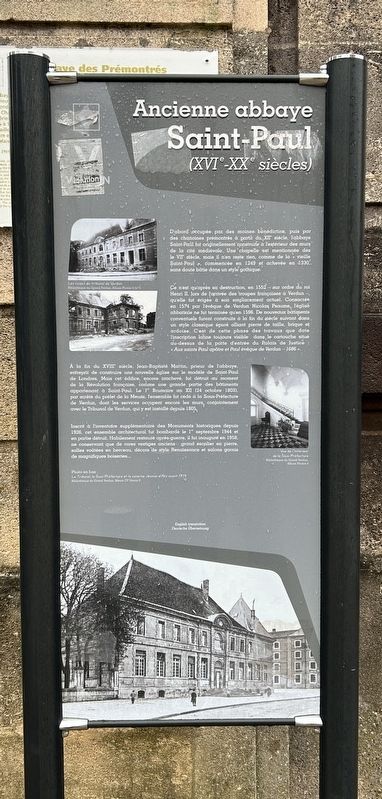
D'abord occupée, par des moines bénédictins, puis par des chanoines prémontrés à partir du Xlle siècle, l’abbaye Saint-Paul fut originellement construite à l'extérieur des murs de la cité médiévale. Une chapelle est mentionnée des le VIle siècle, mais il n'en reste rien, comme de la « vieille Saint-Paul », commencée en 1249 et achevée en 1330, sans doute bâtie dans un style gothique.
Ce n'est qu'après sa destruction, en 1552 - sur ordre du roi Henri II, lors de l'arrivée des troupes françaises à Verdun - qu'elle fut érigée à son emplacement actuel. Consacrée en 1574 par l'évêque de Verdun Nicolas Psaume, l'église abbatiale ne fut terminée qu'en 1596. De nouveaux bâtiments conventuels furent construits à la fin du siècle suivant dans un style classique épuré alliant pierre de taille, brique et ardoise. C'est de cette phase des travaux que date l’inscription latine toujours visible dans le cartouche situé au-dessus de la porte d'entrée du Palais de Justice : « Aux saints Paul apôtre et Paul évêque de Verdun - 1686 ».
À la fin du XVIIIe siècle, Jean-Baptiste Martin, prieur de l'abbaye, entreprit de construire une nouvelle église sur le modèle de Saint-Paul de Londres, Mais cet édifice, encore inachevé, fut détruit au moment de la Révolution française, comme une grande partie des bâtiments appartenant à Saint-Paul. Le 1* Brumaire an XII (24 octobre 1803). par arrêté du préfet de la Meuse, l'ensemble fut cédé à la Sous-Préfecture de Verdun, dont les services occupent encore les murs, conjointement avec le Tribunal de Verdun, qui y est installé depuis 1805.
Inscrit à l'inventaire supplémentaire des Monuments historiques depuis 1926, cet ensemble architectural fut bombardé le 1" septembre 1944 et en partie détruit. Habilement restauré après-guerre, il fut inauguré en 1958. ne conservant que de rares
this page online
First occupied by Benedictine monks, then by Premonstratensian canons from the 12th century, the Saint-Paul Abbey was originally built outside the walls of the medieval city. A chapel is mentioned from the 7th century, but nothing remains of it, like the "old Saint-Paul", begun in 1249 and completed in 1330, probably built in a Gothic style.
It was only after its destruction, in 1552 - on the orders of King Henry II, when French troops arrived in Verdun - that it was erected in its current location. Consecrated in 1574 by the Bishop of Verdun Nicolas Psaume, the abbey church was not completed until 1596. New convent buildings were built at the end of the following century in a refined classical style combining cut stone, brick and slate. It is from this phase of the work that the Latin inscription still visible in the cartouche above the entrance door of the Palais de Justice dates: "To the Saints Paul the Apostle and Paul the Bishop of Verdun - 1686".
At the end of the 18th
Photographed by Steve Stoessel, November 18, 2024
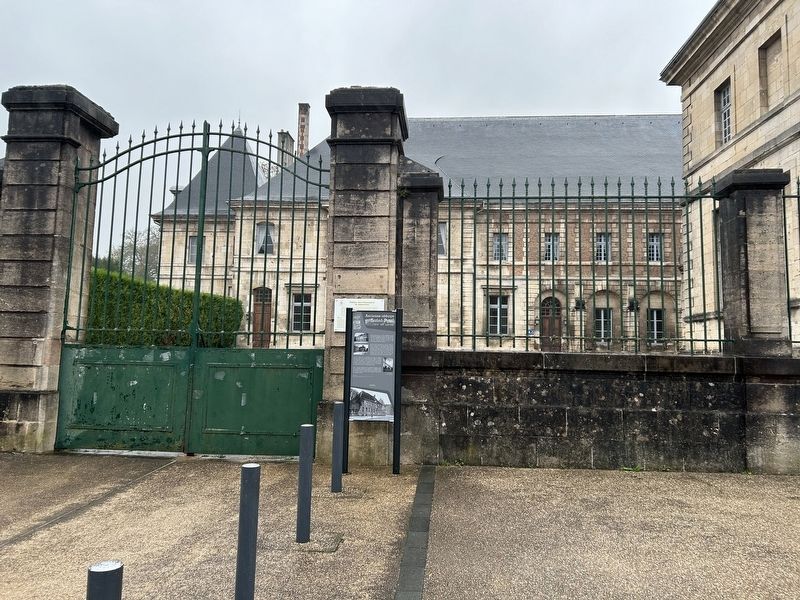
2. Ancienne abbaye Saint-Paul Marker
Listed in the supplementary inventory of Historic Monuments since 1926, this architectural ensemble was bombed on September 1, 1944 and partly destroyed. Skillfully restored after the war, it was inaugurated in 1958. retaining only rare ancient vestiges: large stone staircase. barrel-vaulted rooms, Renaissance-style decor and lounges decorated with magnificent woodwork...
[Photo Captions:]
Les ruines du tribunal de Verdun
The ruins of the Verdun tribunal
La Tribunal, la Sous-Préfecture et la caserne Jeanne-d Are avent 1914
The Tribunal, the Sub-Prefecture and the Joan-of-Arc barracks before 1914
Vue de l'intérieur de la Sous-Préfecture
View of the interior of the Sub-Prefecture
Erected by Ville
Photographed by Steve Stoessel, November 17, 2024
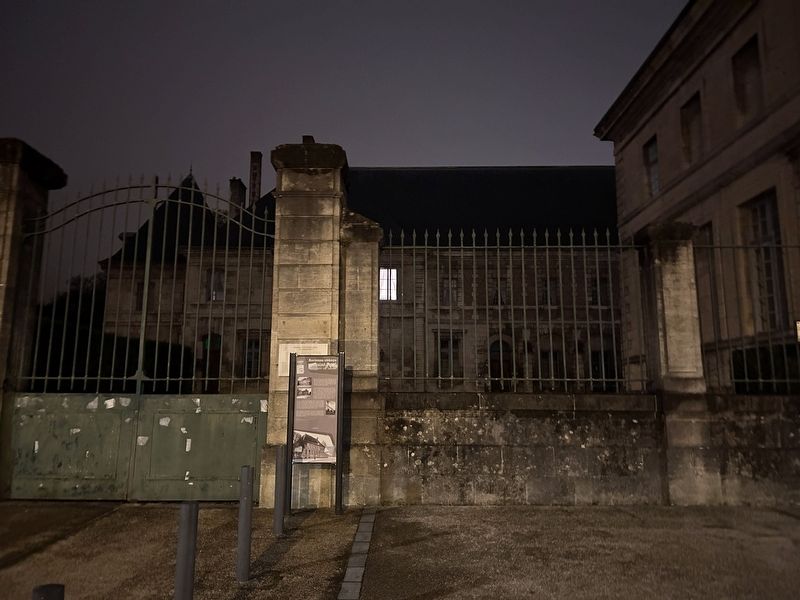
3. Ancienne abbaye Saint-Paul Marker
Topics. This historical marker is listed in these topic lists: Architecture • Religion & Religious Structures. A significant historical year for this entry is 1249.
Location. 49° 9.776′ N, 5° 23.051′ E. Marker is in Verdun, Grand Est (Alsace, Lorraine, Champagne-Ardenne), in Meuse. It is at the intersection of Place Saint-Paul and Place Jeanne d’Arc, on the right when traveling south on Place Saint-Paul. Touch for map. Marker is at or near this postal address: 1 Pl Saint-Paul, Verdun, Grand Est 55100, France. Touch for directions.

Regionally, it is in the North Atlantic Region, Europe, the European Union, Atlantic Europe, the Schengen Area, Western Europe, a coastal Mediterranean country, and the Western World. Historically, it finds itself in what was once a French colony, the Roman Empire, and specifically the Holy Roman Empire.
Other nearby markers. At least 8 other markers are within walking distance of this marker: Chapel Saint Nicolas/Chapelle Saint-Nicolas (about 90 meters away, measured in a direct line); St. Nicolas Chapel / Chapelle Saint-Nicholas (about 90 meters away); Porte Saint-Paul (about 120 meters away); Verdun (about 150 meters away); The Defense (about 150 meters away); Victor Schleiter (about 180 meters away); Hôtel de la Princerie (about 180 meters away); « Honneur et Reconnaissance aux Femmes des Territoires » (about 180 meters away). Touch for a list and map of all markers in Verdun.
Credits. This page was last revised on February 3, 2025. It was originally submitted on January 25, 2025, by Steve Stoessel of Niskayuna, New York. This page has been viewed 145 times since then and 11 times this year. Photos: 1, 2, 3. submitted on January 25, 2025, by Steve Stoessel of Niskayuna, New York.
