Wilmington in New Hanover County, North Carolina — The American South (South Atlantic)
Sadgwar House
c. 1877; 1910

Photographed by Duane and Tracy Marsteller, November 23, 2024
1. Sadgwar House Marker
Erected by Historic Wilmington Foundation, Inc.
Topics and series. This historical marker is listed in these topic lists: African Americans • Architecture • Religion & Religious Structures. In addition, it is included in the National Register of Historic Places (NRHP), and the North Carolina, Historic Wilmington Foundation series lists. A significant historical year for this entry is 1877.
Location. 34° 14.21′ N, 77° 56.377′ W. Marker is in Wilmington, North Carolina, in New Hanover County. It is on North 8th Street south of Princess Street, on the right when traveling south. Touch for map. Marker is at or near this postal address: 15 N 8th St, Wilmington NC 28401, United States of America. Touch for directions.

Regionally, this marker
this page online
Other nearby markers. At least 8 other markers are within walking distance of this marker: James F. Shober (within shouting distance of this marker); John Allan Taylor House (about 300 feet away, measured in a direct line); John N. Maffitt (about 300 feet away); Wright-Meares House (about 400 feet away); Col. Walker Taylor House (about 400 feet away); John Hall House (about 400 feet away); The Von Oesen House (about 400 feet away); Robert R. Taylor (about 400 feet away). Touch for a list and map of all markers in Wilmington.
Regarding Sadgwar House. Sadgwar was a free person of color, and considered a leader of Wilmington's African-American
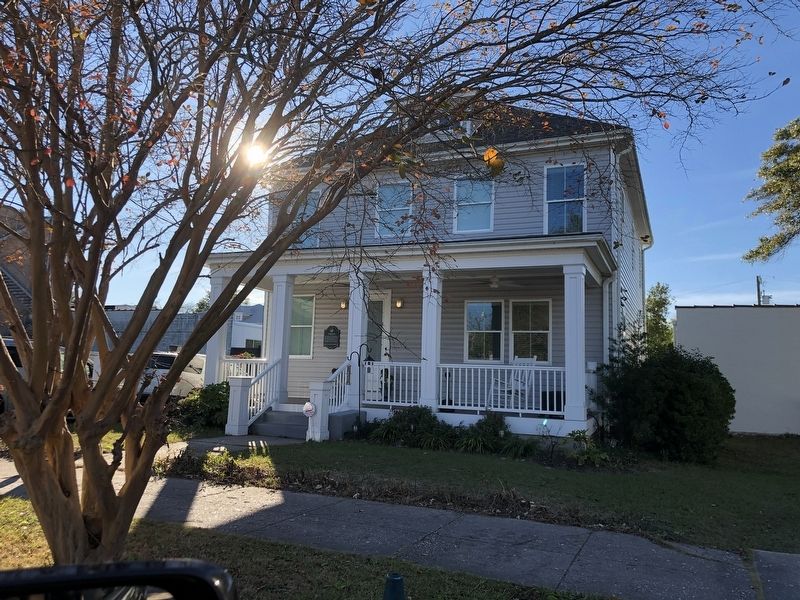
Photographed by Duane and Tracy Marsteller, November 24, 2024
2. Sadgwar House Marker

via Bellamy Mansion Museum of History & Design Arts (Public Domain)
3. Frederick Cutlar Sadgwar (1843-1925)
He was among the builders of Bellamy Mansion. His carpentry skills were so renowned that the federal government hired him to repair the U.S. Marine Hospital in Wilmington.
Also see . . .
1. Sadgwar House. Frederick Sadgwar was a carpenter he was trained by his father David Sadgwar and there is some documentation of him also working at the Bellamy mansion. His father David Sadgwar put a lot of emphasis on education so Fredrick went to Lincoln University in Pennsylvanian. Additionally to his education and training from his father in carpentry he was a very notable figure in his community. (Taylor Meadows, "Beyond the Plaque" project, University of North Carolina-Wilmington, 2024) (Submitted on January 26, 2025, by Duane and Tracy Marsteller of Murfreesboro, Tennessee.)
2. Sadgwar Family. The Sadgwar family of Wilmington, N. C., including David Elias Sadgwar (1819-1889) and his sons, Frederick Cutlar (Cutler) Sadgwar, Sr.(1843-1925), James Sampson Sadgwar (1850-1922), and others, as well as some of David’s grandsons, were house carpenters active in the city for many years. (Catherine W. Bishir, North Carolina Architects & Builders project, North Carolina State University, 2021) (Submitted on January 26, 2025, by Duane and Tracy Marsteller of Murfreesboro, Tennessee.)
3. Wilmington Historic District (PDF). National Register of Historic Places nomination for the district, which includes this property and was listed in 1974. (Prepared by Survey and Planning Unit, North Carolina Division of Archives and History; via North Carolina State Historic Preservation Office) (Submitted on January 26, 2025, by Duane and Tracy Marsteller of Murfreesboro, Tennessee.)
4. Wilmington Historic District Boundary Expansion and Additional Documentation (PDF). National Register nomination that expanded the district in 2003. (Prepared by Sherry Joines Wyatt and L. Robbie King; via North Carolina State Historic Preservation Office) (Submitted on January 26, 2025, by Duane and Tracy Marsteller of Murfreesboro, Tennessee.)
Credits. This page was last revised on January 26, 2025. It was originally submitted on January 26, 2025, by Duane and Tracy Marsteller of Murfreesboro, Tennessee. This page has been viewed 326 times since then and 79 times this year. Photos: 1, 2, 3. submitted on January 26, 2025, by Duane and Tracy Marsteller of Murfreesboro, Tennessee.
