Rione X Campitelli in Roma in Città metropolitana di Roma Capitale, Latium, Rome, Italy — Central Italy (Tyrrhenian Coast)
Un Patrimonio da Curare
⎯⎯⎯
A Heritage Worth Protecting

Photographed by James Hulse, March 4, 2024
1. Un Patrimonio da Curare / A Heritage Worth Protecting Marker

Questi olivi piantati negli anni 60/70 appartengono alla cultivar (varietà) Leccino, una varietà ampiamente diffusa in Italia, definita "a duplice attitudine" in quanto dai suoi frutti si possono ottenere sia olio che olive da tavola. L'Italia possiede un patrimonio olivicolo unico, il più cospicuo del mondo, circa 540 diverse cultivar, frutto di un'opera plurimillenaria di selezione per permettere di arrivare a una produzione di eccellente qualità. Tale biodiversità olivicola consente all'Italia di produrre innumerevoli oli, che esprimono una gamma inimitabile di sentori, flavour, sfumature sensoriali e gradi di intensità.
These olive trees planted in the 1960's-70's belong to the Leccino cultivar, an olive variety that is widespread throughout Italy and which is often defined "dual-purpose", due to the fact that its fruit can be pressed for oil or eaten as table olives. Italy possesses a peerless olive-growing heritage: the largest in the world with roughly 540 different cultivars that are the fruit of millennia of selection, allowing for productions of excellent quality. Such biodiversity
this page online
Erected by Parco Archeologico del Colosseo.
Topics. This historical marker is listed in this topic list: Horticulture & Forestry.
Location. 41° 53.314′ N, 12° 29.341′ E. Marker is in Roma, Lazio (Latium, Rome), in Città metropolitana di Roma Capitale. It is in Rione X Campitelli. It is on Via dei Fori Imperiali. The marker is located on the Palatine Hill. Touch for map. Marker is in this post office area: Roma, Lazio 00186, Italy. Touch for directions.

Regionally, it is in Europe, the European Union, the Schengen Area, a coastal Mediterranean country, and the Western World. Historically, it finds itself in what was once the Roman Empire.
Other nearby markers. At least 8 other markers are within walking distance of this marker: Nymphaeum and Adjoining Cisterns / Ninfeo e Annesse Cisterne (within shouting distance of this marker); Chiesa di San Bonaventura / Church of San Bonaventura (within shouting distance of this
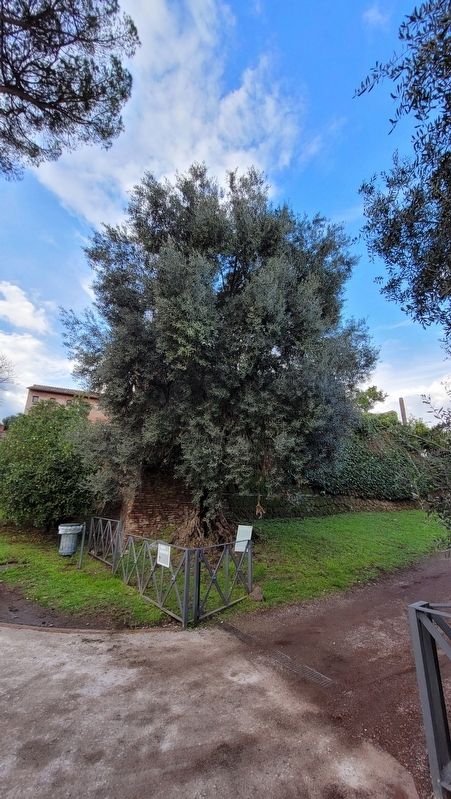
Photographed by James Hulse, March 4, 2024
2. The view of an Olive tree and Marker
More about this marker. The marker is located in the Parco Archeologico del Colosseo (Roman Forum Archaeological Park) and it does require an entry fee to visit.
Also see . . . Roma Turismo. Parco Archeologico del Colosseo (Submitted on January 26, 2025, by James Hulse of Medina, Texas.)
Credits. This page was last revised on January 27, 2025. It was originally submitted on January 26, 2025, by James Hulse of Medina, Texas. This page has been viewed 96 times since then and 6 times this year. Photos: 1, 2. submitted on January 27, 2025, by James Hulse of Medina, Texas.
