Verdun in Meuse, Alsace, Lorraine, Champagne-Ardenne, France — Western Europe
Hôtel de la Princerie
Musée municipal de Verdun
| — | (XVIe - XXe siècles) | — |
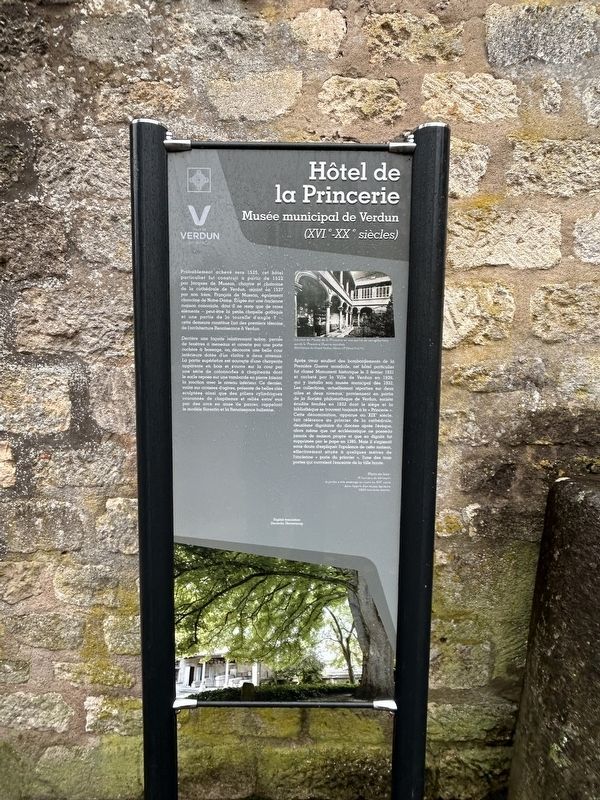
Photographed by Steve Stoessel, November 18, 2024
1. Hôtel de la Princerie Marker
Probablement achevé vers 1525, cet hôtel particulier fut construit à partir de 1522 par Jacques de Musson, chantre et chanoine de la cathédrale de Verdun, rejoint en 1527 par son frère, François de Musson, également chanoine de Notre-Dame. Engée sur une ancienne maison canoniale, dont il ne resto que de rares éléments - peut-être id petite chapelle gothique et une partie de la tourelle d'angle 2 -; cette demeure constitue l'un des premiers témoins de l'architecture Renaissance à Verdun.
Dernière une façade relativement sobre, percée de fenêtres à meneaux et ouverte par une porte cochère à bossage, on découvre une belle cour intérieure dotée d'un cloitré à deux niveaux. La partie supérieure est couverte d'une charpente apparente en bois et s'ouvre sur la cour par une série de colonnades à chapiteaux dont le socle repose sur une rambarde on plerre faisant la jonction avec le niveau intérieur. Ce dominer, voûté sur croisées d'ogives, présente de belles clés sculptées ainsi que des piliers cylindriques couronnés de chapiteaux et reliés entre eux par des arcs en anse de panier, rappelant le modèle florentin et la Renaissance
this page online
Après avoir souffert des bombardements de la Première Guerre mondiale, cet hôtel particulier fut classé Monument historique le 3 février 1921 et racheté par la Ville de Verdun en 1926. qui y installa son musée municipal dès 1932 Les collections, actuellement réparties sur deux ailes et deux niveaux, proviennent en partie de la Société philomathique de Verdun, société érudite fondée en 1822 dont le siège et la bibliothèque se trouvent toujours à la « Princerie » Cette dénomination, apparue au XIX siècle. tait référence au princier de la cathédrale. deuxième dignitaire du diocèse après l'évêque, alors môme que cet ecclésiastique ne posséda jamais de maison propre et que sa dignité tut supprimée par le pape en 1385. Mais il s'agissait sans doute d'expliquer l’opulence de cette maison, effectivement située à quelques mètres de l'ancienne « porto du princier », l’une dos trois portes qui ouvraient l'enceinte de la ville haute.
Hôtel de la Princerie , Municipal Museum of Verdun (16th-20th Centuries)
Probably completed around 1525, this private mansion was built from 1522 by Jacques de Musson, cantor and canon of Verdun
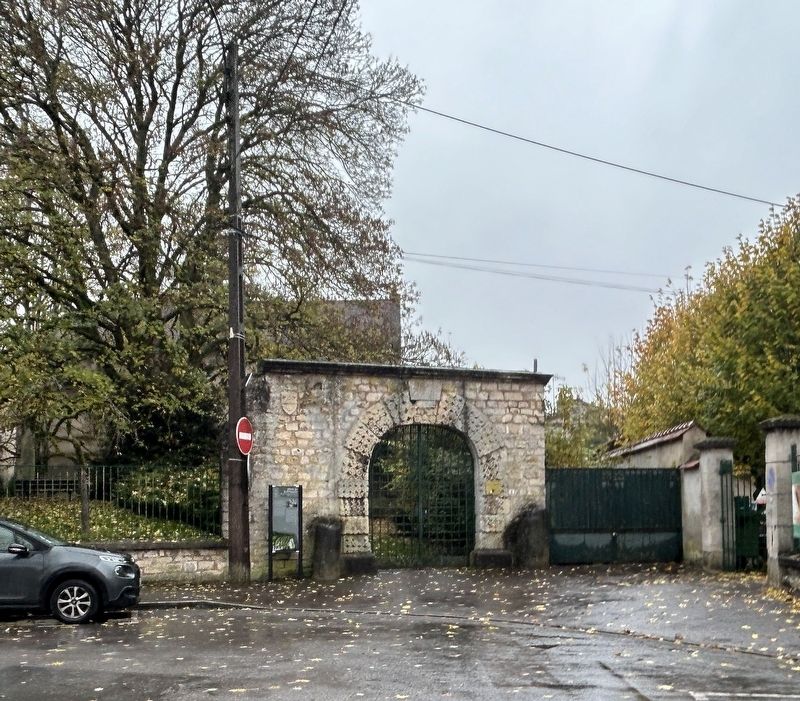
Photographed by Steve Stoessel, November 18, 2024
2. Hôtel de la Princerie Marker
Behind a relatively sober façade, pierced with mullioned windows and opened by a bossed carriage door, we discover a beautiful interior courtyard with a two-level cloister. The upper part is covered with an exposed wooden frame and opens onto the courtyard by a series of colonnades with capitals, the base resting on a railing or plerre joining the interior level. This tower, vaulted on ribbed vaults, has beautiful sculpted keystones as well as cylindrical pillars crowned with capitals and linked together by basket-handle arches, reminiscent of the Florentine model and the Italian Renaissance.
After suffering from the bombings of the First World War, this private mansion was classified as a Historic Monument on February 3, 1921 and purchased by the City of Verdun in 1926. which installed its municipal museum there in 1932 The collections, currently spread over two wings and two levels, come in part from the Philomathic Society of Verdun, a scholarly society founded in 1822 whose headquarters and library are still located at the "Princerie". This name, which appeared in the 19th century. was a reference to the prince of the cathedral. second dignitary of the diocese after the bishop, even though this ecclesiastic never had a house of his own and his dignity was suppressed by the pope in 1385. But it was doubtless a question of explaining the opulence of this house, effectively located a few meters from the old "porto du princier", one of the three gates which opened the enclosure of the upper town.
Erected by Ville Verdun.
Topics. This historical marker is listed in this topic list: Architecture. A significant historical year for this entry is 1525.
Location. 49° 9.678′ N, 5° 22.999′ E. Marker is in Verdun, Grand Est (Alsace, Lorraine, Champagne-Ardenne), in Meuse. It is on Place de la Libération north of Rue de Magdeleine. Touch for map. Marker is in this post office area: Verdun, Grand Est 55100, France. Touch for directions.

Regionally, it is in the North Atlantic Region, Europe, the European Union, Atlantic Europe, the Schengen Area, Western Europe, a coastal Mediterranean country, and the Western World. Historically, it finds itself in what was once a French colony, the Roman Empire, and specifically the Holy Roman Empire.
Other nearby markers. At least 8 other markers are within walking distance of this marker: Monument à la Victoire et aux Soldats de Verdun (XXe siècle) (about 90 meters away, measured in a direct line); St. Nicolas Chapel / Chapelle Saint-Nicholas (about 120 meters away); Chapel Saint Nicolas/Chapelle Saint-Nicolas (about 150 meters away); Ancienne abbaye Saint-Paul (about 180 meters away); Porte Saint-Paul (approx. 0.3 kilometers away); The Defense (approx. 0.3 kilometers away); Verdun (approx. 0.3 kilometers away); Le 166eme Régiment d'Infanterie (approx. 0.3 kilometers away). Touch for a list and map of all markers in Verdun.
Credits. This page was last revised on January 27, 2025. It was originally submitted on January 26, 2025, by Steve Stoessel of Niskayuna, New York. This page has been viewed 111 times since then and 11 times this year. Photos: 1, 2. submitted on January 26, 2025, by Steve Stoessel of Niskayuna, New York.
